Department of Wildlife and Fisheries Sciences, Texas A&M University, College Station, TX, 77843, USA.
Department of Entomology, Texas A&M AgriLife Research, College Station, TX, 77843, USA.
Parasit Vectors. 2019 Apr 27;12(1):185. doi: 10.1186/s13071-019-3443-6.
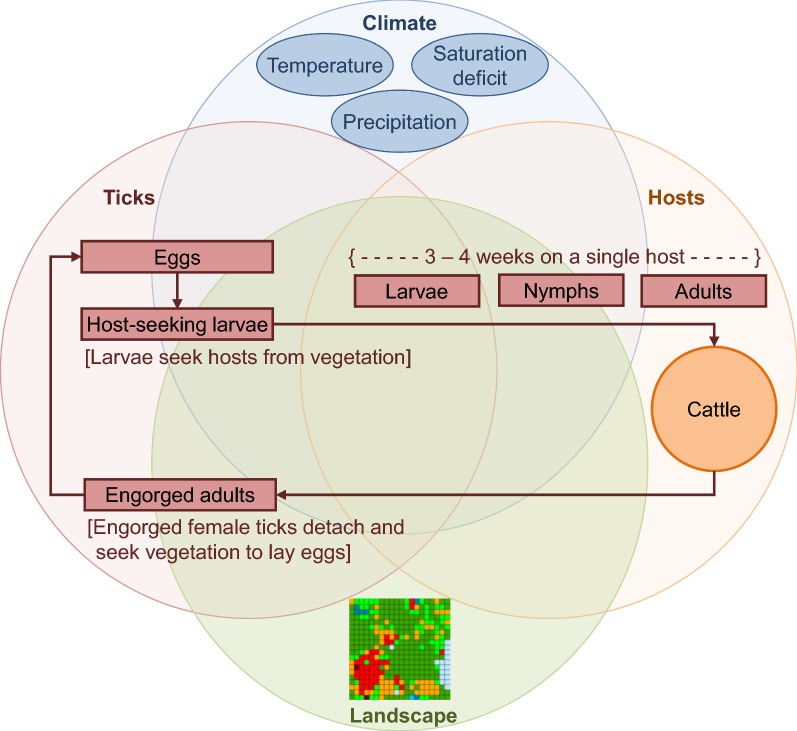
The southern cattle fever tick (SCFT), Rhipicephalus (Boophilus) microplus, remains endemic in Puerto Rico. Systematic treatment programmes greatly reduced and even eradicated temporarily this tick from the island. However, a systemic treatment programme that includes integrated management practices for livestock against SCFT remains to be established in the island. We describe a spatially-explicit, individual-based model that simulates climate-livestock-SCFT-landscape interactions. This model was developed as an investigative tool to aid in a research project on integrated management of the SCFT that took place in Puerto Rico between 2014 and 2017. We used the model to assess the efficacy of tick suppression and probability of tick elimination when applying safer acaricides at 3-week intervals to different proportions of a herd of non-lactating dairy cattle.
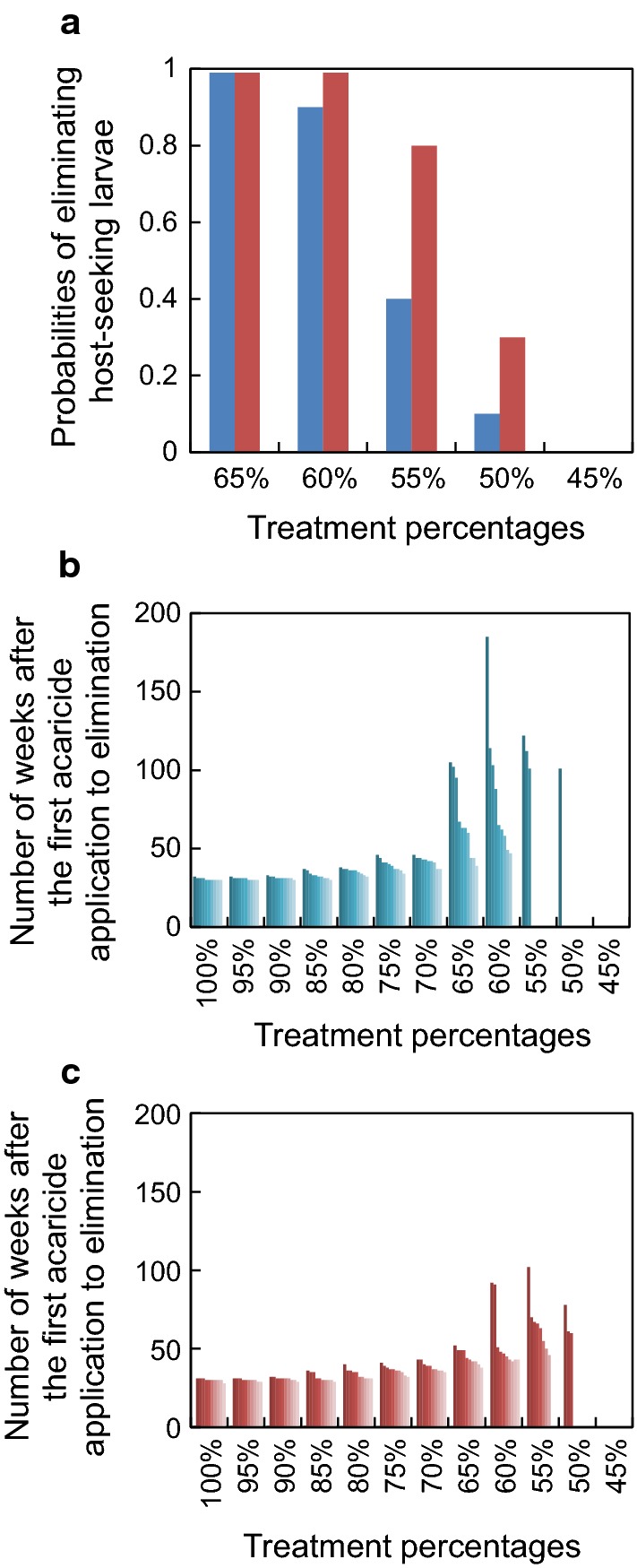
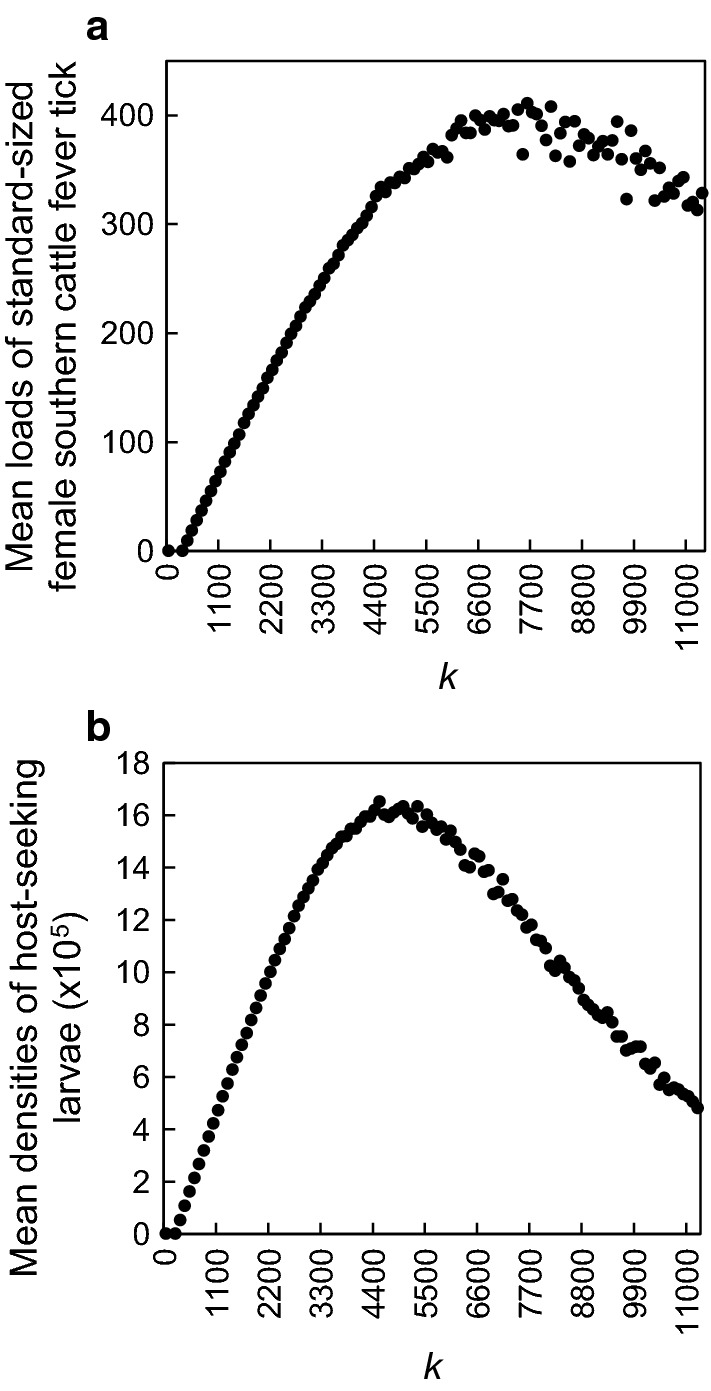
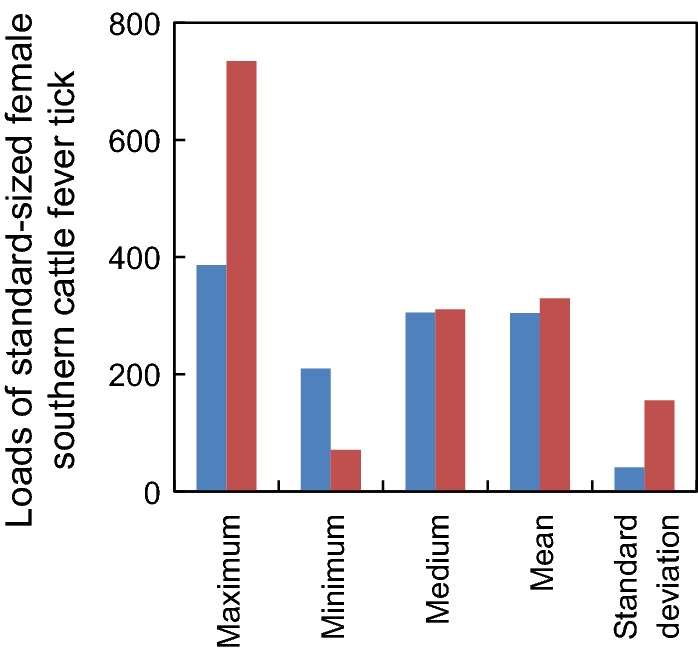
Probabilities of eliminating host-seeking larvae from the simulated system decreased from ≈ 1 to ≈ 0 as the percentage of cattle treated decreased from 65 to 45, with elimination probabilities ≈ 1 at higher treatment percentages and ≈ 0 at lower treatment percentages. For treatment percentages between 65% and 45%, a more rapid decline in elimination probabilities was predicted by the version of the model that produced higher densities of host-seeking larvae. Number of weeks after the first acaricide application to elimination of host-seeking larvae was variable among replicate simulations within treatment percentages, with within-treatment variation increasing markedly at treatment percentages ≤ 65. Number of weeks after first application to elimination generally varied between 30 and 40 weeks for those treatment percentages with elimination probabilities ≈ 1.
Explicit simulation of the spatial and temporal dynamics of off-host (host-seeking) larvae in response to control methods should be an essential element of research that involves the evaluation of integrated SCFT management programmes. This approach could provide the basis to evaluate novel control technologies and to develop protocols for their cost-effective use with other treatment methods.
南方牛热蜱(SCFT),即 Rhipicephalus(Boophilus)microplus,在波多黎各仍然流行。系统的治疗方案大大减少了,甚至暂时根除了该岛上的这种蜱虫。然而,在该岛建立包括针对 SCFT 的牲畜综合管理实践在内的系统治疗方案仍然是必要的。我们描述了一个空间显式的、基于个体的模型,用于模拟气候-牲畜-SCFT-景观相互作用。该模型是作为一种研究工具开发的,用于协助 2014 年至 2017 年期间在波多黎各进行的 SCFT 综合管理研究项目。我们使用该模型评估了在不同比例的非哺乳期奶牛群中,每 3 周应用更安全的杀蜱剂时,抑制蜱虫和消除蜱虫的效果。
当处理牛群的比例从 65%降至 45%时,从模拟系统中消除宿主寻找幼虫的概率从 ≈1 降至 ≈0,而在更高的处理比例下,消除概率为 ≈1,在更低的处理比例下,消除概率为 ≈0。对于 65%至 45%之间的处理比例,产生更高的宿主寻找幼虫密度的模型版本预测消除概率的下降速度更快。在每个处理比例的重复模拟中,首次施药后到消除宿主寻找幼虫的时间长度各不相同,在 ≤65%的处理比例下,处理内的变化显著增加。对于消除概率 ≈1 的那些处理比例,首次施药后到消除的时间通常在 30 至 40 周之间。