Tibet Autonomous Region Center for Diseases Control and Prevention, Lhasa, 850 000, Tibet Autonomous Region, China.
National Institute of Parasitic Diseases, Chinese Center for Disease Control and Prevention, Chinese Center for Tropical Diseases Research, WHO Collaborating Centre for Tropical Diseases, National Center for International Research on Tropical Diseases, Ministry of Science and Technology, Key Laboratory of Parasite and Vector Biology, MOH, Huangpu District, Shanghai, 200 025, China.
Infect Dis Poverty. 2019 Apr 28;8(1):29. doi: 10.1186/s40249-019-0537-5.
The echinococcosis is prevalent in 10 provinces /autonomous region in western and northern China. Epidemiological survey of echinococcosis in China in 2012 showed the average prevalence of four counties in Tibet Autonomous Region (TAR) is 4.23%, much higher than the average prevalence in China (0.24%). It is important to understand the transmission risks and the prevalence of echinococcosis in human and animals in TAR.
A stratified and proportionate sampling method was used to select samples in TAR. The selected residents were examined by B-ultrasonography diagnostic, and the faeces of dogs were tested for the canine coproantigen against Echinococcus spp. using enzyme-linked immunosorbent assay. The internal organs of slaughtered domestic animals were examined by visual examination and palpation. The awareness of the prevention and control of echinococcosis among of residents and students was investigated using questionnaire. All data were inputted using double entry in the Epi Info database, with error correction by double-entry comparison, the statistical analysis of all data was processed using SPSS 21.0, and the map was mapped using ArcGIS 10.1, the data was tested by Chi-square test and Cochran-Armitage trend test.
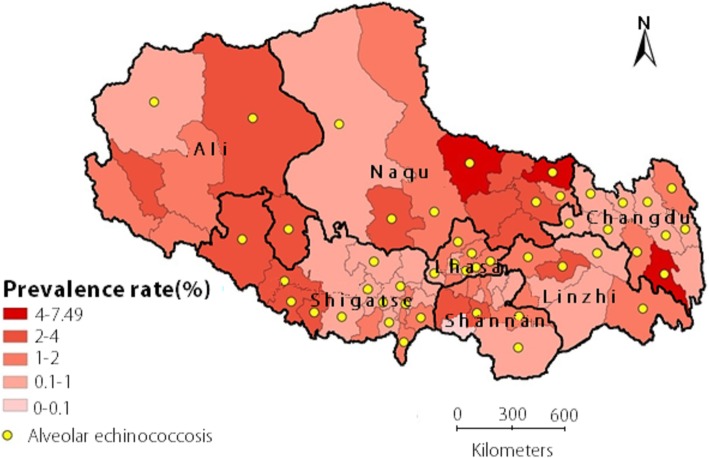
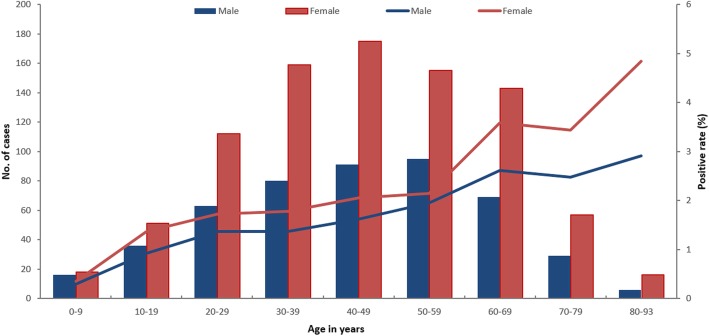
A total of 80 384 people, 7564 faeces of dogs, and 2103 internal organs of slaughtered domestic animals were examined. The prevalence of echinococcosis in humans in TAR was 1.66%, the positive rate in females (1.92%) was significantly higher than that in males (1.41%), (χ = 30.31, P < 0.01), the positive rate of echinococcosis was positively associated with age (χ = 423.95, P < 0.01), and the occupational populations with high positive rates of echinococcosis were herdsmen (3.66%) and monks (3.48%). The average positive rate of Echinococcus coproantigen in TAR was 7.30%. The positive rate of echinococcosis in livestock for the whole region was 11.84%. The average awareness rate of echinococcosis across the region was 33.39%.
A high prevalence of echinococcosis is found across the TAR, representing a very serious concern to human health. Efforts should be made to develop an action plan for echinococcosis prevention and control as soon as possible, so as to control the endemic of echinococcosis and reduce the medical burden on the population.
包虫病在中国西部和北部的 10 个省/自治区流行。2012 年中国包虫病流行病学调查显示,西藏自治区(TAR)四个县的平均流行率为 4.23%,远高于中国的平均流行率(0.24%)。了解 TAR 地区人与动物包虫病的传播风险和流行情况非常重要。
采用分层和比例抽样方法在 TAR 选择样本。对选定的居民进行 B 超诊断检查,用酶联免疫吸附试验检测犬粪便中针对棘球蚴属的犬粪抗原。对屠宰家畜的内脏进行肉眼和触诊检查。采用问卷调查的方式了解居民和学生对包虫病防治的认识。所有数据均采用双录入方式输入 Epi Info 数据库,通过双录入比较进行错误校正,采用 SPSS 21.0 对所有数据进行统计分析,采用 ArcGIS 10.1 绘制地图,采用卡方检验和 Cochran-Armitage 趋势检验对数据进行检验。
共检查 80384 人、7564 份犬粪和 2103 份屠宰家畜内脏。TAR 地区人群包虫病患病率为 1.66%,女性(1.92%)阳性率明显高于男性(1.41%)(χ=30.31,P<0.01),包虫病阳性率与年龄呈正相关(χ=423.95,P<0.01),阳性率较高的职业人群为牧民(3.66%)和僧侣(3.48%)。TAR 地区棘球蚴 coproantigen 的平均阳性率为 7.30%。全地区家畜包虫病阳性率为 11.84%。全地区包虫病平均知晓率为 33.39%。
TAR 地区包虫病患病率较高,对人类健康构成严重威胁。应尽快制定包虫病防治行动计划,以控制包虫病的流行,减轻人群的医疗负担。