Alecu Irina, Bennett Steffany A L
Neural Regeneration Laboratory, Department of Biochemistry, Microbiology and Immunology, Ottawa Institute of Systems Biology, University of Ottawa, Ottawa, ON, Canada.
Department of Cellular and Molecular Medicine, Brain and Mind Research Institute, University of Ottawa, Ottawa, ON, Canada.
Front Neurosci. 2019 Apr 11;13:328. doi: 10.3389/fnins.2019.00328. eCollection 2019.
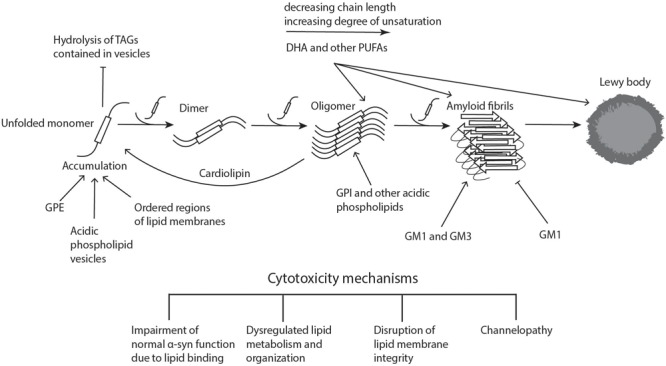
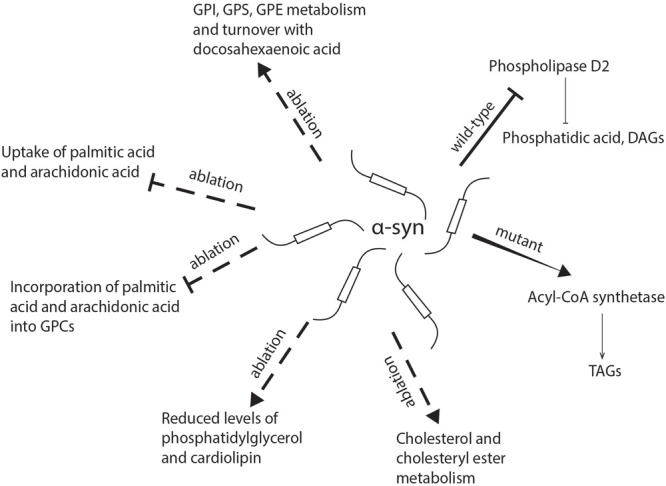
Parkinson's disease (PD) is the second most common neurodegenerative disease, the main pathological hallmark of which is the accumulation of α-synuclein (α-syn) and the formation of filamentous aggregates called Lewy bodies in the brainstem, limbic system, and cortical areas. Lipidomics is a newly emerging field which can provide fresh insights and new answers that will enhance our capacity for early diagnosis, tracking disease progression, predicting critical endpoints, and identifying risk in pre-symptomatic persons. In recent years, lipids have been implicated in many aspects of PD pathology. Biophysical and lipidomic studies have demonstrated that α-syn binds preferentially not only to specific lipid families but also to specific molecular species and that these lipid-protein complexes enhance its interaction with synaptic membranes, influence its oligomerization and aggregation, and interfere with the catalytic activity of cytoplasmic lipid enzymes and lysosomal lipases, thereby affecting lipid metabolism. The genetic link between aberrant lipid metabolism and PD is even more direct, with mutations in and enhancing PD risk in humans and loss of function increasing α-syn aggregation and accumulation in experimental murine models. Moreover, a number of lipidomic studies have reported PD-specific lipid alterations in both patient brains and plasma, including alterations in the lipid composition of lipid rafts in the frontal cortex. A further aspect of lipid dysregulation promoting PD pathogenesis is oxidative stress and inflammation, with proinflammatory lipid mediators such as platelet activating factors (PAFs) playing key roles in arbitrating the progressive neurodegeneration seen in PD linked to α-syn intracellular trafficking. Lastly, there are a number of genetic risk factors of PD which are involved in normal lipid metabolism and function. Genes such as and , which are involved in glycerophospholipid and sphingolipid metabolism either directly or indirectly are associated with risk of PD. This review seeks to describe these facets of metabolic lipid dysregulation as they relate to PD pathology and potential pathomechanisms involved in disease progression, while highlighting incongruous findings and gaps in knowledge that necessitate further research.
帕金森病(PD)是第二常见的神经退行性疾病,其主要病理标志是α-突触核蛋白(α-syn)的积累以及在脑干、边缘系统和皮质区域形成称为路易小体的丝状聚集体。脂质组学是一个新兴领域,它可以提供新的见解和答案,增强我们早期诊断、追踪疾病进展、预测关键终点以及识别症状前个体风险的能力。近年来,脂质与帕金森病病理学的许多方面都有关联。生物物理和脂质组学研究表明,α-syn不仅优先与特定脂质家族结合,还与特定分子种类结合,并且这些脂质-蛋白质复合物增强了它与突触膜的相互作用,影响其寡聚化和聚集,并干扰细胞质脂质酶和溶酶体脂肪酶的催化活性,从而影响脂质代谢。异常脂质代谢与帕金森病之间的遗传联系更为直接,相关基因的突变会增加人类患帕金森病的风险,而该基因功能的丧失会增加实验小鼠模型中α-syn的聚集和积累。此外,多项脂质组学研究报告了患者大脑和血浆中帕金森病特异性的脂质改变,包括额叶皮质中脂筏脂质组成的改变。脂质失调促进帕金森病发病机制的另一个方面是氧化应激和炎症,促炎脂质介质如血小板活化因子(PAF)在介导与α-syn细胞内运输相关的帕金森病中进行性神经退行性变方面发挥关键作用。最后,有许多帕金森病的遗传风险因素参与正常脂质代谢和功能。直接或间接参与甘油磷脂和鞘脂代谢的基因如 和 与帕金森病风险相关。本综述旨在描述代谢性脂质失调与帕金森病病理学相关的这些方面以及疾病进展中涉及的潜在发病机制,同时强调不一致的发现和知识空白,这些都需要进一步研究。