Department of Biological Sciences, University of Alberta, Edmonton, AB T6G 2E9, Canada.
Smithsonian Tropical Research Institute, Balboa-Ancón 0843-03092, Panamá, Panamá.
Sci Adv. 2019 Apr 24;5(4):eaav3875. doi: 10.1126/sciadv.aav3875. eCollection 2019 Apr.
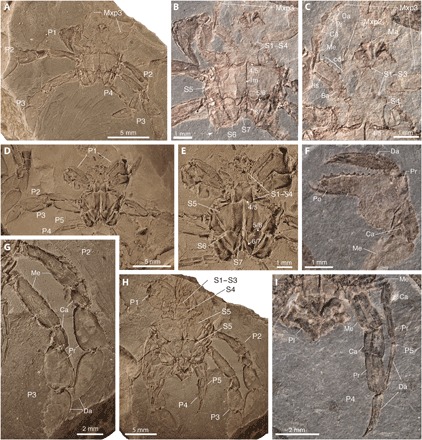
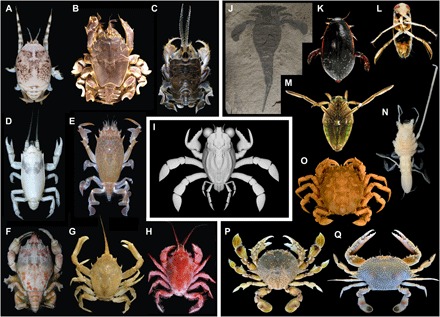
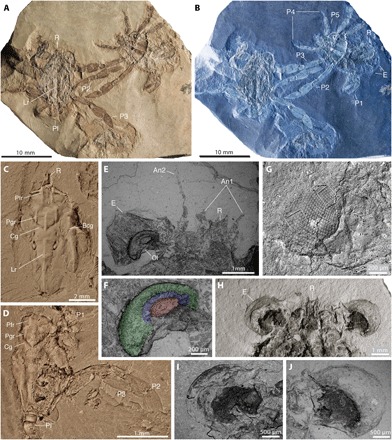
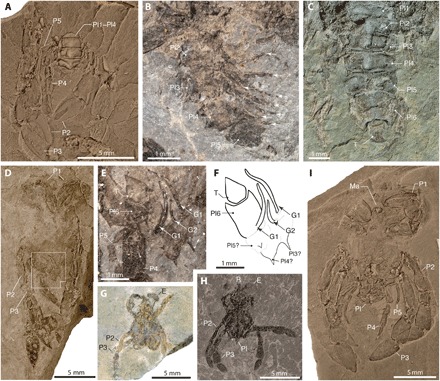
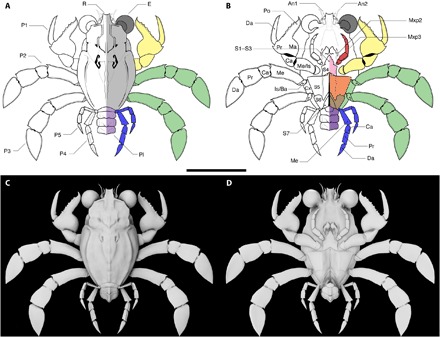
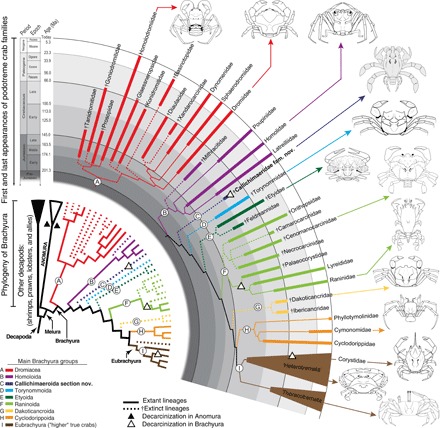
Evolutionary origins of novel forms are often obscure because early and transitional fossils tend to be rare, poorly preserved, or lack proper phylogenetic contexts. We describe a new, exceptionally preserved enigmatic crab from the mid-Cretaceous of Colombia and the United States, whose completeness illuminates the early disparity of the group and the origins of novel forms. Its large and unprotected compound eyes, small fusiform body, and leg-like mouthparts suggest larval trait retention into adulthood via heterochronic development (pedomorphosis), while its large oar-like legs represent the earliest known adaptations in crabs for active swimming. Our phylogenetic analyses, including representatives of all major lineages of fossil and extant crabs, challenge conventional views of their evolution by revealing multiple convergent losses of a typical "crab-like" body plan since the Early Cretaceous. These parallel morphological transformations may be associated with repeated invasions of novel environments, including the pelagic/necto-benthic zone in this pedomorphic chimera crab.
新形式的进化起源通常是不清楚的,因为早期和过渡化石往往很少,保存不佳,或缺乏适当的系统发育背景。我们描述了一种来自哥伦比亚和美国中白垩纪的新的、保存异常完好的神秘螃蟹,其完整性揭示了该组的早期多样性和新形式的起源。它的大而无保护的复眼、小的梭形身体和类似腿的口器表明,通过异时发育(幼态持续),幼虫特征保留到成年期,而它的大桨状腿代表了已知最早的螃蟹适应主动游泳的特征。我们的系统发育分析,包括化石和现存螃蟹的所有主要谱系的代表,通过揭示自早白垩世以来多次典型“螃蟹样”身体计划的趋同丧失,对它们的进化提出了挑战。这些平行的形态转化可能与反复入侵新环境有关,包括这种幼态持续的拟态螃蟹的浮游/中间底栖区。