Department of Endocrinology and Metabolism, Institute of Endocrinology, Liaoning Provincial Key Laboratory of Endocrine Diseases, The First Affiliated Hospital of China Medical University, Shenyang, China.
Department of Laboratory Medicine, The First Affiliated Hospital of China Medical University, Shenyang, China.
J Clin Lab Anal. 2019 Jul;33(6):e22904. doi: 10.1002/jcla.22904. Epub 2019 Apr 29.
Graves' disease (GD) is a common autoimmune disease characterized by genetic and environmental factors. Fcγ receptors (FcγRs) are involved in several autoimmune disorders through recognizing immunoglobulin (Ig) G antibodies and mediating immune response. The study on the expression of FcγRs in GD patients is scarce. The purpose of this study was to evaluate the expression of three different types of FcγRs in patients with active and remissive GD.
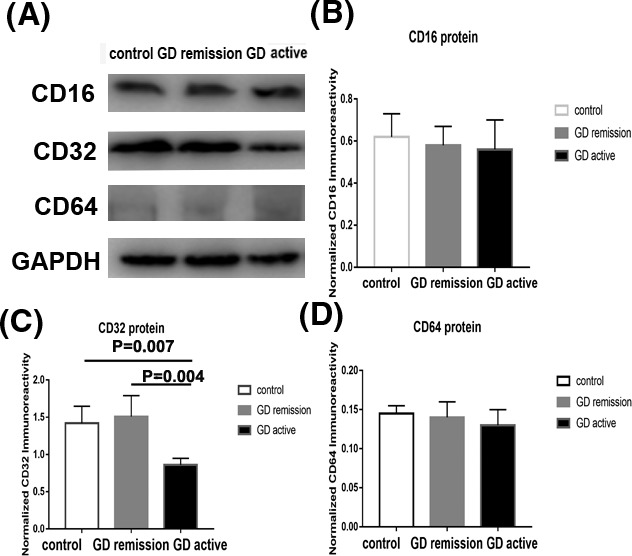
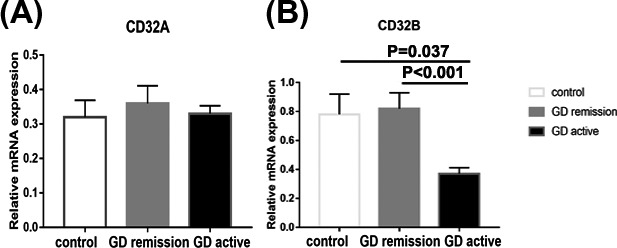
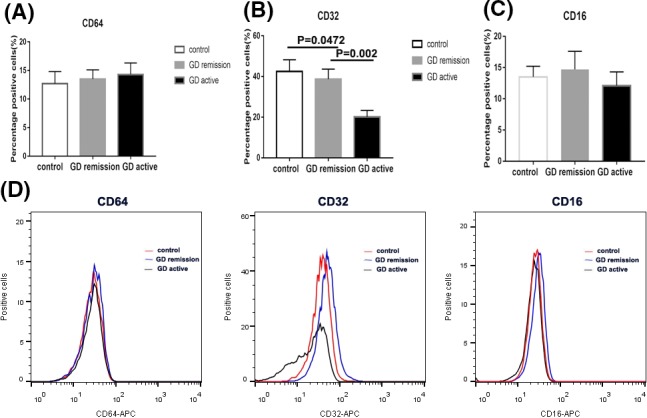
Blood samples of patients and healthy subjects were collected to analyze the percentage of FcγRI (CD64), FcγRII (CD32), and FcγRIII (CD16) on peripheral blood mononuclear cells (PBMCs) and monocytes by flow cytometry and Western blotting. CD32 isotypes were also examined in cases and controls by real-time PCR.
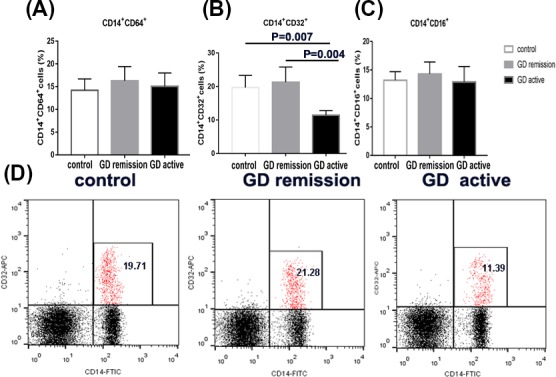
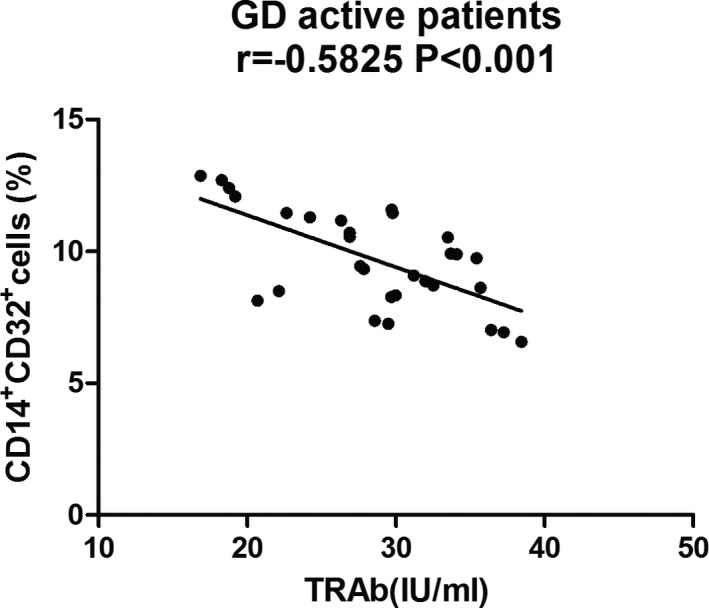
The cell percentages expressed CD32 and protein expressions of CD32 on PBMCs, and monocytes from patients with active GD were significantly reduced compared to controls and patients with remissive GD. In particular, the expression of CD32B on PBMC was also decreased in active GD patients. However, the cell percentages expressed CD16 and CD64 from PBMCs and monocytes were comparable between three groups. Besides, the percentages of CD14 CD32 cells were negatively correlated with TRAb titers in active GD patients (r = -0.5825, P < 0.001).
These results suggested that CD32 may act as a novel marker for active GDs. The expression of monocytic CD32, in particular CD32B, in GD patients might play a crucial role in maintaining FcγRs function and be a therapeutic target in GD patients.
格雷夫斯病(GD)是一种常见的自身免疫性疾病,其特征是遗传和环境因素。Fcγ 受体(FcγRs)通过识别免疫球蛋白(Ig)G 抗体并介导免疫反应,参与多种自身免疫性疾病。关于 GD 患者 FcγRs 表达的研究较少。本研究旨在评估活动期和缓解期 GD 患者三种不同类型 FcγRs 的表达。
收集 GD 患者和健康对照者的血样,通过流式细胞术和 Western blot 分析外周血单个核细胞(PBMC)和单核细胞上 FcγRI(CD64)、FcγRII(CD32)和 FcγRIII(CD16)的百分比,并用实时 PCR 检测病例和对照组的 CD32 同种型。
与对照组和缓解期 GD 患者相比,活动期 GD 患者的 PBMC 和单核细胞上 CD32 的细胞百分比和蛋白表达显著降低。特别是,活动期 GD 患者的 PBMC 上 CD32B 的表达也降低。然而,PBMC 和单核细胞上 CD16 和 CD64 的细胞百分比在三组之间无差异。此外,活动期 GD 患者中 CD14+CD32+细胞的百分比与 TRAb 滴度呈负相关(r=-0.5825,P<0.001)。
这些结果表明 CD32 可能是活动型 GD 的一个新标志物。GD 患者单核细胞 CD32,尤其是 CD32B 的表达,可能在维持 FcγRs 功能方面发挥重要作用,是 GD 患者的治疗靶点。