Center for Cancer Genomics and Precision Oncology, Wake Forest Baptist Comprehensive Cancer Center, Wake Forest Baptist Medical Center, Winston Salem, North Carolina.
Department of Cancer Biology, Wake Forest School of Medicine, Winston Salem, North Carolina.
Cancer Med. 2019 Jun;8(6):3072-3085. doi: 10.1002/cam4.2113. Epub 2019 Apr 29.
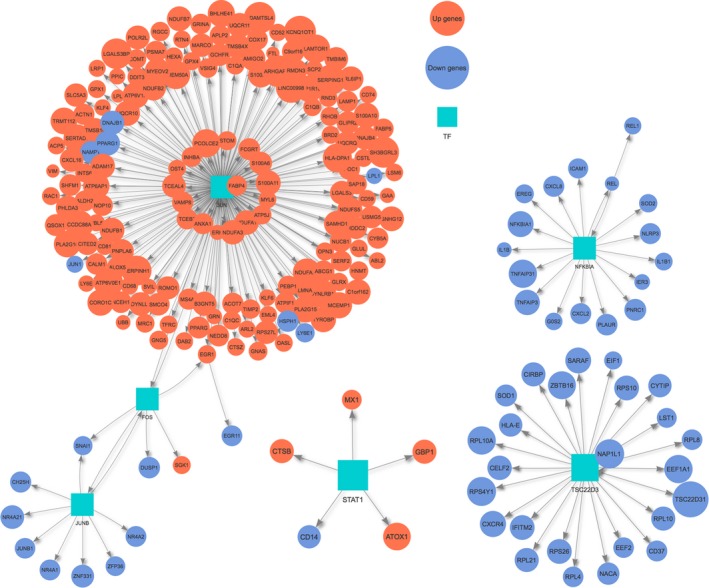
Tumor-infiltrating myeloid cells are the most abundant leukocyte population within tumors. Molecular cues from the tumor microenvironment promote the differentiation of immature myeloid cells toward an immunosuppressive phenotype. However, the in situ dynamics of the transcriptional reprogramming underlying this process are poorly understood. Therefore, we applied single cell RNA-seq (scRNA-seq) to computationally investigate the cellular composition and transcriptional dynamics of tumor and adjacent normal tissues from 4 early-stage non-small cell lung cancer (NSCLC) patients. Our scRNA-seq analyses identified 11 485 cells that varied in identity and gene expression traits between normal and tumor tissues. Among these, myeloid cell populations exhibited the most diverse changes between tumor and normal tissues, consistent with tumor-mediated reprogramming. Through trajectory analysis, we identified a differentiation path from CD14+ monocytes to M2 macrophages (monocyte-to-M2). This differentiation path was reproducible across patients, accompanied by increased expression of genes (eg, MRC1/CD206, MSR1/CD204, PPARG, TREM2) with significantly enriched functions (Oxidative phosphorylation and P53 pathway) and decreased expression of genes (eg, CXCL2, IL1B) with significantly enriched functions (TNF-α signaling via NF-κB and inflammatory response). Our analysis further identified a co-regulatory network implicating upstream transcription factors (JUN, NFKBIA) in monocyte-to-M2 differentiation, and activated ligand-receptor interactions (eg, SFTPA1-TLR2, ICAM1-ITGAM) suggesting intratumoral mechanisms whereby epithelial cells stimulate monocyte-to-M2 differentiation. Overall, our study identified the prevalent monocyte-to-M2 differentiation in NSCLC, accompanied by an intricate transcriptional reprogramming mediated by specific transcriptional activators and intercellular crosstalk involving ligand-receptor interactions.
肿瘤浸润髓系细胞是肿瘤内最丰富的白细胞群体。肿瘤微环境中的分子线索促进未成熟髓系细胞向免疫抑制表型分化。然而,这一过程中潜在转录重编程的原位动力学仍知之甚少。因此,我们应用单细胞 RNA 测序 (scRNA-seq) 从 4 名早期非小细胞肺癌 (NSCLC) 患者的肿瘤和相邻正常组织中计算性地研究细胞组成和转录动力学。我们的 scRNA-seq 分析确定了 11485 个细胞,这些细胞在正常组织和肿瘤组织之间的身份和基因表达特征上有所不同。在这些细胞中,髓系细胞群体在肿瘤和正常组织之间表现出最显著的变化,这与肿瘤介导的重编程一致。通过轨迹分析,我们确定了从 CD14+单核细胞到 M2 巨噬细胞(单核细胞向-M2)的分化途径。该分化途径在患者间具有可重复性,伴随着基因表达的增加(例如,MRC1/CD206、MSR1/CD204、PPARG、TREM2)和基因表达的减少(例如,CXCL2、IL1B)具有显著富集功能(氧化磷酸化和 P53 途径)。我们的分析还进一步确定了一个共调控网络,其中涉及到单核细胞向-M2 分化的上游转录因子(JUN、NFKBIA),以及激活的配体-受体相互作用(例如,SFTPA1-TLR2、ICAM1-ITGAM),提示上皮细胞刺激单核细胞向-M2 分化的肿瘤内机制。总的来说,我们的研究在 NSCLC 中鉴定了普遍存在的单核细胞向-M2 分化,并伴有特定转录激活因子介导的复杂转录重编程和涉及配体-受体相互作用的细胞间串扰。