Department of Global Health, School of Health Sciences, Wuhan University, 115# Donghu Road, Wuhan, China.
Department of Environmental and Occupational Health Sciences, University of Washington, 1959 NE Pacific Street, Seattle, USA.
Environ Int. 2019 Jul;128:95-102. doi: 10.1016/j.envint.2019.04.037. Epub 2019 May 3.
The epidemiological evidence on relationships between long-term exposure to particulate matter and hypertension and blood pressure has been inconclusive. Limited evidence was available for particulate matter with an aerodynamic diameter ≤ 1 μm (PM) in rural areas of developing countries.
This study aimed to investigate the associations between long-term exposure to PM and hypertension and blood pressure among rural Chinese population.
This study included 39,259 participants who had completed the baseline survey from Henan Rural Cohort. Participants' exposure to PM was assessed by a satellite-based spatiotemporal model. The binary logistic regression model was used to examine the association between long-term PM exposure and hypertension, and multivariable linear regression model was used to investigate the associations between long-term PM exposure and systolic blood pressure (SBP), diastolic blood pressure (DBP), mean arterial pressure (MAP) and pulse pressure (PP). Moreover, we examined potential effect modifications by demographic, lifestyle and diet factors.
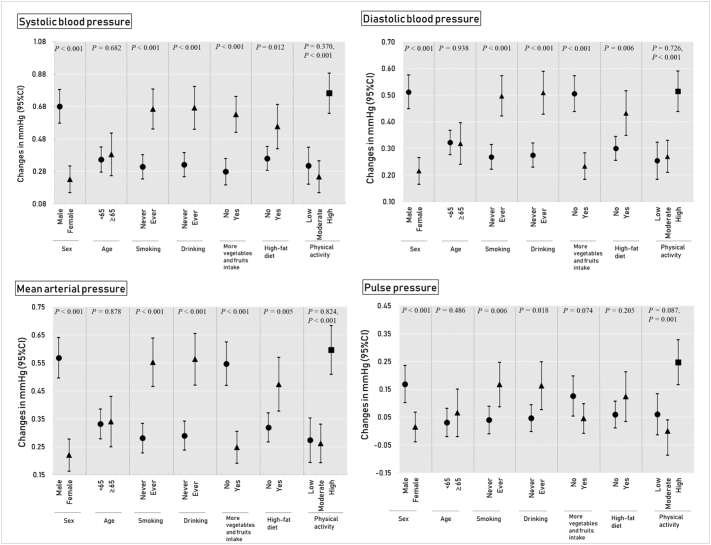
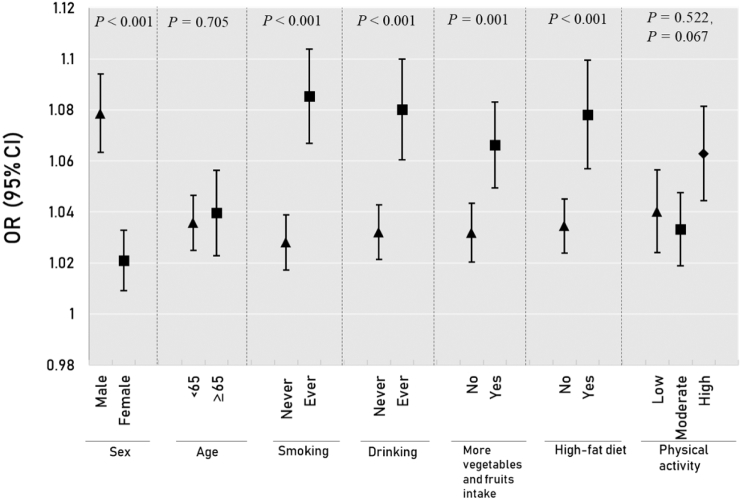
The mean concentration of PM for all participants during the 3-year before baseline survey was 59.98 μg/m. Each 1 μg/m increase in PM concentration was significantly associated with an increase of 4.3% [Odds ratio(OR) = 1.043, 95% confidence interval(CI): 1.033, 1.053] in odds for hypertension, an increase of 0.401 mm Hg (95% CI, 0.335, 0.467), 0.328 mm Hg (95% CI, 0.288, 0.369), 0.353 mm Hg (95% CI, 0.307, 0.399) and 0.073 mm Hg (95% CI, 0.030, 0.116) in SBP, DBP, MAP and PP, respectively. Further stratified analyses showed that the effect of PM on hypertension and blood pressure could be modified by sex, lifestyle and diet.
This study suggests that long-term exposure to ambient PM increases the risk of hypertension and is associated with elevations in blood pressure in rural Chinese adults, especially in male and those with unhealthy habits.
长期暴露于颗粒物与高血压和血压之间的关系的流行病学证据尚无定论。发展中国家农村地区关于直径≤1μm 的颗粒物(PM)的有限证据。
本研究旨在调查中国农村人群长期暴露于 PM 与高血压和血压之间的关系。
本研究纳入了完成河南农村队列基线调查的 39259 名参与者。参与者的 PM 暴露情况通过基于卫星的时空模型进行评估。采用二元逻辑回归模型来检验长期 PM 暴露与高血压之间的关系,采用多变量线性回归模型来检验长期 PM 暴露与收缩压(SBP)、舒张压(DBP)、平均动脉压(MAP)和脉压(PP)之间的关系。此外,我们还检测了人口统计学、生活方式和饮食因素的潜在效应修饰作用。
所有参与者在基线调查前 3 年的 PM 平均浓度为 59.98μg/m。PM 浓度每增加 1μg/m,高血压的几率增加 4.3%(比值比[OR] = 1.043,95%置信区间[CI]:1.033,1.053),SBP 增加 0.401mmHg(95%CI:0.335,0.467),DBP 增加 0.328mmHg(95%CI:0.288,0.369),MAP 增加 0.353mmHg(95%CI:0.307,0.399),PP 增加 0.073mmHg(95%CI:0.030,0.116)。进一步的分层分析表明,PM 对高血压和血压的影响可能受到性别、生活方式和饮食的修饰。
本研究表明,长期暴露于环境 PM 会增加患高血压的风险,并与中国农村成年人的血压升高有关,尤其是男性和生活方式不健康的人。