Department of Global Health, School of Health Sciences, Wuhan University, Wuhan, China; Global Health Institute, Wuhan University, Wuhan, China.
Department of Environmental and Occupational Health Sciences, University of Washington, 1959 NE Pacific Street, Seattle, USA.
Environ Res. 2020 Mar;182:109109. doi: 10.1016/j.envres.2019.109109. Epub 2020 Jan 7.
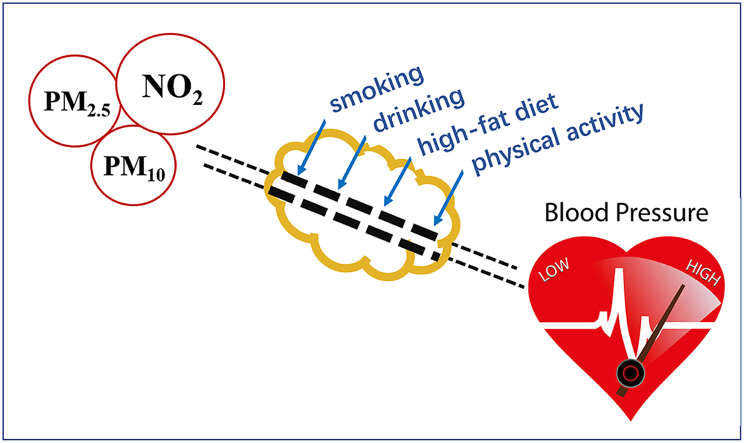
Studies on the hypertensive effect of long-term air pollution exposure were inconclusive and showed scarce evidence from rural areas in developing countries. In this context, we examined the associations of air pollution exposure with hypertension and blood pressure, and their effect modifiers in rural Chinese adults.
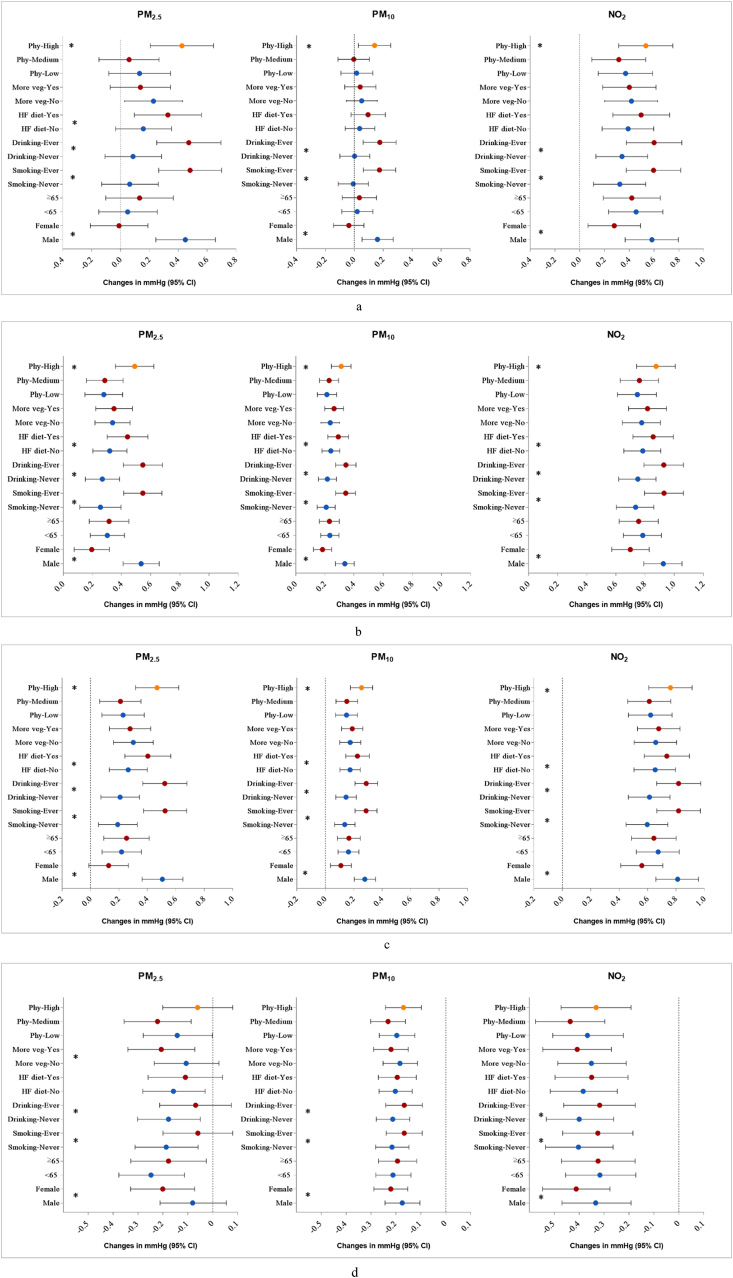
We studied 39,259 participants from a cohort established in five rural regions of central China. Individual exposures to PM and PM (particulate matter with an aerodynamic diameter less than or equal to 2.5 μm and 10 μm) and nitrogen dioxide (NO) was evaluated using satellite-based spatiotemporal models. Mixed-effect regression models were applied to examine the associations of long-term exposure to air pollution with hypertension and four blood pressure component measurements, including systolic blood pressure (SBP), diastolic blood pressure (DBP), mean arterial pressure (MAP) and pulse pressure (PP). Several potential effect modifiers related to demographic and behavioral factors were also examined.
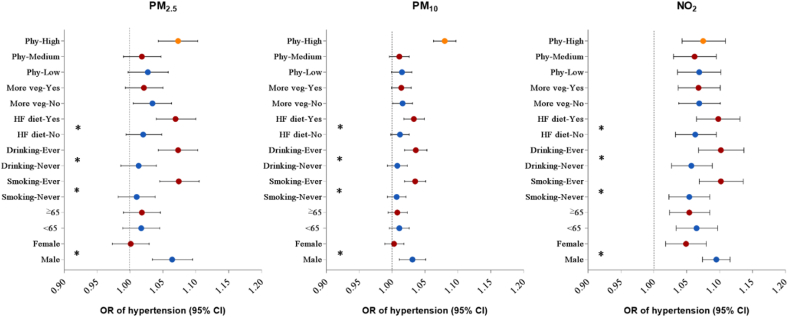
The results showed that for each 1 μg/m increase in PM, PM and NO, the adjusted odds ratio of hypertension was 1.029 (95%CI: 1.001,1.057), 1.015 (95%CI: 1.001, 1.029) and 1.069 (95%CI: 1.038, 1.100), respectively. These three air pollutants were also associated with increased SBP (except for PM), DBP and MAP. The hypertensive effects of air pollution were more pronounced among males, smokers, drinkers, individuals with a high-fat diet, and those with high-level physical activity.
Long-term exposure to PM, PM and NO was associated with increased blood pressure and hypertension in rural Chinese adults, and the associations were modified by several behavioral factors.
关于长期空气污染暴露对高血压影响的研究结果并不一致,发展中国家农村地区的证据也很少。在此背景下,我们研究了空气污染暴露与中国农村成年人高血压和血压的关联,以及它们的效应修饰因子。
我们研究了来自中国中部五个农村地区队列的 39259 名参与者。使用基于卫星的时空模型评估个体对 PM 和 PM(空气动力学直径小于或等于 2.5μm 和 10μm 的颗粒物)以及二氧化氮(NO)的暴露。采用混合效应回归模型来研究长期暴露于空气污染与高血压和四项血压成分测量值(包括收缩压[SBP]、舒张压[DBP]、平均动脉压[MAP]和脉压[PP])之间的关联。还研究了与人口统计学和行为因素有关的几个潜在效应修饰因子。
结果表明,PM、PM 和 NO 每增加 1μg/m,高血压的调整比值比(OR)分别为 1.029(95%CI:1.001,1.057)、1.015(95%CI:1.001,1.029)和 1.069(95%CI:1.038,1.100)。这三种空气污染物也与 SBP(PM 除外)、DBP 和 MAP 升高有关。空气污染对高血压的影响在男性、吸烟者、饮酒者、高脂肪饮食者和高水平体力活动者中更为明显。
长期暴露于 PM、PM 和 NO 与中国农村成年人的血压升高和高血压有关,这些关联受到多种行为因素的修饰。