Nutrition Sciences Academic Unit, Autonomous University of Sinaloa, Cedros y Calle Sauces S/N, Fraccionamiento Los Fresnos, Culiacán 80019, Sinaloa, Mexico.
Division of Sciences and Engineering, Department of Chemical, Biological, and Agricultural Sciences (DC-QB), University of Sonora, Navojoa 85880, Sonora, Mexico.
Medicina (Kaunas). 2019 Apr 26;55(5):117. doi: 10.3390/medicina55050117.
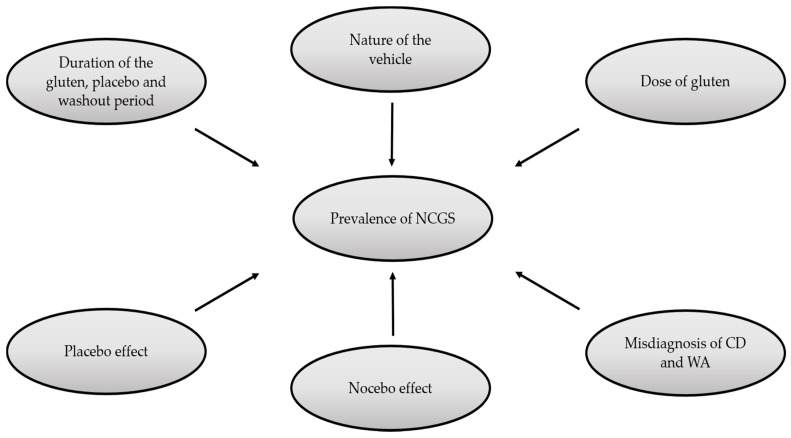
Non-celiac gluten sensitivity (NCGS) is a syndrome characterized by gastrointestinal and extraintestinal manifestations triggered after gluten ingestion in the absence of celiac disease and wheat allergy. Because of the lack of biomarkers for NCGS diagnosis, the cornerstone for its assessment is a single- or double-blind placebo-controlled (DBPC) gluten challenge. However, there are some non-standardized points in the diagnostic approach proposed by the experts. This complicate comparisons among the results published by different research groups. The gluten vehicle and placebo must be indistinguishable from each other, which entails sensory and technological evaluations of the designed gluten vehicle and placebo products. At the moment, there is no standardized method for the preparation of the gluten vehicle and placebo for carrying out DBPC gluten challenges for NCGS assessment. This review focuses on the challenges that researchers have to face, either for the development of an accepted gluten vehicle and placebo or for identifying NCGS cases on the basis of DBPC gluten challenges.
非麸质敏感性肠病(NCGS)是一种综合征,其特征为在无乳糜泻和小麦过敏的情况下,摄入麸质后会引发胃肠道和肠外表现。由于缺乏 NCGS 诊断的生物标志物,因此其评估的基石是单盲或双盲安慰剂对照(DBPC)麸质挑战。然而,专家提出的诊断方法中存在一些非标准化的要点。这使得不同研究小组发表的结果之间的比较变得复杂。麸质载体和安慰剂必须彼此无法区分,这需要对设计的麸质载体和安慰剂产品进行感官和技术评估。目前,尚无用于制备麸质载体和安慰剂以进行 NCGS 评估的 DBPC 麸质挑战的标准化方法。本综述重点介绍了研究人员在开发可接受的麸质载体和安慰剂或基于 DBPC 麸质挑战来确定 NCGS 病例时所面临的挑战。