Grupo de Investigación en Interacciones Gen-Ambiente y Salud (GIIGAS)/Instituto de Biomedicina (IBIOMED), Universidad de León, 24071 León, Spain.
Unit of Nutrition and Cancer, Cancer Epidemiology Research Programme, Catalan Institute of Oncology (ICO), Bellvitge Biomedical Research Institute (IDIBELL), 08908 L'Hospitalet de Llobregat (Barcelona), Spain.
Nutrients. 2019 Apr 27;11(5):967. doi: 10.3390/nu11050967.
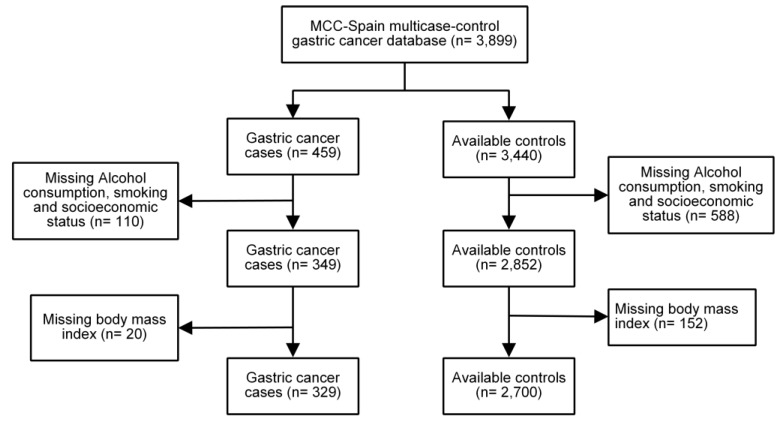
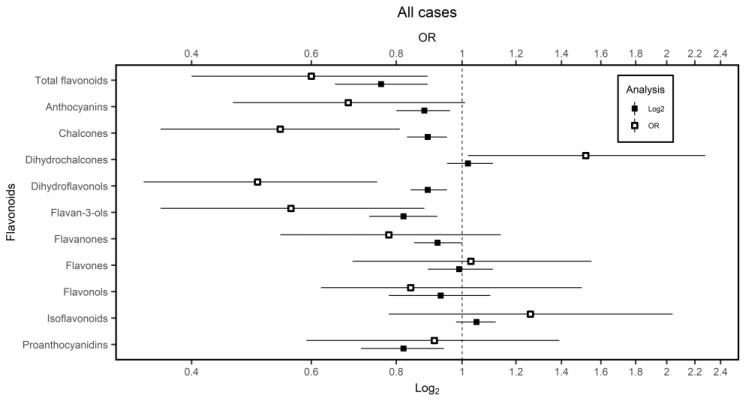
Several epidemiological studies have investigated the association between the dietary flavonoid intake and gastric cancer (GC) risk; however, the results remain inconclusive. Investigating the relationship between the different classes of flavonoids and the histological types and origin of GC can be of interest to the research community. We used data from a population-based multi-case control study (MCC-Spain) obtained from 12 different regions of Spain. 2700 controls and 329 GC cases were included in this study. Odds ratios (ORs) were calculated using the mixed effects logistic regression considering quartiles of flavonoid intakes and log2. Flavonoid intake was associated with a lower GC risk (ORlog2 = 0.76; 95% CI = 0.65-0.89; ORq4vsq1 = 0.60; 95%CI = 0.40-0.89; ptrend = 0.007). Inverse and statistically significant associations were observed with anthocyanidins, chalcones, dihydroflavonols and flavan-3-ols. The isoflavanoid intake was positively associated with higher cancer risk, but without reaching a statistical significance. In general, no differences were observed in the GC risk according to the location and histological type. The flavonoid intake seems to be a protective factor against GC within the MCC-study. This effect may vary depending on the flavonoid class but not by the histological type and location of the tumor. Broader studies with larger sample size and greater geographical variability are necessary.
一些流行病学研究调查了饮食类黄酮摄入与胃癌(GC)风险之间的关联;然而,结果仍不确定。研究不同类黄酮与 GC 的组织学类型和起源之间的关系可能对研究界有意义。我们使用了来自西班牙 12 个不同地区的基于人群的多病例对照研究(MCC-Spain)的数据。本研究纳入了 2700 名对照者和 329 名 GC 病例。使用混合效应逻辑回归考虑类黄酮摄入量的四分位数和 log2 计算比值比(OR)。类黄酮的摄入与较低的 GC 风险相关(ORlog2=0.76;95%CI=0.65-0.89;ORq4vsq1=0.60;95%CI=0.40-0.89;ptrend=0.007)。与花色苷、查尔酮、二氢黄酮醇和黄烷-3-醇呈负相关且具有统计学意义。异黄酮的摄入与更高的癌症风险呈正相关,但没有达到统计学意义。总体而言,根据肿瘤的位置和组织学类型,GC 风险没有差异。类黄酮的摄入似乎是 MCC 研究中 GC 的保护因素。这种影响可能因类黄酮的种类而异,但与肿瘤的组织学类型和位置无关。需要进行更大样本量和更大地理变异性的更广泛研究。