Norell Pejner Margaretha, Ourique de Morais Wagner, Lundström Jens, Laurell Hélène, Skärsäter Ingela
Department of Health and Care, School of Health and Welfare, Halmstad University, Halmstad, Sweden.
Technical Science, School of Information Technology, Halmstad University, Halmstad, Sweden.
JMIR Res Protoc. 2019 Apr 30;8(4):e12447. doi: 10.2196/12447.
Older adults often want to stay in a familiar place, such as their home, as they get older. This so-called aging in place, which may involve support from relatives or care professionals, can promote older people's independence and well-being. The combination of aging and disease, however, can lead to complex medication regimes and difficulties for care providers in correctly assessing the older person's health. In addition, the organization of health care is fragmented, which makes it difficult for health professionals to encourage older people to participate in their own care. It is also a challenge to perform adequate health assessments and to engage in appropriate communication between health care professionals.
The purpose of this paper is to describe the design for an integrated home-based system that can acquire and compile health-related evidence for guidance and information-sharing among care providers and care receivers in order to support and promote medication self-management among older people.
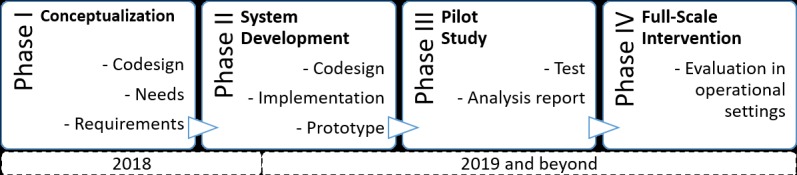
The authors used a participatory design approach for this mixed-methods project, which was divided into four phases. Phase I, Conceptualization, consists of the conceptualization of a system to support medication self-management, objective health assessments, and communication between health care professionals. Phase II, Development of a System, consists of building and bringing together the conceptualized systems from Phase I. Phase III, Pilot Study, and Phase IV, Full-Scale Intervention, are described briefly.
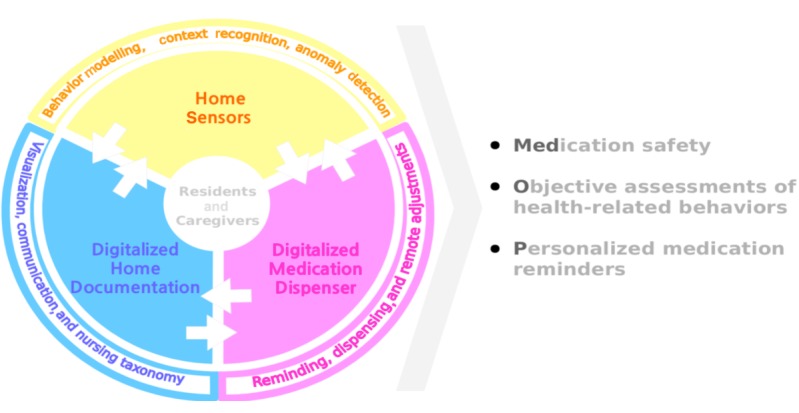
Participants in Phase I were people who were involved in some way in the care of older adults and included older adults themselves, relatives of older adults, care professionals, and industrial partners. With input from Phase I participants, we identified two relevant concepts for promoting medication self-management, both of which related to systems that participants believed could provide guidance for the older adults themselves, relatives of older adults, and care professionals. The systems will also encourage information-sharing between care providers and care receivers. The first is the concept of the Intelligent Age-Friendly Home (IAFH), defined as an integrated residential system that evolves to sense, reason, and act in response to individuals' needs, preferences, and behaviors as these change over time. The second concept is the Medication safety, Objective assessments of health-related behaviors, and Personalized medication reminders (MedOP) system, a system that would be supported by the IAFH, and which consists of three related components: one that assesses health behaviors, another that communicates health data, and a third that promotes medication self-management.
The participants in this project were older adults, relatives of older adults, care professionals, and our industrial partners. With input from the participants, we identified two main concepts that could comprise a system for health assessment, communication, and medication self-management: the IAFH and the MedOP system. These concepts will be tested in this study to determine whether they can facilitate and promote medication self-management among older people.
INTERNATIONAL REGISTERED REPORT IDENTIFIER (IRRID): DERR1-10.2196/12447.
随着年龄增长,老年人通常希望待在熟悉的地方,比如自己家中。这种所谓的居家养老可能需要亲属或护理专业人员的支持,它能够促进老年人的独立性和幸福感。然而,衰老与疾病并存会导致用药方案复杂,护理人员难以正确评估老年人的健康状况。此外,医疗保健的组织分散,这使得健康专业人员难以鼓励老年人参与自身护理。进行充分的健康评估以及在医疗保健专业人员之间进行适当沟通也是一项挑战。
本文旨在描述一个基于家庭的综合系统的设计,该系统能够获取并整理与健康相关的证据,以便在护理提供者和接受者之间进行指导和信息共享,从而支持和促进老年人的用药自我管理。
作者针对这个混合方法项目采用了参与式设计方法,该项目分为四个阶段。第一阶段,概念化,包括对支持用药自我管理、客观健康评估以及医疗保健专业人员之间沟通的系统进行概念化。第二阶段,系统开发,包括构建并整合第一阶段概念化的系统。第三阶段,试点研究,以及第四阶段,全面干预,将进行简要描述。
第一阶段的参与者是以某种方式参与老年人护理的人员,包括老年人自身、老年人的亲属、护理专业人员以及行业合作伙伴。根据第一阶段参与者的意见,我们确定了两个促进用药自我管理的相关概念,这两个概念都与参与者认为可以为老年人自身、老年人的亲属和护理专业人员提供指导的系统有关。这些系统还将鼓励护理提供者和接受者之间进行信息共享。第一个是智能老年友好型家庭(IAFH)的概念,定义为一个综合居住系统,它会随着时间的推移,根据个人的需求、偏好和行为的变化进行感知、推理和行动。第二个概念是用药安全、健康相关行为的客观评估和个性化用药提醒(MedOP)系统,该系统将由IAFH提供支持,它由三个相关组件组成:一个评估健康行为,另一个传达健康数据,第三个促进用药自我管理。
该项目的参与者包括老年人、老年人的亲属、护理专业人员以及我们的行业合作伙伴。根据参与者的意见,我们确定了两个主要概念,它们可以构成一个健康评估、沟通和用药自我管理系统:IAFH和MedOP系统。这些概念将在本研究中进行测试,以确定它们是否能够促进和推动老年人的用药自我管理。
国际注册报告标识符(IRRID):DERR1-10.2196/12447。