Exercise Physiology Research Group, Department of Movement Sciences, KU Leuven, Leuven, Belgium.
Bakala Academy-Athletic Performance Center, KU Leuven, Leuven, Belgium.
J Physiol. 2019 Jun;597(12):3009-3027. doi: 10.1113/JP277831. Epub 2019 May 22.
Overload training is required for sustained performance gain in athletes (functional overreaching). However, excess overload may result in a catabolic state which causes performance decrements for weeks (non-functional overreaching) up to months (overtraining). Blood ketone bodies can attenuate training- or fasting-induced catabolic events. Therefore, we investigated whether increasing blood ketone levels by oral ketone ester (KE) intake can protect against endurance training-induced overreaching. We show for the first time that KE intake following exercise markedly blunts the development of physiological symptoms indicating overreaching, and at the same time significantly enhances endurance exercise performance. We provide preliminary data to indicate that growth differentiation factor 15 (GDF15) may be a relevant hormonal marker to diagnose the development of overtraining. Collectively, our data indicate that ketone ester intake is a potent nutritional strategy to prevent the development of non-functional overreaching and to stimulate endurance exercise performance.
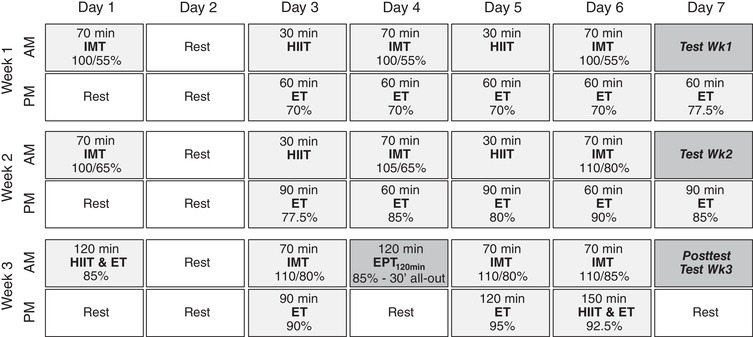
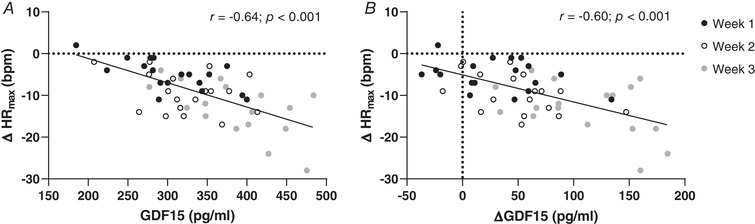
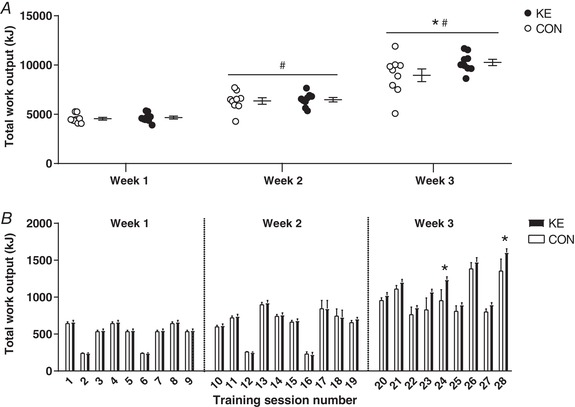
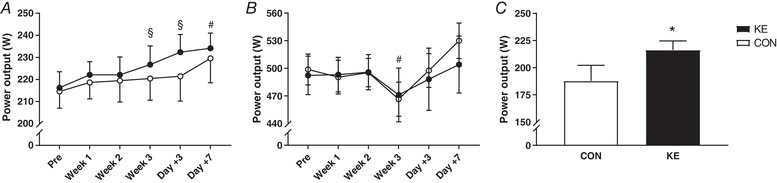
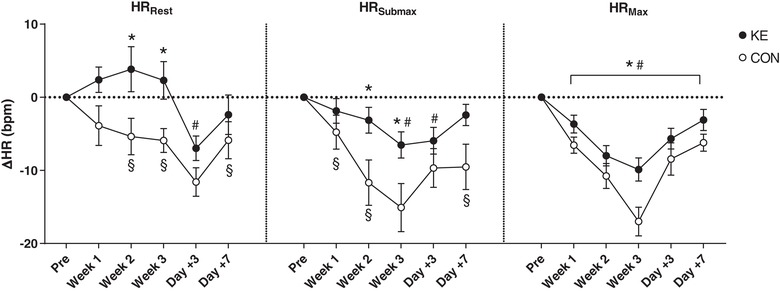
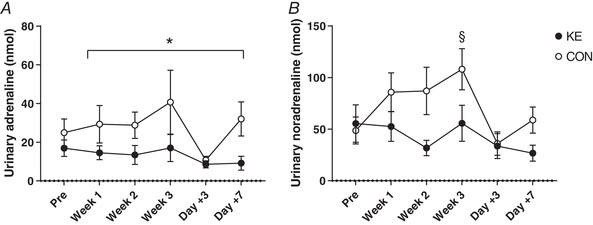
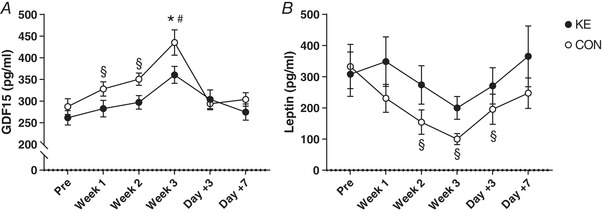
It is well known that elevated blood ketones attenuate net muscle protein breakdown, as well as negate catabolic events, during energy deficit. Therefore, we hypothesized that oral ketones can blunt endurance training-induced overreaching. Fit male subjects participated in two daily training sessions (3 weeks, 6 days/week) while receiving either a ketone ester (KE, n = 9) or a control drink (CON, n = 9) following each session. Sustainable training load in week 3 as well as power output in the final 30 min of a 2-h standardized endurance session were 15% higher in KE than in CON (both P < 0.05). KE inhibited the training-induced increase in nocturnal adrenaline (P < 0.01) and noradrenaline (P < 0.01) excretion, as well as blunted the decrease in resting (CON: -6 ± 2 bpm; KE: +2 ± 3 bpm, P < 0.05), submaximal (CON: -15 ± 3 bpm; KE: -7 ± 2 bpm, P < 0.05) and maximal (CON: -17 ± 2 bpm; KE: -10 ± 2 bpm, P < 0.01) heart rate. Energy balance during the training period spontaneously turned negative in CON (-2135 kJ/day), but not in KE (+198 kJ/day). The training consistently increased growth differentiation factor 15 (GDF15), but ∼2-fold more in CON than in KE (P < 0.05). In addition, delta GDF15 correlated with the training-induced drop in maximal heart rate (r = 0.60, P < 0.001) and decrease in osteocalcin (r = 0.61, P < 0.01). Other measurements such as blood ACTH, cortisol, IL-6, leptin, ghrelin and lymphocyte count, and muscle glycogen content did not differentiate KE from CON. In conclusion, KE during strenuous endurance training attenuates the development of overreaching. We also identify GDF15 as a possible marker of overtraining.
运动员需要超负荷训练才能获得持续的成绩提高(功能性超越)。然而,过度的超负荷可能导致分解代谢状态,导致数周(非功能性超越)甚至数月(过度训练)的成绩下降。血液酮体可以减轻训练或禁食引起的分解代谢事件。因此,我们研究了通过口服酮酯(KE)摄入增加血液酮体水平是否可以预防耐力训练引起的超越。我们首次表明,运动后摄入 KE 可显著抑制生理症状的发展,表明超越,同时显着提高耐力运动表现。我们提供初步数据表明,生长分化因子 15(GDF15)可能是诊断过度训练发展的相关激素标志物。总的来说,我们的数据表明,酮酯摄入是一种有效的营养策略,可以防止非功能性超越的发展,并刺激耐力运动表现。
众所周知,在能量不足期间,升高的血液酮体可减轻净肌肉蛋白分解,并消除分解代谢事件。因此,我们假设口服酮体可以减轻耐力训练引起的超越。健康男性参与者在 3 周内每天进行两次训练(6 天/周),每次训练后接受酮酯(KE,n=9)或对照饮料(CON,n=9)。在第 3 周,KE 组的可持续训练负荷以及 2 小时标准化耐力训练的最后 30 分钟的功率输出比 CON 组高 15%(均 P<0.05)。KE 抑制了训练引起的夜间肾上腺素(P<0.01)和去甲肾上腺素(P<0.01)排泄的增加,并减轻了静息(CON:-6±2bpm;KE:+2±3bpm,P<0.05)、亚最大(CON:-15±3bpm;KE:-7±2bpm,P<0.05)和最大(CON:-17±2bpm;KE:-10±2bpm,P<0.01)心率的降低。在训练期间,CON 中的能量平衡自发转为负值(-2135kJ/天),而 KE 中则没有(+198kJ/天)。训练一致地增加了生长分化因子 15(GDF15),但 CON 中的增加是 KE 的约 2 倍(P<0.05)。此外,GDF15 的变化与最大心率的训练诱导下降(r=0.60,P<0.001)和骨钙素的下降相关(r=0.61,P<0.01)。其他测量值,如血液 ACTH、皮质醇、IL-6、瘦素、ghrelin 和淋巴细胞计数以及肌肉糖原含量,并没有将 KE 与 CON 区分开来。总之,在剧烈的耐力训练中,KE 可减轻超越的发展。我们还确定 GDF15 可能是过度训练的标志物。