Corteva Agriscience™, Agriculture Division of DowDuPont™, Johnston, IA, 50131, USA.
Institute of Biotechnology, Vilnius University, Vilnius, LT, 10257, Lithuania.
Sci Rep. 2019 Apr 30;9(1):6729. doi: 10.1038/s41598-019-43141-6.
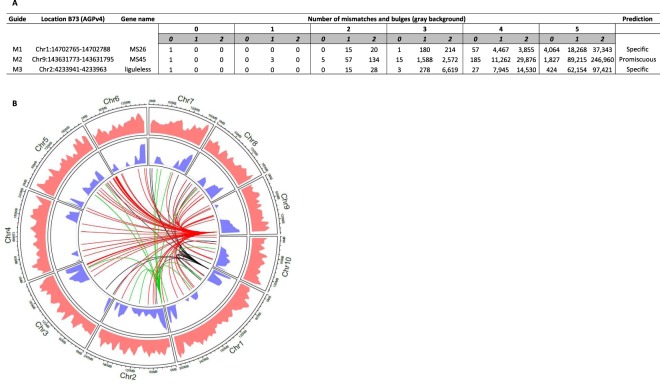
CRISPR-Cas9 enabled genome engineering has great potential for improving agriculture productivity, but the possibility of unintended off-target edits has evoked some concerns. Here we employ a three-step strategy to investigate Cas9 nuclease specificity in a complex plant genome. Our approach pairs computational prediction with genome-wide biochemical off-target detection followed by validation in maize plants. Our results reveal high frequency (up to 90%) on-target editing with no evidence of off-target cleavage activity when guide RNAs were bioinformatically predicted to be specific. Predictable off-target edits were observed but only with a promiscuous guide RNA intentionally designed to validate our approach. Off-target editing can be minimized by designing guide RNAs that are different from other genomic locations by at least three mismatches in combination with at least one mismatch occurring in the PAM proximal region. With well-designed guides, genetic variation from Cas9 off-target cleavage in plants is negligible, and much less than inherent variation.
CRISPR-Cas9 基因编辑技术在提高农业生产力方面具有巨大潜力,但非预期的脱靶编辑的可能性引起了一些关注。在这里,我们采用三步策略来研究复杂植物基因组中 Cas9 核酸酶的特异性。我们的方法将计算预测与全基因组生化脱靶检测相结合,然后在玉米植株中进行验证。我们的结果显示,当指导 RNA 经生物信息学预测为特异性时,靶编辑的频率很高(高达 90%),没有证据表明存在脱靶切割活性。可预测的脱靶编辑是观察到的,但仅与故意设计的混杂指导 RNA 有关,旨在验证我们的方法。通过设计指导 RNA,使其与其他基因组位置至少有三个错配,同时至少在 PAM 近端区域发生一个错配,可以最小化脱靶编辑。使用设计良好的指南,来自 Cas9 脱靶切割的植物遗传变异可以忽略不计,而且比内在变异要少得多。