Aboueid Stephanie, Liu Rebecca H, Desta Binyam Negussie, Chaurasia Ashok, Ebrahim Shanil
Applied Health Sciences, University of Waterloo, Waterloo, ON, Canada.
Faculty of Health Sciences, University of Ottawa, Ottawa, ON, Canada.
JMIR Med Inform. 2019 May 1;7(2):e13445. doi: 10.2196/13445.
Self-diagnosis is the process of diagnosing or identifying a medical condition in oneself. Artificially intelligent digital platforms for self-diagnosis are becoming widely available and are used by the general public; however, little is known about the body of knowledge surrounding this technology.
The objectives of this scoping review were to (1) systematically map the extent and nature of the literature and topic areas pertaining to digital platforms that use computerized algorithms to provide users with a list of potential diagnoses and (2) identify key knowledge gaps.
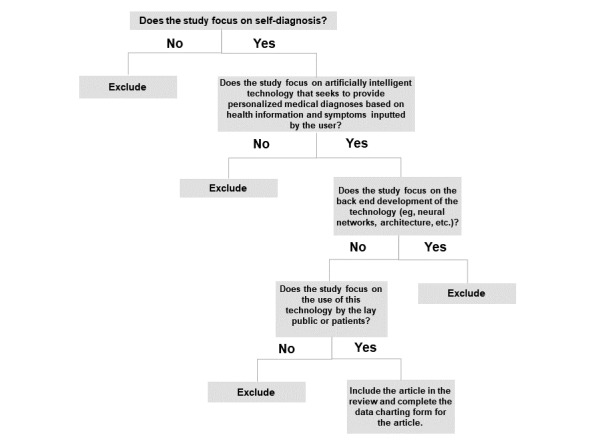
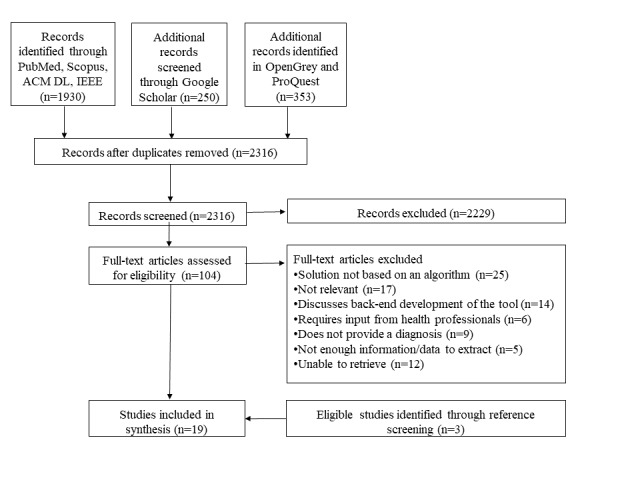
The following databases were searched: PubMed (Medline), Scopus, Association for Computing Machinery Digital Library, Institute of Electrical and Electronics Engineers, Google Scholar, Open Grey, and ProQuest Dissertations and Theses. The search strategy was developed and refined with the assistance of a librarian and consisted of 3 main concepts: (1) self-diagnosis; (2) digital platforms; and (3) public or patients. The search generated 2536 articles from which 217 were duplicates. Following the Tricco et al 2018 checklist, 2 researchers screened the titles and abstracts (n=2316) and full texts (n=104), independently. A total of 19 articles were included for review, and data were retrieved following a data-charting form that was pretested by the research team.
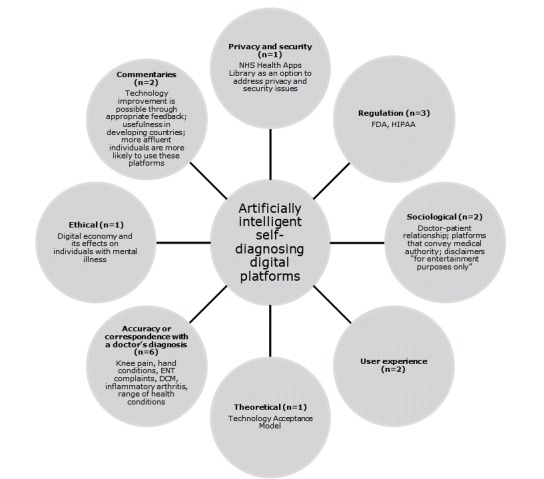
The included articles were mainly conducted in the United States (n=10) or the United Kingdom (n=4). Among the articles, topic areas included accuracy or correspondence with a doctor's diagnosis (n=6), commentaries (n=2), regulation (n=3), sociological (n=2), user experience (n=2), theoretical (n=1), privacy and security (n=1), ethical (n=1), and design (n=1). Individuals who do not have access to health care and perceive to have a stigmatizing condition are more likely to use this technology. The accuracy of this technology varied substantially based on the disease examined and platform used. Women and those with higher education were more likely to choose the right diagnosis out of the potential list of diagnoses. Regulation of this technology is lacking in most parts of the world; however, they are currently under development.
There are prominent research gaps in the literature surrounding the use of artificially intelligent self-diagnosing digital platforms. Given the variety of digital platforms and the wide array of diseases they cover, measuring accuracy is cumbersome. More research is needed to understand the user experience and inform regulations.
自我诊断是个体对自身医疗状况进行诊断或识别的过程。用于自我诊断的人工智能数字平台正广泛普及并为公众所使用;然而,关于这项技术的知识体系却鲜为人知。
本范围综述的目的是:(1)系统梳理与使用计算机算法为用户提供潜在诊断列表的数字平台相关的文献范围、性质及主题领域;(2)识别关键知识空白。
检索了以下数据库:PubMed(医学索引数据库)、Scopus、美国计算机协会数字图书馆、电气和电子工程师协会数据库、谷歌学术、Open Grey以及ProQuest学位论文数据库。在一名图书馆员的协助下制定并完善了检索策略,该策略包含3个主要概念:(1)自我诊断;(2)数字平台;(3)公众或患者。检索共得到2536篇文章,其中217篇为重复文章。按照Tricco等人2018年的清单,两名研究人员独立筛选了标题和摘要(n = 2316)以及全文(n = 104)。共纳入19篇文章进行综述,并根据研究团队预先测试的数据图表形式检索数据。
纳入的文章主要在美国(n = 10)或英国(n = 4)开展。在这些文章中,主题领域包括与医生诊断结果的准确性或一致性(n = 6)、评论(n = 2)、监管(n = 3)、社会学(n = 2)、用户体验(n = 2)、理论(n = 1)、隐私与安全(n = 1)、伦理(n = 1)以及设计(n = 1)。无法获得医疗服务且认为自身患有被污名化疾病的个体更有可能使用这项技术。这项技术的准确性因所检查的疾病和所使用的平台而有很大差异。女性和受过高等教育的人更有可能从潜在诊断列表中选择正确的诊断。世界上大多数地区都缺乏对这项技术的监管;不过,相关监管目前正在制定中。
围绕使用人工智能自我诊断数字平台的文献存在显著的研究空白。鉴于数字平台种类繁多且涵盖的疾病范围广泛,衡量准确性很麻烦。需要更多研究来了解用户体验并为监管提供信息。