Bhagia Samarthya, Wyman Charles E, Kumar Rajeev
1Department of Chemical and Environmental Engineering, Bourns College of Engineering, University of California Riverside, 900 University Ave, Riverside, CA 92521 USA.
2Center for Environmental Research and Technology (CE-CERT), Bourns College of Engineering, University of California Riverside, 1084 Columbia Avenue, Riverside, CA 92507 USA.
Biotechnol Biofuels. 2019 Apr 23;12:96. doi: 10.1186/s13068-019-1439-2. eCollection 2019.
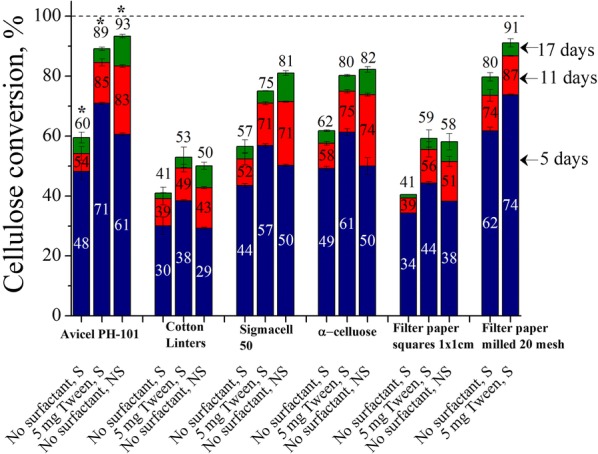
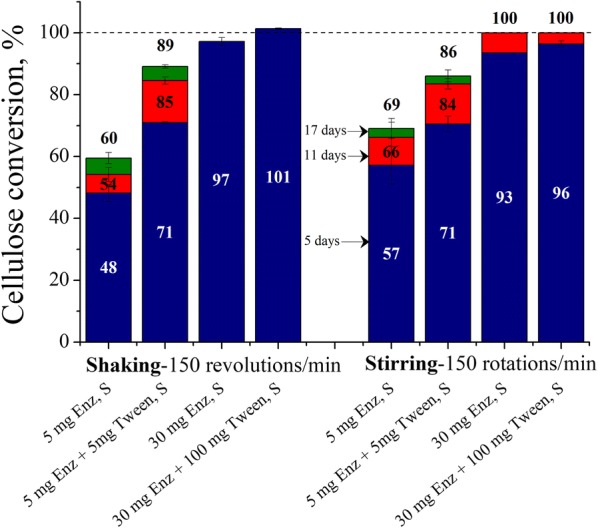
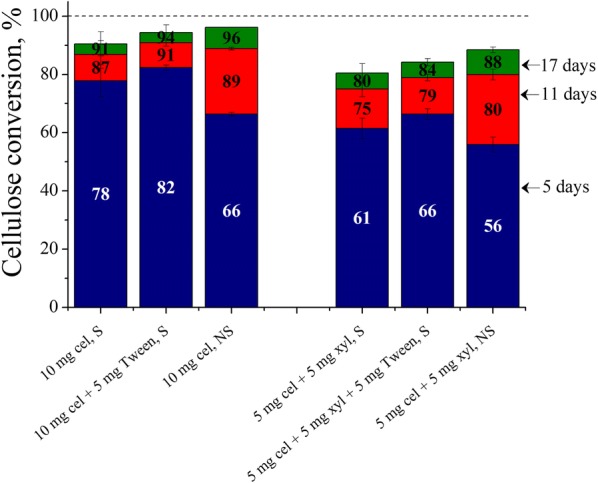
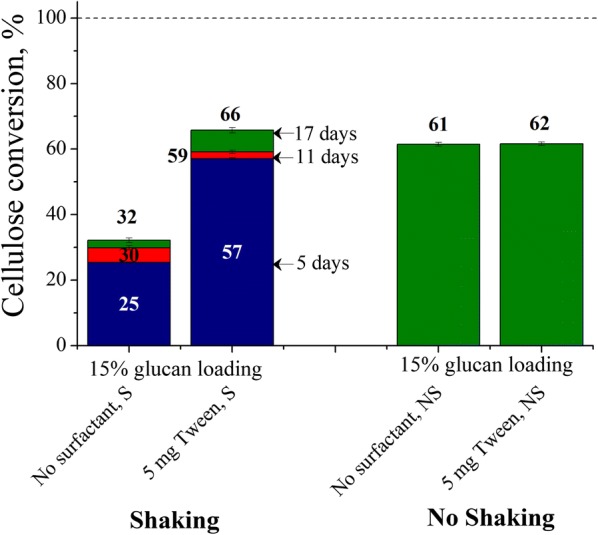
We recently confirmed that the deactivation of cellulases at the air-liquid interface reduces microcrystalline cellulose conversion at low enzyme loadings in shaken flasks. It is one of the main causes for lowering of cellulose conversions at low enzyme loadings. However, supplementing cellulases with small quantities of surface-active additives in shaken flasks can increase cellulose conversions at low enzyme loadings. It was also shown that cellulose conversions at low enzyme loadings can be increased in unshaken flasks if the reactions are carried for a longer time. This study further explores these recent findings to better understand the impact of air-liquid interfacial phenomena on enzymatic hydrolysis of cellulose contained in Avicel, Sigmacell, α-cellulose, cotton linters, and filter paper. The impacts of solids and enzyme loadings, supplementation with nonionic surfactant Tween 20 and xylanases, and application of different types of mixing and reactor designs on cellulose hydrolysis were also evaluated.
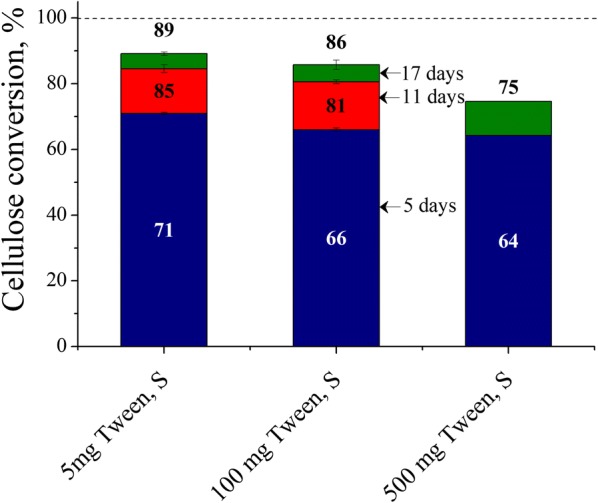
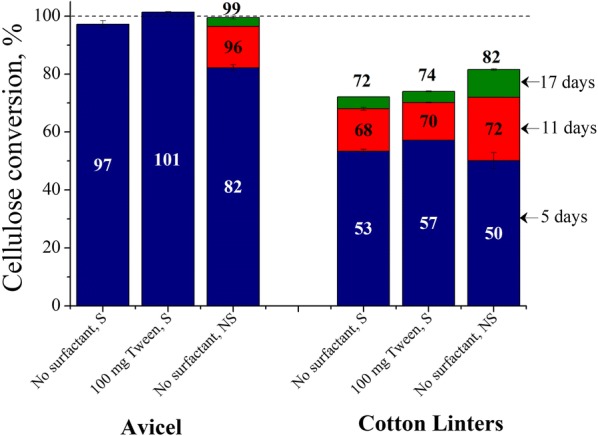
Avicel cellulose conversions at high solid loading were more than doubled by minimizing loss of cellulases to the air-liquid interface. Maximum cellulose conversions were high for surface-active supplemented shaken flasks or unshaken flasks because of low cellulase deactivation at the air-liquid interface. The nonionic surfactant Tween 20 was unable to completely prevent cellulase deactivation in shaken flasks and only reduced cellulose conversions at unreasonably high concentrations.
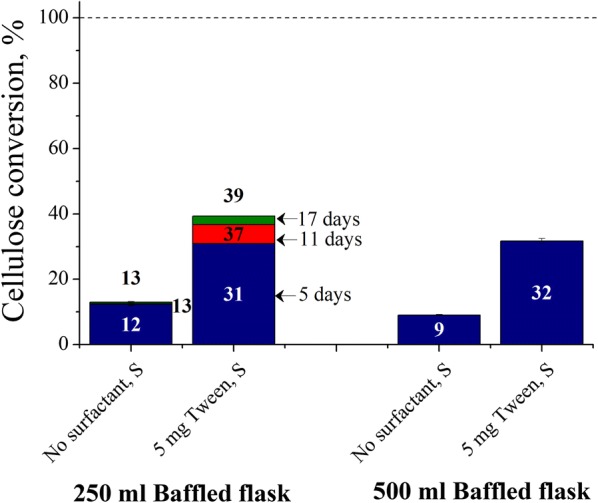
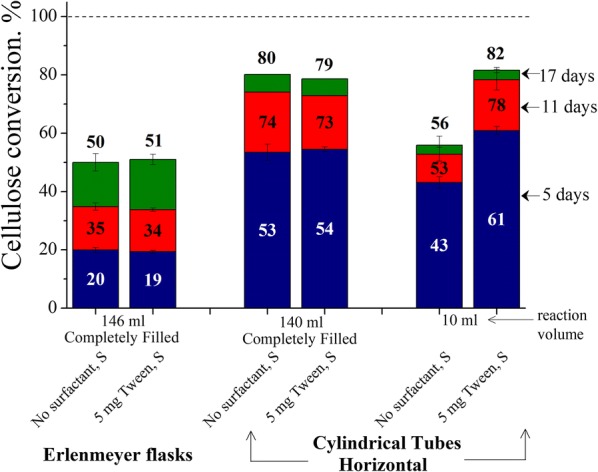
High dynamic interfacial areas created through baffles in reactor vessels, low volumes in high-capacity vessels, or high shaking speeds severely limited cellulose conversions at low enzyme loadings. Precipitation of cellulases due to aggregation at the air-liquid interface caused their continuous deactivation in shaken flasks and severely limited solubilization of cellulose.
我们最近证实,在摇瓶中,纤维素酶在气液界面失活会降低低酶负载量下微晶纤维素的转化率。这是低酶负载量下纤维素转化率降低的主要原因之一。然而,在摇瓶中向纤维素酶中添加少量表面活性添加剂可以提高低酶负载量下的纤维素转化率。研究还表明,如果反应时间延长,在未振荡的烧瓶中低酶负载量下的纤维素转化率也可以提高。本研究进一步探索这些最新发现,以更好地了解气液界面现象对微晶纤维素、西格玛纤维素、α-纤维素、棉短绒和滤纸中纤维素酶解的影响。还评估了固体和酶负载量、添加非离子表面活性剂吐温20和木聚糖酶以及应用不同类型的混合和反应器设计对纤维素水解的影响。
通过尽量减少纤维素酶向气液界面的损失,高固体负载量下的微晶纤维素转化率增加了一倍多。由于气液界面处纤维素酶失活程度低,添加表面活性剂的振荡烧瓶或未振荡烧瓶中的纤维素转化率最高。非离子表面活性剂吐温20无法完全防止摇瓶中纤维素酶的失活,并且仅在浓度过高时才会降低纤维素转化率。
通过反应器容器中的挡板产生的高动态界面面积、高容量容器中的低体积或高振荡速度严重限制了低酶负载量下的纤维素转化率。纤维素酶在气液界面聚集导致沉淀,使其在摇瓶中持续失活,并严重限制了纤维素的溶解。