Center for Environmental Research and Technology, Bourns College of Engineering, University of California, Riverside, 1084 Columbia Avenue, Riverside, California 92507, USA.
Biotechnol Biofuels. 2011 Jun 24;4(1):18. doi: 10.1186/1754-6834-4-18.
Hemicellulose is often credited with being one of the important physical barriers to enzymatic hydrolysis of cellulose, and acts by blocking enzyme access to the cellulose surface. In addition, our recent research has suggested that hemicelluloses, particularly in the form of xylan and its oligomers, can more strongly inhibit cellulase activity than do glucose and cellobiose. Removal of hemicelluloses or elimination of their negative effects can therefore become especially pivotal to achieving higher cellulose conversion with lower enzyme doses.
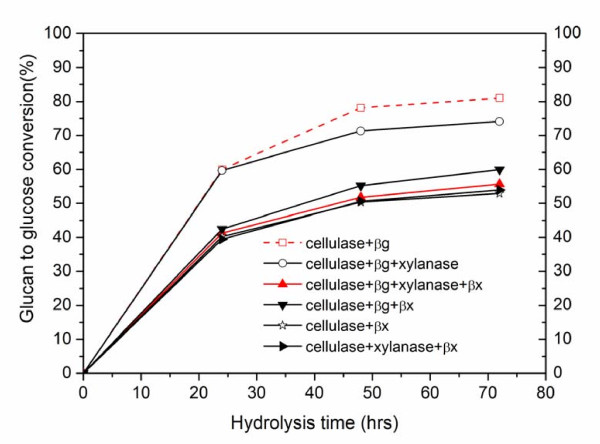
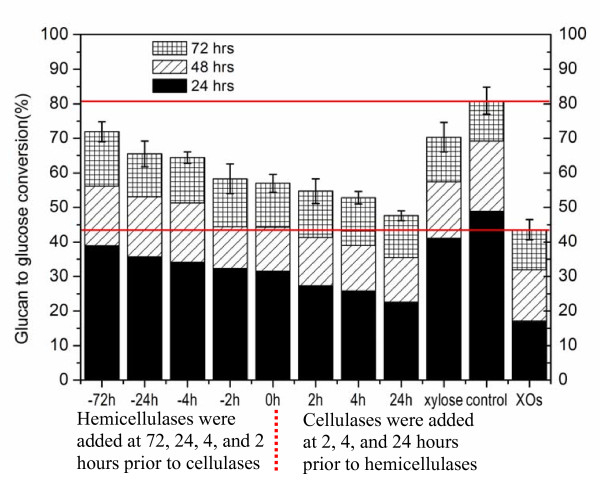
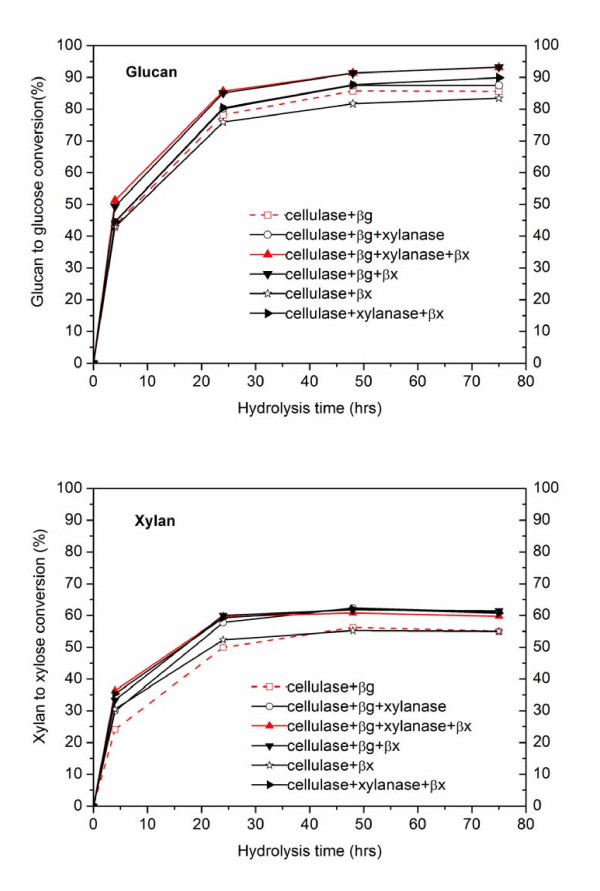
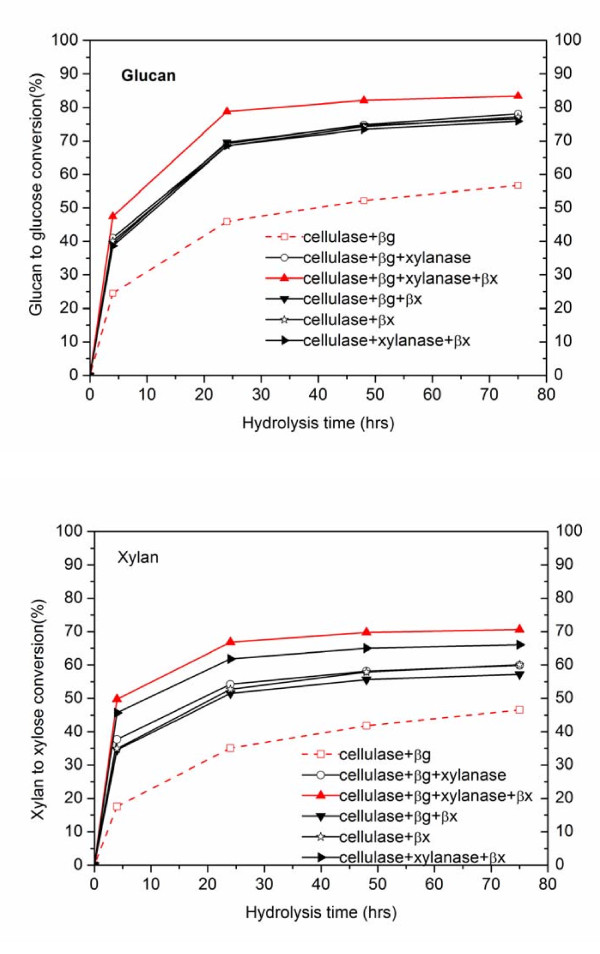
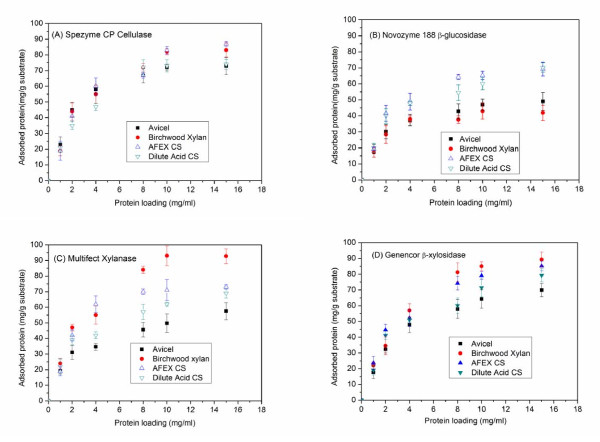
In this study, cellulase was supplemented with xylanase and β-xylosidase to boost conversion of both cellulose and hemicellulose in pretreated biomass through conversion of xylan and xylo-oligomers to the less inhibitory xylose. Although addition of xylanase and β-xylosidase did not necessarily enhance Avicel hydrolysis, glucan conversions increased by 27% and 8% for corn stover pretreated with ammonia fiber expansion (AFEX) and dilute acid, respectively. In addition, adding hemicellulase several hours before adding cellulase was more beneficial than later addition, possibly as a result of a higher adsorption affinity of cellulase and xylanase to xylan than glucan.
This key finding elucidates a possible mechanism for cellulase inhibition by xylan and xylo-oligomers and emphasizes the need to optimize the enzyme formulation for each pretreated substrate. More research is needed to identify advanced enzyme systems designed to hydrolyze different substrates with maximum overall enzyme efficacy.
木聚糖通常被认为是纤维素酶水解的重要物理障碍之一,它通过阻止酶与纤维素表面接触来发挥作用。此外,我们最近的研究表明,木聚糖及其低聚物等半纤维素可以比葡萄糖和纤维二糖更强烈地抑制纤维素酶的活性。因此,去除半纤维素或消除其负面影响对于以较低的酶剂量实现更高的纤维素转化率变得尤为关键。
在这项研究中,通过将木聚糖和木二糖转化为抑制作用较小的木糖,向纤维素酶中添加木聚糖酶和β-木糖苷酶,以促进预处理生物质中纤维素和半纤维素的转化。虽然添加木聚糖酶和β-木糖苷酶不一定能提高微晶纤维素的水解度,但氨纤维膨胀(AFEX)预处理和稀酸预处理的玉米秸秆的葡聚糖转化率分别提高了 27%和 8%。此外,在添加纤维素酶之前几个小时添加半纤维素酶比之后添加更有利,这可能是因为纤维素酶和木聚糖酶对半纤维素的吸附亲和力高于对葡聚糖的吸附亲和力。
这一关键发现阐明了木聚糖和木二糖对纤维素酶抑制的可能机制,并强调了需要针对每种预处理底物优化酶制剂。需要更多的研究来确定旨在以最大整体酶效水解不同底物的先进酶系统。