Department of Gastroenterology, The Second People's Hospital of China Three Gorges University, Yichang, P.R. China.
School of Clinical Medical, Hubei University of Chinese Medicine, Wuhan, P.R. China.
Saudi J Gastroenterol. 2019 Sep-Oct;25(5):302-308. doi: 10.4103/sjg.SJG_520_18.
BACKGROUND/AIMS: This study was carried out to investigate the effect of Bletilla striata polysaccharide (BSP) treating on lipopolysaccharide (LPS)-induced intestinal epithelial barrier disruption in rat intestinal epithelial cell (IEC) line.
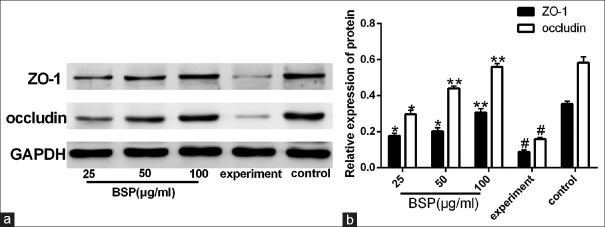
LPS was used to stimulate the IEC-18 cells (1 μg/ml), with or without different concentrations of BSP (25, 50 and 100 μg/ml) for 24 h. Transepithelial electrical resistance (TEER) was measured to detect the permeability of cells. Interleukin-6 (IL-6) and tumor necrosis factor-α (TNF-α) in the cell supernatant were detected with the enzyme-linked immunosorbent assay (ELISA). Real-time polymerase chain reaction (PCR) was employed to detect the mRNA levels of zonulae occludens (ZO)-1 and occludin. Western blot and immunofluorescence analysis were used for analyzing the expression level and the distribution patterns of ZO-1 and occludin protein.
After treatment with BSP, the IL-6 and TNF-α levels in the cell supernatant were significantly decreased compared with the experiment group (P < 0.05 or 0.01). The permeability of IEC was decreased in BSP groups when compared with the experiment group (P < 0.05 or 0.01). In addition, compared with the experiment group, treatment with BSP up-regulated mRNA and protein expression levels of ZO-1 and occludin, and kept the ZO-1 and occludin protein intact in IEC-18 cells injured with LPS (P < 0.05 or 0.01).
BSP has the capacity to protect IEC-18 cells from LPS-induced injury. The mechanisms may be associated with decreasing the inflammatory cytokine levels of IL-6 and TNF-α, and elevating the expression of ZO-1 and occludin, which might serve as a new protective agent for LPS-induced intestinal epithelial barrier disruption.
背景/目的:本研究旨在探讨白芨多糖(BSP)对脂多糖(LPS)诱导的大鼠肠上皮细胞(IEC)系肠上皮屏障破坏的作用。
用 LPS(1 μg/ml)刺激 IEC-18 细胞,加入或不加入不同浓度的 BSP(25、50 和 100 μg/ml)24 小时。用跨上皮电阻(TEER)测量来检测细胞通透性。用酶联免疫吸附试验(ELISA)检测细胞上清液中的白细胞介素-6(IL-6)和肿瘤坏死因子-α(TNF-α)。采用实时聚合酶链反应(PCR)检测紧密连接蛋白(ZO)-1 和闭合蛋白的 mRNA 水平。用 Western blot 和免疫荧光分析来检测 ZO-1 和闭合蛋白的表达水平和分布模式。
与实验组相比,BSP 处理后细胞上清液中的 IL-6 和 TNF-α 水平显著降低(P < 0.05 或 0.01)。与实验组相比,BSP 组 IEC 的通透性降低(P < 0.05 或 0.01)。此外,与实验组相比,BSP 处理可上调 LPS 损伤的 IEC-18 细胞中 ZO-1 和闭合蛋白的 mRNA 和蛋白表达水平,并使 ZO-1 和闭合蛋白蛋白保持完整(P < 0.05 或 0.01)。
BSP 具有保护 IEC-18 细胞免受 LPS 诱导损伤的能力。其机制可能与降低 IL-6 和 TNF-α 等炎症细胞因子水平以及提高 ZO-1 和闭合蛋白表达有关,可作为 LPS 诱导肠上皮屏障破坏的一种新的保护剂。