Department of Medicine , Imperial College London , London , W21PG , United Kingdom.
Department of Plastic Surgery , Imperial NHS Trust , London , W68RF , United Kingdom.
ACS Nano. 2019 May 28;13(5):5920-5930. doi: 10.1021/acsnano.9b01774. Epub 2019 May 3.
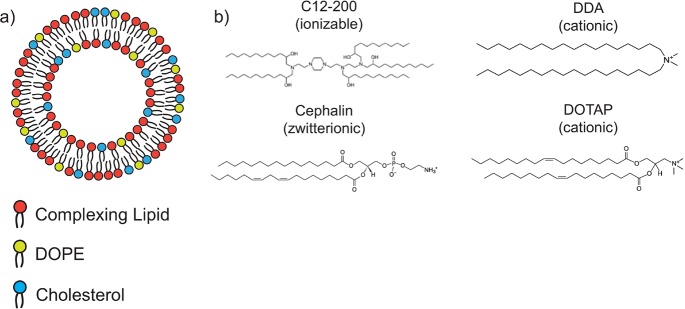
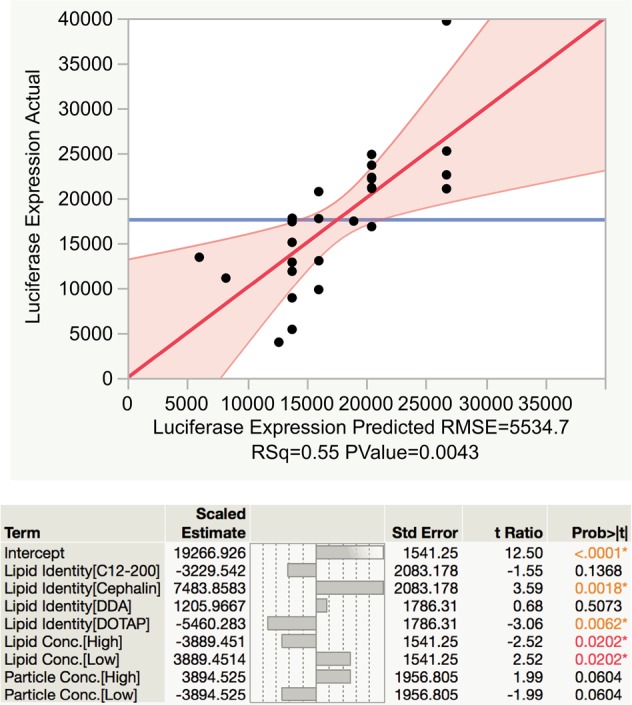
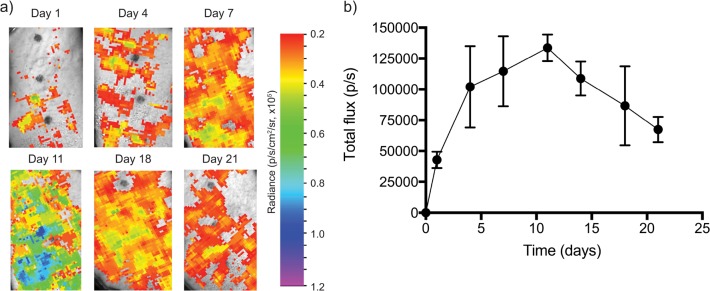
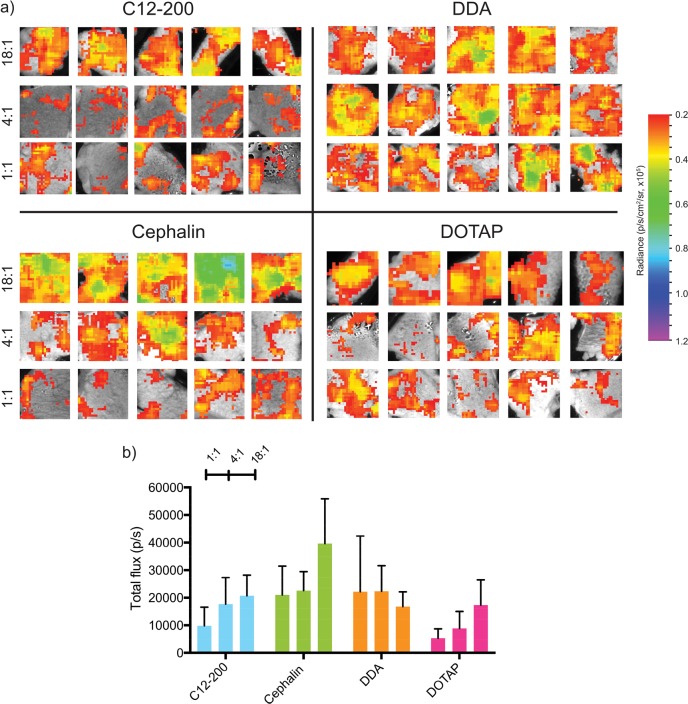
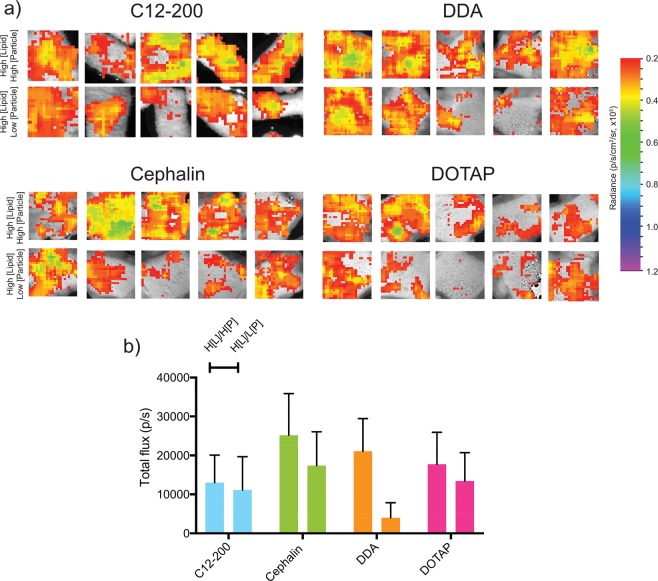
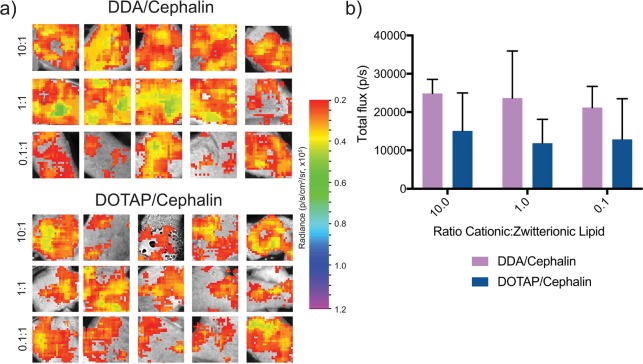
Messenger RNA (mRNA) is a promising tool for biotherapeutics, and self-amplifying mRNA (saRNA) is particularly advantageous, because it results in abundant protein expression and production is easily scalable. While mRNA therapeutics have been shown to be highly effective in small animals, the outcomes do not scale linearly when these formulations are translated to dose-escalation studies in humans. Here, we utilize a design of experiments (DoE) approach to optimize the formulation of saRNA lipid nanoparticles in human skin explants. We first observed that luciferase expression from saRNA peaked after 11 days in human skin. Using DoE inputs of complexing lipid identity, lipid nanoparticle dose, lipid concentration, particle concentration, and ratio of zwitterionic to cationic lipids, we optimized the saRNA-induced luciferase expression in skin explants. Lipid identity and lipid concentration were found to be significant parameters in the DoE model, and the optimized formulation resulted in ∼7-fold increase in luciferase expression, relative to initial 1,2-dioleoyl-3-trimethylammonium-propane (DOTAP) formulation. Using flow cytometry, we observed that optimized formulations delivered the saRNA to ∼2% of the resident cells in the human skin explants. Although immune cells comprise only 7% of the total population of cells in skin, immune cells were found to express ∼50% of the RNA. This study demonstrates the powerful combination of using a DoE approach paired with clinically relevant human skin explants to optimize nucleic acid formulations. We expect that this system will be useful for optimizing both formulation and molecular designs of clinically translational nucleic acid vaccines and therapeutics.
信使 RNA(mRNA)是生物疗法的一种有前途的工具,而自扩增 mRNA(saRNA)尤其有利,因为它可以导致大量蛋白质表达,并且生产很容易规模化。虽然 mRNA 疗法在小动物中已被证明具有很高的疗效,但当这些制剂被转化为人体剂量递增研究时,效果并没有呈线性放大。在这里,我们利用实验设计(DoE)方法来优化 saRNA 脂质纳米粒在人皮肤外植体中的制剂。我们首先观察到 saRNA 在人皮肤中表达的荧光素酶在 11 天后达到峰值。使用 DoE 输入的复杂脂质种类、脂质纳米粒剂量、脂质浓度、颗粒浓度以及两性离子与阳离子脂质的比例,我们优化了皮肤外植体中 saRNA 诱导的荧光素酶表达。脂质种类和脂质浓度被发现是 DoE 模型中的重要参数,优化的制剂使荧光素酶表达相对于初始 1,2-二油酰基-3-三甲基铵丙烷(DOTAP)制剂增加了约 7 倍。通过流式细胞术,我们观察到优化的制剂将 saRNA 递送到人皮肤外植体中约 2%的常驻细胞。尽管免疫细胞仅占皮肤中总细胞数的 7%,但发现免疫细胞表达了约 50%的 RNA。这项研究证明了使用 DoE 方法与临床相关的人皮肤外植体相结合来优化核酸制剂的强大组合。我们预计该系统将有助于优化临床转化核酸疫苗和治疗剂的制剂和分子设计。