School of Health and Related Research, University of Sheffield, Sheffield, UK.
Department of Psychology and Language Sciences, University College London, London, UK.
BMJ Open. 2019 May 1;9(4):e023448. doi: 10.1136/bmjopen-2018-023448.
Brief interventions (BI) for smoking and risky drinking are effective and cost-effective policy approaches to reducing alcohol harm currently used in primary care in England; however, little is known about their contribution to health inequalities. This paper aims to investigate whether self-reported receipt of BI is associated with socioeconomic position (SEP) and whether this differs for smoking or alcohol.
Population survey of 8978 smokers or risky drinkers in England aged 16+ taking part in the Alcohol and Smoking Toolkit Studies.
Survey participants answered questions regarding whether they had received advice and support to cut down their drinking or smoking from a primary healthcare professional in the past 12 months as well as their SEP, demographic details, whether they smoke and their motivation to cut down their smoking and/or drinking. Respondents also completed the Alcohol Use Disorders Identification Test (AUDIT). Smokers were defined as those reporting any smoking in the past year. Risky drinkers were defined as those scoring eight or more on the AUDIT.
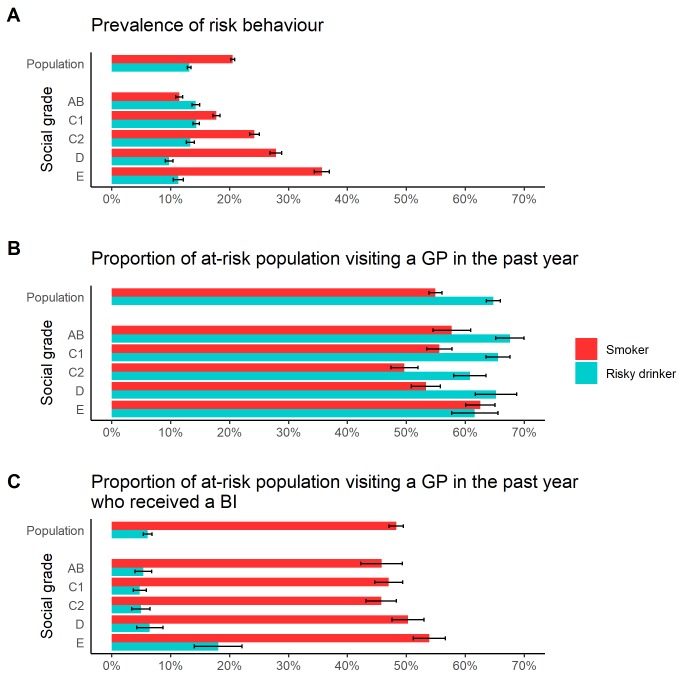
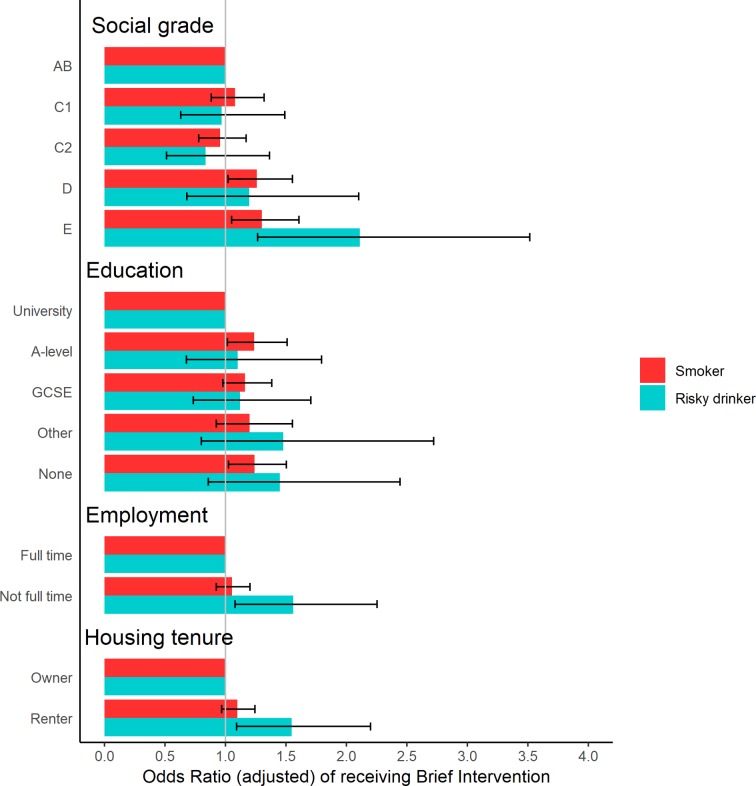
After adjusting for demographic factors and patterns in smoking and drinking, BI delivery was highest in lower socioeconomic groups. Smokers in the lowest social grade had 30% (95% CI 5% to 61%) greater odds of reporting receipt of a BI than those in the highest grade. The relationship for risky drinking appeared stronger, with those in the lowest social grade having 111% (95% CI 27% to 252%) greater odds of reporting BI receipt than the highest grade. Rates of BI delivery were eight times greater among smokers than risky drinkers (48.3% vs 6.1%).
Current delivery of BI for smoking and drinking in primary care in England may be contributing to a reduction in socioeconomic inequalities in health. This effect could be increased if intervention rates, particularly for drinking, were raised.
简短干预(BI)用于吸烟和危险饮酒,是目前在英国初级保健中减少酒精危害的有效且具有成本效益的政策方法;然而,对于其对健康不平等的贡献知之甚少。本文旨在调查自我报告是否接受 BI 与社会经济地位(SEP)相关,以及这是否因吸烟或饮酒而异。
对英格兰 16 岁及以上的 8978 名吸烟者或危险饮酒者进行的人口调查,他们参加了酒精和吸烟工具包研究。
调查参与者回答了他们在过去 12 个月中是否从初级保健专业人员那里获得过减少饮酒或吸烟的建议和支持的问题,以及他们的 SEP、人口统计细节、是否吸烟以及他们减少吸烟和/或饮酒的动机。受访者还完成了酒精使用障碍识别测试(AUDIT)。吸烟者被定义为过去一年中有任何吸烟的人。危险饮酒者被定义为 AUDIT 得分达到 8 分或以上的人。
在调整了人口因素和吸烟与饮酒模式后,BI 的提供率在社会经济地位较低的群体中最高。社会等级最低的吸烟者报告接受 BI 的可能性比社会等级最高的吸烟者高 30%(95%CI 5%至 61%)。对于危险饮酒,这种关系似乎更强,社会等级最低的人报告接受 BI 的可能性比社会等级最高的人高 111%(95%CI 27%至 252%)。与危险饮酒者相比,吸烟者接受 BI 的比率高 8 倍(48.3%比 6.1%)。
英国初级保健中目前针对吸烟和饮酒的 BI 提供可能有助于减少健康方面的社会经济不平等。如果提高干预率,特别是饮酒干预率,这种效果可能会增加。