Orr Michael F, Burduli Ekaterina, Hirchak Katherine A, Walsh Dotson Jo Ann, Young Sara L, Nelson Lonnie, Lennstrom Emma, Slaney Trevor, Bush Terry, Gillaspy Stephen R, Roll John M, Buchwald Dedra, McPherson Sterling M
Elson S. Floyd College of Medicine, Washington State University, Spokane, WA, 99210-1495, USA.
Program of Excellence in Addictions Research (PEAR), Washington State University, Spokane, WA, 99210-1495, USA.
Contemp Clin Trials Commun. 2019 Apr 13;15:100363. doi: 10.1016/j.conctc.2019.100363. eCollection 2019 Sep.
American Indian (AI) and Alaska Native (AN) communities experience disproportionately high rates of tobacco use when compared to the overall U.S. population, especially among rural populations.
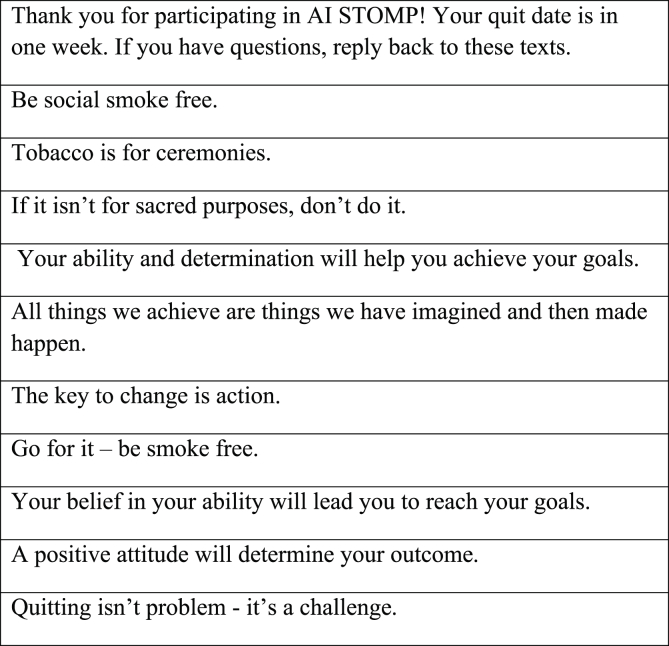
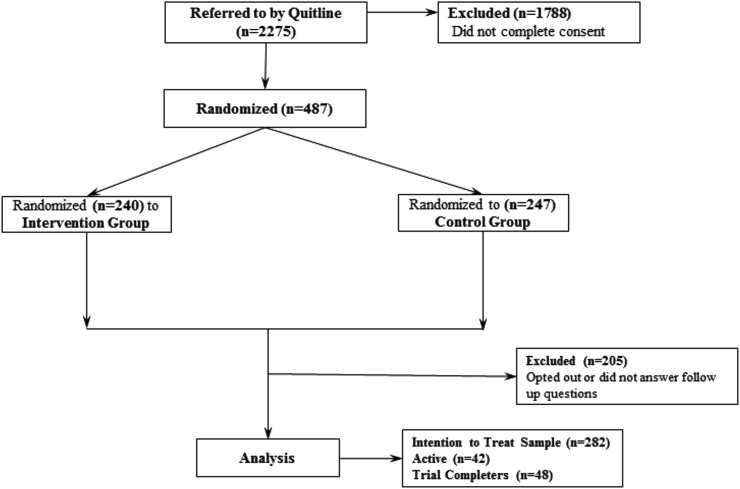
We implemented a single-blind, randomized clinical trial of a text messaging-based smoking cessation intervention through the tobacco quitlines of five states (Alaska, Minnesota, New Mexico, Oklahoma, and Wisconsin) with high percentages of AI residents. We partnered with state quitlines and Optum, a multi-state entity that manages quitlines. Participants who called the quitlines and identified as AI/AN were given the option to enroll in this trial. Upon consent, they were randomly assigned to either the standard quitline program (control) or a program culturally tailored for AI/ANs (intervention), which used a text messaging intervention to encourage smoking cessation. We adapted the text messages based on key informant and focus group input. Baseline data was analyzed for differences across age, sex, and the Fagerström Test for Nicotine Dependence.
We recruited n = 487 AIs into the trial. Participants had an average age of 41.9 years (SD = 11.7) and 66% were female. The average Fagerström Test for Nicotine Dependence score was 5.38 (SD = 2.37). The intervention and control arms did not significantly differ across any of the baseline characteristics.
Implementation of this trial illustrated important lessons in adapting, implementing, and evaluating trials in collaboration with AI communities and local and national organizations. This work will inform future efforts to implement culturally-tailored interventions with AI/ANs and advance our knowledge about adapting and implementing smoking cessation interventions.
与美国总体人口相比,美国印第安人(AI)和阿拉斯加原住民(AN)社区的烟草使用率极高,在农村人口中尤为明显。
我们通过五个拥有高比例AI居民的州(阿拉斯加、明尼苏达、新墨西哥、俄克拉何马和威斯康星)的戒烟热线开展了一项基于短信的戒烟干预单盲随机临床试验。我们与州戒烟热线以及管理戒烟热线的多州实体Optum合作。拨打戒烟热线并自认为是AI/AN的参与者可选择参加本试验。获得同意后,他们被随机分配到标准戒烟热线项目(对照组)或为AI/AN量身定制的项目(干预组),后者采用短信干预来鼓励戒烟。我们根据关键信息提供者和焦点小组的意见对短信进行了调整。对基线数据进行分析,以了解年龄、性别和尼古丁依赖程度弗格斯特罗姆测试之间的差异。
我们招募了n = 487名AI参与试验。参与者的平均年龄为41.9岁(标准差 = 11.7),66%为女性。尼古丁依赖程度弗格斯特罗姆测试的平均得分为5.38(标准差 = 2.37)。干预组和对照组在任何基线特征方面均无显著差异。
本试验的实施为与AI社区以及地方和国家组织合作开展适应性试验、实施试验和评估试验提供了重要经验教训。这项工作将为今后对AI/AN实施文化定制干预的努力提供参考,并增进我们对适应性戒烟干预措施的实施及相关知识的了解。