Department of Clinical Neurosciences, Western General Hospital, Edinburgh, EH4 2XU, Scotland.
Centre for Clinical Brain Sciences, University of Edinburgh, Edinburgh, EH16 4SB, UK.
Curr Oncol Rep. 2019 May 2;21(6):55. doi: 10.1007/s11912-019-0793-3.
Informed consent is the integral part of good medical practice in patients with brain tumours. Capacity to consent may be affected by the brain disorder or its treatment. We intend to draw upon the current neuro-oncology literature to discuss the influence intracranial tumours have upon patients' capacity to consent to treatment and research.
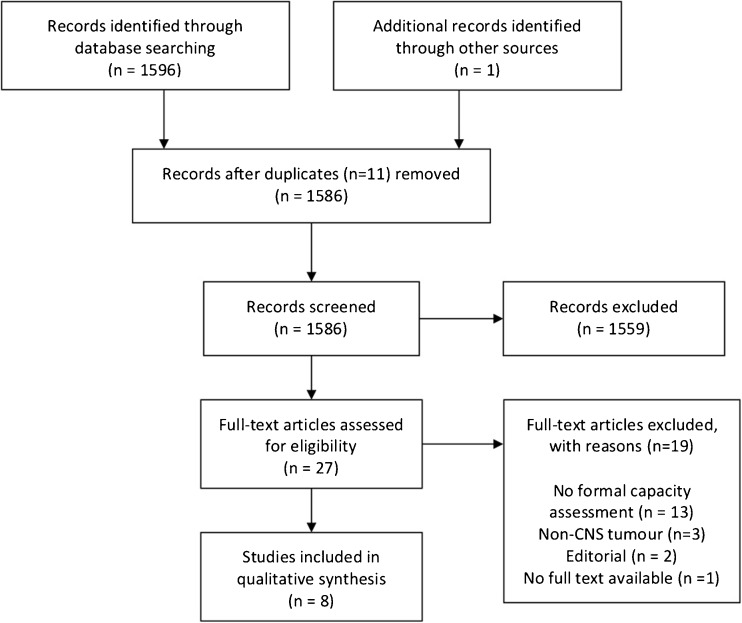
We performed a systematic review of studies of capacity to consent for treatment or research in patients with intracranial tumours. The search retrieved 1597 papers of which 8 were considered eligible for review. Although there are obvious inherent limitations to solely assessing cognition, most research consistently demonstrated increased risk of incapacity in brain tumour patients with cognitive impairment. Specific items in cognitive screening batteries, for example Semantic Verbal Fluency Test (SVFT), Hopkins Verbal Learning Test (HVLT-Recall), and Trail Making Test A/B (TMT), are simple, easily applied tests that may act as significant red flags to identify patients at increased risk of incapacity and who subsequently will require additional cognitive/psychiatric evaluation or more formal tests for capacity to consent for treatment or research.
知情同意是脑肿瘤患者医疗实践的重要组成部分。同意能力可能受到脑部疾病或其治疗的影响。我们旨在参考当前神经肿瘤学文献,讨论颅内肿瘤对患者同意治疗和研究的能力的影响。
我们对颅内肿瘤患者同意治疗或研究的能力的研究进行了系统综述。检索到 1597 篇论文,其中 8 篇被认为符合审查标准。尽管仅评估认知能力存在明显的固有局限性,但大多数研究一致表明,认知障碍的脑肿瘤患者丧失能力的风险增加。认知筛查测试中的特定项目,例如语义流畅性测试(SVFT)、霍普金斯语言学习测试(HVLT-Recall)和连线测试 A/B(TMT),是简单易用的测试,可以作为识别能力丧失风险增加的患者的重要标志,这些患者随后需要进行额外的认知/精神评估或更正式的治疗或研究同意能力测试。