• 文献检索
  • 文档翻译
  • 深度研究
  • 学术资讯
  • Suppr Zotero 插件Zotero 插件
  • 邀请有礼
  • 套餐&价格
  • 历史记录
应用&插件
Suppr Zotero 插件Zotero 插件浏览器插件Mac 客户端Windows 客户端微信小程序
定价
高级版会员购买积分包购买API积分包
服务
文献检索文档翻译深度研究API 文档MCP 服务
关于我们
关于 Suppr公司介绍联系我们用户协议隐私条款
关注我们

Suppr 超能文献

核心技术专利:CN118964589B侵权必究
粤ICP备2023148730 号-1Suppr @ 2026

文献检索

告别复杂PubMed语法,用中文像聊天一样搜索,搜遍4000万医学文献。AI智能推荐,让科研检索更轻松。

立即免费搜索

文件翻译

保留排版,准确专业,支持PDF/Word/PPT等文件格式,支持 12+语言互译。

免费翻译文档

深度研究

AI帮你快速写综述,25分钟生成高质量综述,智能提取关键信息,辅助科研写作。

立即免费体验

肿瘤细胞衍生的补体成分C1r和C1s促进皮肤鳞状细胞癌的生长。

Tumour-cell-derived complement components C1r and C1s promote growth of cutaneous squamous cell carcinoma.

作者信息

Riihilä P, Viiklepp K, Nissinen L, Farshchian M, Kallajoki M, Kivisaari A, Meri S, Peltonen J, Peltonen S, Kähäri V-M

机构信息

Department of Dermatology, University of Turku and Turku University Hospital, Hämeentie 11 TE6, FI-20520, Turku, Finland.

MediCity Research Laboratory, University of Turku, Turku, Finland.

出版信息

Br J Dermatol. 2020 Mar;182(3):658-670. doi: 10.1111/bjd.18095. Epub 2019 Jul 28.

DOI:10.1111/bjd.18095
PMID:31049937
原文链接:https://pmc.ncbi.nlm.nih.gov/articles/PMC7065064/
Abstract

BACKGROUND

The incidence of epidermal keratinocyte-derived cutaneous squamous cell carcinoma (cSCC) is increasing worldwide.

OBJECTIVES

To study the role of the complement classical pathway components C1q, C1r and C1s in the progression of cSCC.

METHODS

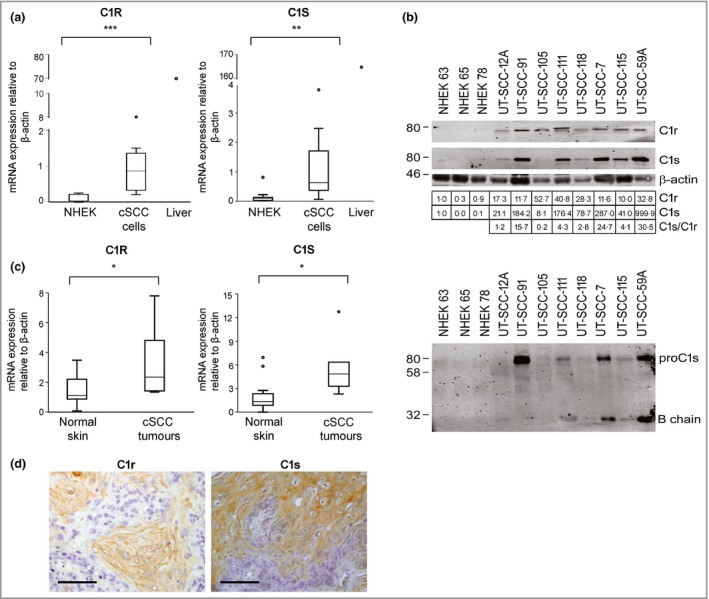
The mRNA levels of C1Q subunits and C1R and C1S in cSCC cell lines, normal human epidermal keratinocytes, cSCC tumours in vivo and normal skin were analysed with quantitative real-time polymerase chain reaction. The production of C1r and C1s was determined with Western blotting. The expression of C1r and C1s in tissue samples in vivo was analysed with immunohistochemistry and further investigated in human cSCC xenografts by knocking down C1r and C1s.

RESULTS

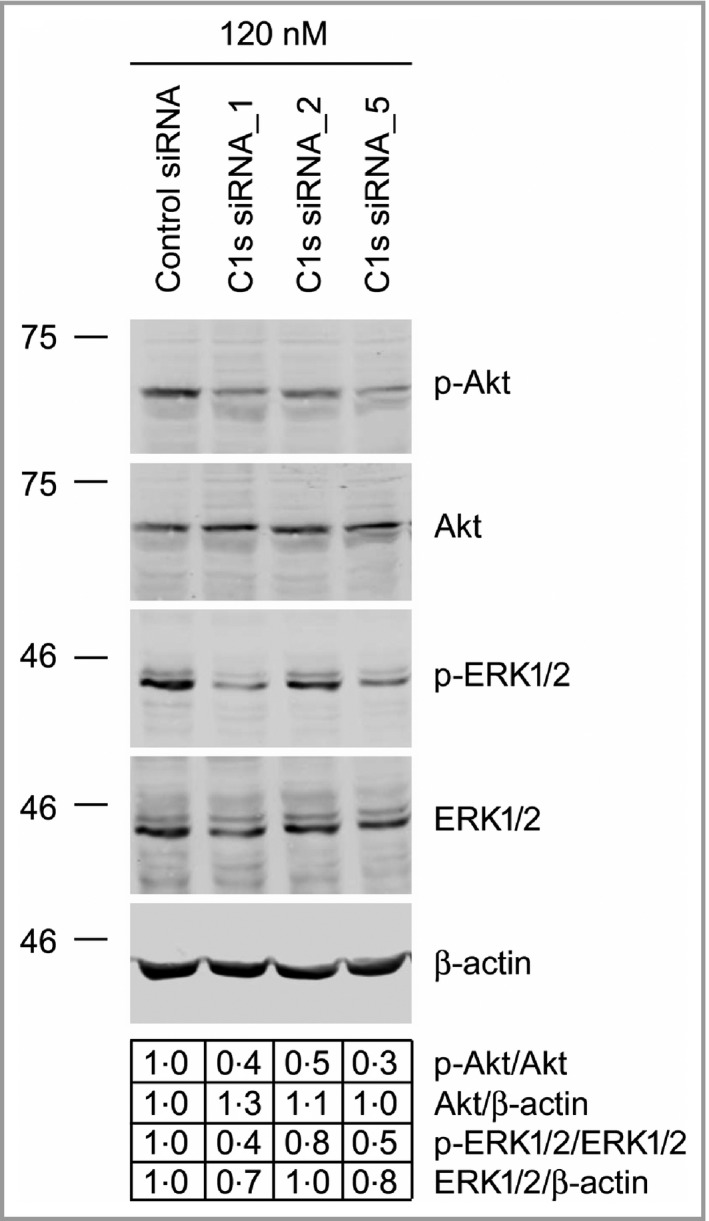
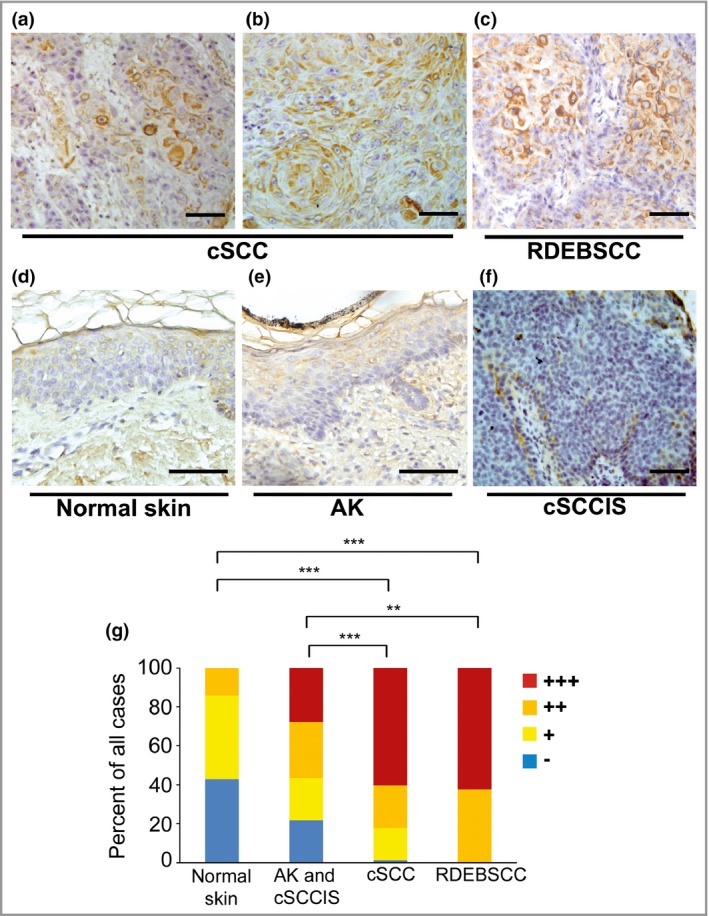
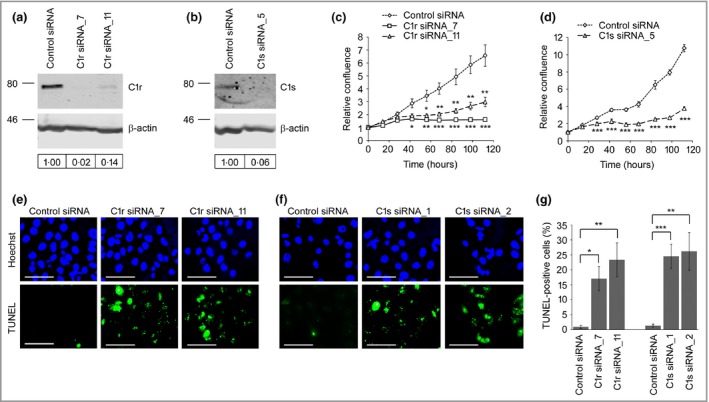
Significantly elevated C1R and C1S mRNA levels and production of C1r and C1s were detected in cSCC cells, compared with normal human epidermal keratinocytes. The mRNA levels of C1R and C1S were markedly elevated in cSCC tumours in vivo compared with normal skin. Abundant expression of C1r and C1s by tumour cells was detected in invasive sporadic cSCCs and recessive dystrophic epidermolysis bullosa-associated cSCCs, whereas the expression of C1r and C1s was lower in cSCC in situ, actinic keratosis and normal skin. Knockdown of C1r and C1s expression in cSCC cells inhibited activation of extracellular signal-related kinase 1/2 and Akt, promoted apoptosis of cSCC cells and significantly suppressed growth and vascularization of human cSCC xenograft tumours in vivo.

CONCLUSIONS

These results provide evidence for the role of tumour-cell-derived C1r and C1s in the progression of cSCC and identify them as biomarkers and putative therapeutic targets in cSCC. What's already known about this topic? The incidences of actinic keratosis, cutaneous squamous cell carcinoma (cSCC) in situ and invasive cSCC are increasing globally. Few specific biomarkers for progression of cSCC have been identified, and no biological markers are in clinical use to predict the aggressiveness of actinic keratosis, cSCC in situ and invasive cSCC. What does this study add? Our results provide novel evidence for the role of complement classical pathway components C1r and C1s in the progression of cSCC. What is the translational message? Our results identify complement classical pathway components C1r and C1s as biomarkers and putative therapeutic targets in cSCC.

摘要

背景

表皮角质形成细胞来源的皮肤鳞状细胞癌(cSCC)的发病率在全球范围内呈上升趋势。

目的

研究补体经典途径成分C1q、C1r和C1s在cSCC进展中的作用。

方法

采用定量实时聚合酶链反应分析cSCC细胞系、正常人表皮角质形成细胞、体内cSCC肿瘤及正常皮肤中C1Q亚基、C1R和C1S的mRNA水平。用蛋白质免疫印迹法测定C1r和C1s的产生。用免疫组织化学法分析体内组织样本中C1r和C1s的表达,并通过敲低C1r和C1s在人cSCC异种移植瘤中进一步研究。

结果

与正常人表皮角质形成细胞相比,在cSCC细胞中检测到C1R和C1S mRNA水平显著升高,且C1r和C1s产生增加。与正常皮肤相比,体内cSCC肿瘤中C1R和C1S的mRNA水平明显升高。在侵袭性散发性cSCC和隐性营养不良性大疱性表皮松解症相关的cSCC中检测到肿瘤细胞大量表达C1r和C1s,而原位cSCC、光化性角化病和正常皮肤中C1r和C1s的表达较低。敲低cSCC细胞中C1r和C1s的表达可抑制细胞外信号调节激酶1/2和Akt的激活,促进cSCC细胞凋亡,并显著抑制体内人cSCC异种移植瘤的生长和血管生成。

结论

这些结果为肿瘤细胞来源的C1r和C1s在cSCC进展中的作用提供了证据,并将它们鉴定为cSCC的生物标志物和潜在治疗靶点。关于该主题已知的信息有哪些?光化性角化病、原位皮肤鳞状细胞癌(cSCC)和侵袭性cSCC的发病率在全球范围内都在增加。已鉴定出的用于cSCC进展的特异性生物标志物很少,且尚无生物标志物用于临床预测光化性角化病、原位cSCC和侵袭性cSCC的侵袭性。本研究增加了什么?我们的结果为补体经典途径成分C1r和C1s在cSCC进展中的作用提供了新的证据。转化信息是什么?我们的结果将补体经典途径成分C1r和C1s鉴定为cSCC的生物标志物和潜在治疗靶点。
https://cdn.ncbi.nlm.nih.gov/pmc/blobs/becb/7065064/fed5aa057e66/BJD-182-658-g009.jpg
https://cdn.ncbi.nlm.nih.gov/pmc/blobs/becb/7065064/e44b5183fc04/BJD-182-658-g001.jpg
https://cdn.ncbi.nlm.nih.gov/pmc/blobs/becb/7065064/33e6fcb9877d/BJD-182-658-g002.jpg
https://cdn.ncbi.nlm.nih.gov/pmc/blobs/becb/7065064/2428d3e3b9ae/BJD-182-658-g003.jpg
https://cdn.ncbi.nlm.nih.gov/pmc/blobs/becb/7065064/78bbad39f0c4/BJD-182-658-g004.jpg
https://cdn.ncbi.nlm.nih.gov/pmc/blobs/becb/7065064/f58fe5902296/BJD-182-658-g005.jpg
https://cdn.ncbi.nlm.nih.gov/pmc/blobs/becb/7065064/af0858357e88/BJD-182-658-g006.jpg
https://cdn.ncbi.nlm.nih.gov/pmc/blobs/becb/7065064/959186f2ed52/BJD-182-658-g007.jpg
https://cdn.ncbi.nlm.nih.gov/pmc/blobs/becb/7065064/7cbf3f993978/BJD-182-658-g008.jpg
https://cdn.ncbi.nlm.nih.gov/pmc/blobs/becb/7065064/fed5aa057e66/BJD-182-658-g009.jpg
https://cdn.ncbi.nlm.nih.gov/pmc/blobs/becb/7065064/e44b5183fc04/BJD-182-658-g001.jpg
https://cdn.ncbi.nlm.nih.gov/pmc/blobs/becb/7065064/33e6fcb9877d/BJD-182-658-g002.jpg
https://cdn.ncbi.nlm.nih.gov/pmc/blobs/becb/7065064/2428d3e3b9ae/BJD-182-658-g003.jpg
https://cdn.ncbi.nlm.nih.gov/pmc/blobs/becb/7065064/78bbad39f0c4/BJD-182-658-g004.jpg
https://cdn.ncbi.nlm.nih.gov/pmc/blobs/becb/7065064/f58fe5902296/BJD-182-658-g005.jpg
https://cdn.ncbi.nlm.nih.gov/pmc/blobs/becb/7065064/af0858357e88/BJD-182-658-g006.jpg
https://cdn.ncbi.nlm.nih.gov/pmc/blobs/becb/7065064/959186f2ed52/BJD-182-658-g007.jpg
https://cdn.ncbi.nlm.nih.gov/pmc/blobs/becb/7065064/7cbf3f993978/BJD-182-658-g008.jpg
https://cdn.ncbi.nlm.nih.gov/pmc/blobs/becb/7065064/fed5aa057e66/BJD-182-658-g009.jpg

相似文献

1
Tumour-cell-derived complement components C1r and C1s promote growth of cutaneous squamous cell carcinoma.肿瘤细胞衍生的补体成分C1r和C1s促进皮肤鳞状细胞癌的生长。
Br J Dermatol. 2020 Mar;182(3):658-670. doi: 10.1111/bjd.18095. Epub 2019 Jul 28.
2
C1s targeting antibodies inhibit the growth of cutaneous squamous carcinoma cells.靶向 C1s 的抗体抑制皮肤鳞状细胞癌细胞的生长。
Sci Rep. 2024 Jun 12;14(1):13465. doi: 10.1038/s41598-024-64088-3.
3
Tumor cell-specific AIM2 regulates growth and invasion of cutaneous squamous cell carcinoma.肿瘤细胞特异性AIM2调节皮肤鳞状细胞癌的生长和侵袭。
Oncotarget. 2017 Jul 11;8(28):45825-45836. doi: 10.18632/oncotarget.17573.
4
Complement factor H: a biomarker for progression of cutaneous squamous cell carcinoma.补体因子 H:皮肤鳞状细胞癌进展的生物标志物。
J Invest Dermatol. 2014 Feb;134(2):498-506. doi: 10.1038/jid.2013.346. Epub 2013 Aug 12.
5
Complement Component C3 and Complement Factor B Promote Growth of Cutaneous Squamous Cell Carcinoma.补体成分 C3 和补体因子 B 促进皮肤鳞状细胞癌的生长。
Am J Pathol. 2017 May;187(5):1186-1197. doi: 10.1016/j.ajpath.2017.01.006. Epub 2017 Mar 17.
6
Complement factor I promotes progression of cutaneous squamous cell carcinoma.补体因子 I 促进皮肤鳞状细胞癌的进展。
J Invest Dermatol. 2015 Feb;135(2):579-588. doi: 10.1038/jid.2014.376. Epub 2014 Sep 3.
7
Gene expression landscape of cutaneous squamous cell carcinoma progression.皮肤鳞状细胞癌进展的基因表达图谱
Br J Dermatol. 2024 Oct 17;191(5):760-774. doi: 10.1093/bjd/ljae249.
8
Complement Factor D Is a Novel Biomarker and Putative Therapeutic Target in Cutaneous Squamous Cell Carcinoma.补体因子D是皮肤鳞状细胞癌中的一种新型生物标志物和潜在治疗靶点。
Cancers (Basel). 2022 Jan 8;14(2):305. doi: 10.3390/cancers14020305.
9
C1r Upregulates Production of Matrix Metalloproteinase-13 and Promotes Invasion of Cutaneous Squamous Cell Carcinoma.补体1r上调基质金属蛋白酶-13的产生并促进皮肤鳞状细胞癌的侵袭。
J Invest Dermatol. 2022 May;142(5):1478-1488.e9. doi: 10.1016/j.jid.2021.10.008. Epub 2021 Oct 28.
10
New perspectives on role of tumor microenvironment in progression of cutaneous squamous cell carcinoma.肿瘤微环境在皮肤鳞状细胞癌进展中作用的新视角
Cell Tissue Res. 2016 Sep;365(3):691-702. doi: 10.1007/s00441-016-2457-z. Epub 2016 Jul 14.

引用本文的文献

1
Proteomic and metabolomic analysis of platelet related samples reveals energy metabolism disorders in hepatocellular carcinoma.血小板相关样本的蛋白质组学和代谢组学分析揭示了肝细胞癌中的能量代谢紊乱。
J Transl Med. 2025 Jun 13;23(1):654. doi: 10.1186/s12967-025-06694-x.
2
Current and Emerging Insights into the Causes, Immunopathogenesis, and Treatment of Cutaneous Squamous Cell Carcinoma.皮肤鳞状细胞癌病因、免疫发病机制及治疗的最新与新见解
Cancers (Basel). 2025 May 19;17(10):1702. doi: 10.3390/cancers17101702.
3
Non-canonical extracellular complement pathways and the complosome paradigm in cancer: a scoping review.

本文引用的文献

1
Matrix metalloproteinase 9 inhibits the motility of highly aggressive HSC-3 oral squamous cell carcinoma cells.基质金属蛋白酶 9 抑制高度侵袭性 HSC-3 口腔鳞状细胞癌细胞的迁移运动能力。
Exp Cell Res. 2019 Mar 1;376(1):18-26. doi: 10.1016/j.yexcr.2019.01.018. Epub 2019 Jan 30.
2
Update on Keratinocyte Carcinomas.皮肤角质形成细胞癌的最新进展
N Engl J Med. 2018 Jul 26;379(4):363-374. doi: 10.1056/NEJMra1708701.
3
PD-1 Blockade with Cemiplimab in Advanced Cutaneous Squamous-Cell Carcinoma.西妥昔单抗联合 PD-1 抑制剂治疗晚期皮肤鳞状细胞癌的疗效和安全性
癌症中的非经典细胞外补体途径与补体体范式:一项范围综述
Front Immunol. 2025 Apr 30;16:1519465. doi: 10.3389/fimmu.2025.1519465. eCollection 2025.
4
PD-L1 Inhibitor Cosibelimab for Cutaneous Squamous Cell Carcinoma: Comprehensive Evaluation of Efficacy, Mechanism, and Clinical Trial Insights.用于皮肤鳞状细胞癌的程序性死亡受体配体1(PD-L1)抑制剂科斯贝利单抗:疗效、机制及临床试验见解的综合评估
Biomedicines. 2025 Apr 7;13(4):889. doi: 10.3390/biomedicines13040889.
5
C5aR1 Promotes Invasion, Metastasis, and Poor Prognosis in Cutaneous Squamous Cell Carcinoma.C5aR1促进皮肤鳞状细胞癌的侵袭、转移及预后不良。
Am J Pathol. 2025 Jun;195(6):1158-1171. doi: 10.1016/j.ajpath.2025.02.004. Epub 2025 Mar 6.
6
From actinic keratosis to cutaneous squamous cell carcinoma: the key pathogenesis and treatments.从光化性角化病到皮肤鳞状细胞癌:关键发病机制与治疗方法
Front Immunol. 2025 Jan 24;16:1518633. doi: 10.3389/fimmu.2025.1518633. eCollection 2025.
7
Cutaneous Oncology: Strategies for Melanoma Prevention, Diagnosis, and Therapy.皮肤肿瘤学:黑色素瘤预防、诊断和治疗策略。
Cancer Control. 2024 Jan-Dec;31:10732748241274978. doi: 10.1177/10732748241274978.
8
The expression and biological role of complement C1s in esophageal squamous cell carcinoma.补体C1s在食管鳞状细胞癌中的表达及生物学作用
Open Life Sci. 2024 Jul 24;19(1):20220915. doi: 10.1515/biol-2022-0915. eCollection 2024.
9
Biomarkers in Cutaneous Keratinocyte Carcinomas.皮肤角质形成细胞癌中的生物标志物
Dermatol Ther (Heidelb). 2024 Aug;14(8):2039-2058. doi: 10.1007/s13555-024-01233-w. Epub 2024 Jul 20.
10
C1s targeting antibodies inhibit the growth of cutaneous squamous carcinoma cells.靶向 C1s 的抗体抑制皮肤鳞状细胞癌细胞的生长。
Sci Rep. 2024 Jun 12;14(1):13465. doi: 10.1038/s41598-024-64088-3.
N Engl J Med. 2018 Jul 26;379(4):341-351. doi: 10.1056/NEJMoa1805131. Epub 2018 Jun 4.
4
A novel multiplex detection array revealed systemic complement activation in oral squamous cell carcinoma.一种新型多重检测阵列揭示了口腔鳞状细胞癌中的全身补体激活。
Oncotarget. 2017 Dec 6;9(3):3001-3013. doi: 10.18632/oncotarget.22963. eCollection 2018 Jan 9.
5
Cutaneous squamous cell carcinoma: Incidence, risk factors, diagnosis, and staging.皮肤鳞状细胞癌:发病率、危险因素、诊断和分期。
J Am Acad Dermatol. 2018 Feb;78(2):237-247. doi: 10.1016/j.jaad.2017.08.059.
6
Structure of the C1r-C1s interaction of the C1 complex of complement activation.补体激活物 C1 复合物中 C1r-C1s 相互作用的结构。
Proc Natl Acad Sci U S A. 2018 Jan 23;115(4):768-773. doi: 10.1073/pnas.1718709115. Epub 2018 Jan 8.
7
Novel mechanisms and functions of complement.补体的新机制与功能
Nat Immunol. 2017 Nov 16;18(12):1288-1298. doi: 10.1038/ni.3858.
8
Expanding horizons in complement drug discovery: challenges and emerging strategies.拓展补体药物研发的视野:挑战与新兴策略。
Semin Immunopathol. 2018 Jan;40(1):125-140. doi: 10.1007/s00281-017-0655-8. Epub 2017 Oct 6.
9
Complement in cancer: untangling an intricate relationship.补体系统在癌症中的作用:揭示复杂关系。
Nat Rev Immunol. 2018 Jan;18(1):5-18. doi: 10.1038/nri.2017.97. Epub 2017 Sep 18.
10
Complement Component C3 and Complement Factor B Promote Growth of Cutaneous Squamous Cell Carcinoma.补体成分 C3 和补体因子 B 促进皮肤鳞状细胞癌的生长。
Am J Pathol. 2017 May;187(5):1186-1197. doi: 10.1016/j.ajpath.2017.01.006. Epub 2017 Mar 17.