Department of Veterinary Tropical Diseases, Faculty of Veterinary Science, University of Pretoria, Onderstepoort, Gauteng, South Africa.
College of Public Health, Medical and Veterinary Sciences, James Cook University, Townsville, Queensland, Australia.
PLoS Negl Trop Dis. 2019 May 3;13(5):e0007296. doi: 10.1371/journal.pntd.0007296. eCollection 2019 May.
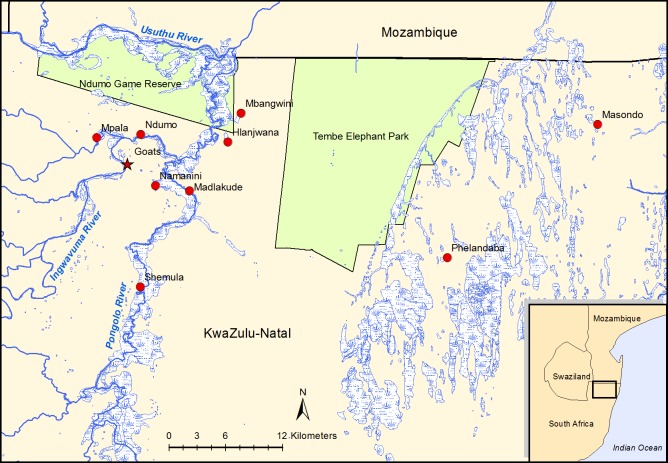
Rift Valley fever (RVF) is a mosquito-borne zoonotic disease characterized in South Africa by large epidemics amongst ruminant livestock at very long, irregular intervals, mainly in the central interior. However, the presence and patterns of occurrence of the virus in the eastern parts of the country are poorly known. This study aimed to detect the presence of RVF virus (RVFV) in cattle and goats in far northern KwaZulu-Natal province and to estimate the prevalence of antibodies to the virus and the incidence rate of seroconversion.
Cross-sectional studies were performed in communally farmed cattle (n = 423) and goats (n = 104), followed by longitudinal follow-up of seronegative livestock (n = 253) 14 times over 24 months, representing 160.3 animal-years at risk. Exposure to RVFV was assessed using an IgG sandwich ELISA and a serum neutralization test (SNT) and seroconversion was assessed using SNT. Incidence density was estimated and compared using multivariable Poisson models and hazard of seroconversion was estimated over time.
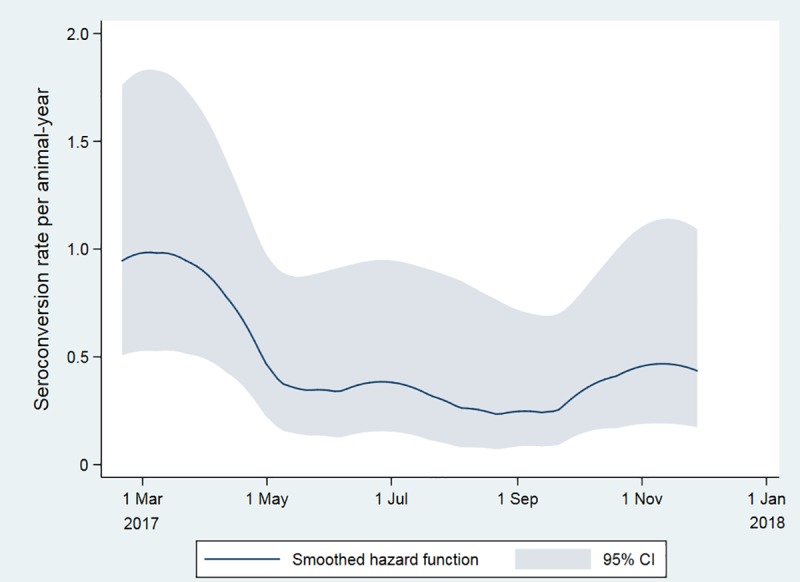
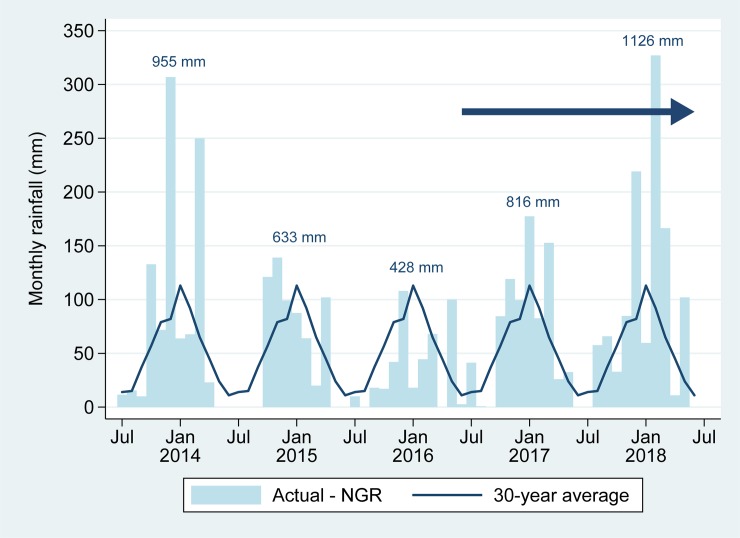
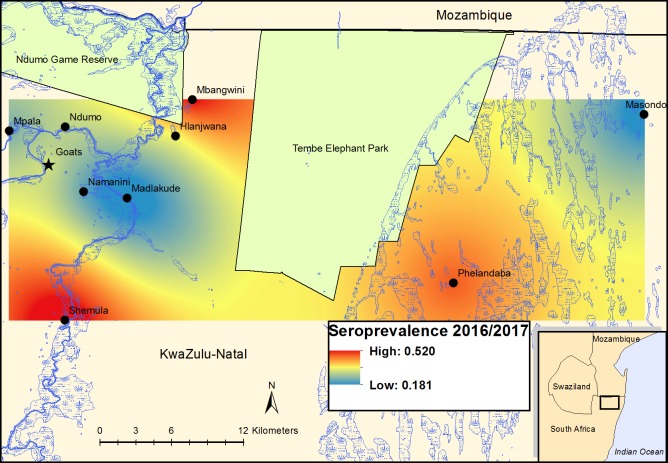
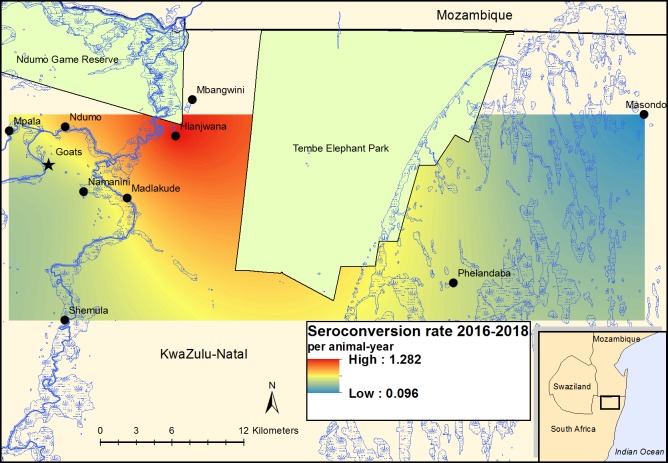
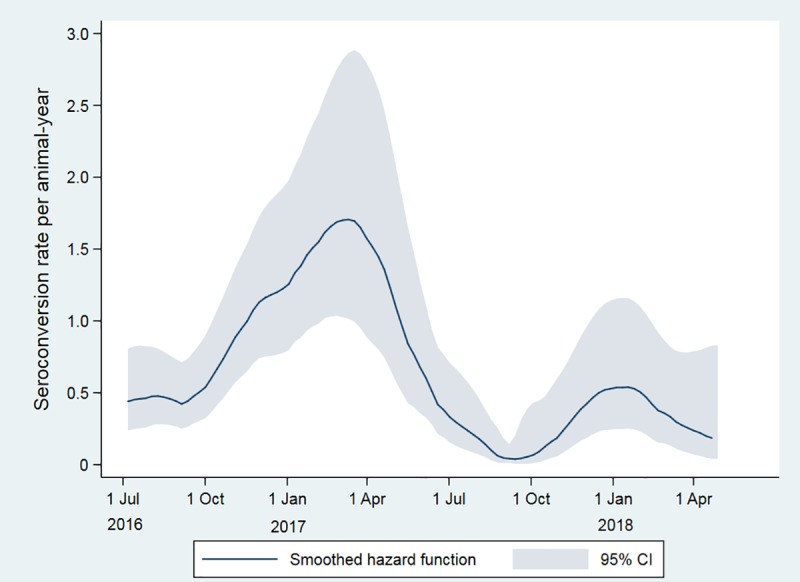
Initial overall seroprevalence was 34.0% (95%CI: 29.5-38.8%) in cattle and 31.7% (95%CI: 22.9-41.6%) in goats, varying by locality from 18-54%. Seroconversions to RVFV based on SNT were detected throughout the year, with the incidence rate peaking during the high rainfall months of January to March, and differed considerably between years. Overall seroconversion rate in cattle was 0.59 per animal-year (95% CI: 0.46-0.75) and in goats it was 0.41 per animal-year (95% CI: 0.25-0.64), varying significantly over short distances.
CONCLUSIONS/SIGNIFICANCE: The high seroprevalence in all age groups and evidence of year-round viral circulation provide evidence for a hyperendemic situation in the study area. This is the first study to directly estimate infection rate of RVFV in livestock in an endemic area in the absence of reported outbreaks and provides the basis for further investigation of factors affecting viral circulation and mechanisms for virus survival during interepidemic periods.
裂谷热(RVF)是一种由蚊子传播的人畜共患病,在南非,反刍动物牲畜每隔很长时间、间隔不规则地发生大流行,主要发生在中部内陆地区。然而,该国东部地区病毒的存在和发生模式知之甚少。本研究旨在检测北夸祖鲁-纳塔尔省偏远地区牛和山羊中裂谷热病毒(RVFV)的存在,并估计针对该病毒的抗体流行率和血清转化率。
对社区养殖的牛(n=423)和山羊(n=104)进行横断面研究,然后对 24 个月内 14 次的 253 头血清阴性牲畜进行纵向随访,共涉及 160.3 个动物年的风险。使用 IgG 夹心 ELISA 和血清中和试验(SNT)评估 RVFV 的暴露情况,使用 SNT 评估血清转化率。使用多变量泊松模型估计并比较发病率密度,并随着时间的推移估计血清转化率的风险。
牛的总体初始血清阳性率为 34.0%(95%CI:29.5-38.8%),山羊为 31.7%(95%CI:22.9-41.6%),不同地区的血清阳性率为 18-54%。基于 SNT 的 RVFV 血清转化率全年均可检测到,发病率峰值出现在高降雨月份的 1 月至 3 月,且各年差异较大。牛的总体血清转化率为 0.59 动物年-1(95%CI:0.46-0.75),山羊为 0.41 动物年-1(95%CI:0.25-0.64),短距离差异显著。
结论/意义:所有年龄段的高血清阳性率以及全年病毒循环的证据表明,研究区域存在高度地方性流行。这是在没有报告暴发的情况下首次直接估计流行地区牲畜 RVFV 感染率的研究,并为进一步调查影响病毒循环的因素和病毒在流行间歇期存活的机制提供了基础。