Gerken Keli Nicole, Ndenga Bryson Alberto, Owuor Kevin Omondi, Winter Christabel Achieng, Seetah Krish, LaBeaud Angelle Desiree
Department of Pediatrics, Division of Infectious Disease, Stanford University School of Medicine, Stanford, CA, USA.
Centre for Global Health Research, Kenya Medical Research Institute, Kisumu, Kenya.
One Health. 2022 Nov 14;15:100457. doi: 10.1016/j.onehlt.2022.100457. eCollection 2022 Dec.
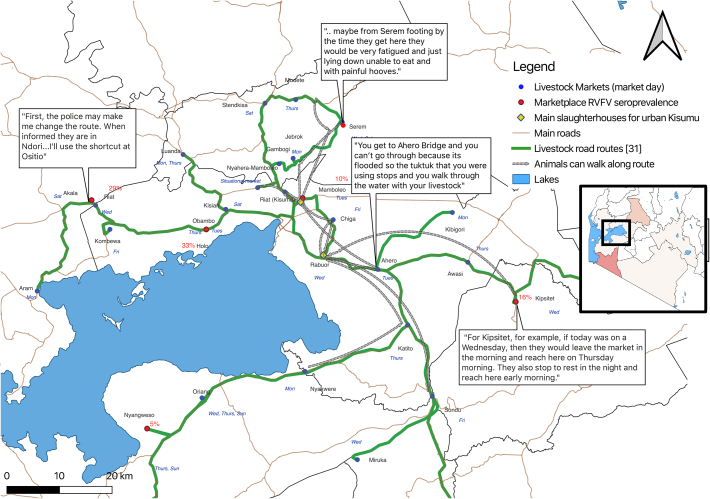
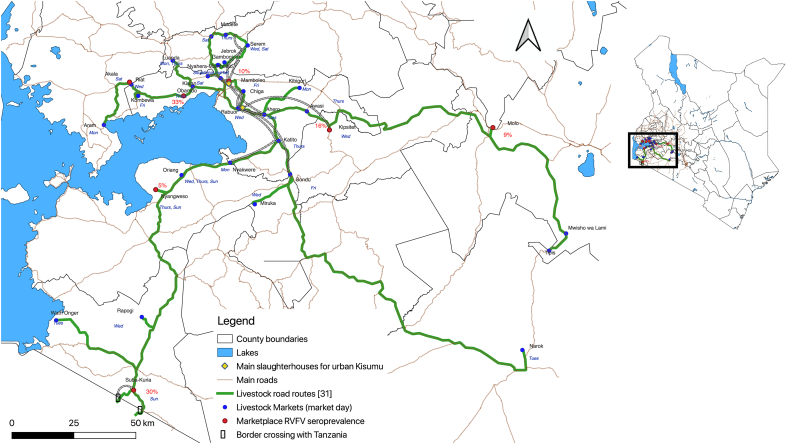
Rift Valley fever virus (RVFV) is an economically devastating, zoonotic arbovirus endemic across Africa with potential to cause severe disease in livestock and humans. Viral spread is primarily driven by movement of domestic ruminants and there is a high potential for transboundary spread. Despite influx of livestock to urban areas in response to the high demand for meat and animal products, RVFV has not been detected in any urban center. The objectives of this study were to determine the feasibility of assessing risk of RVFV introduction to urban Kisumu, Kenya, by testing slaughtered livestock for RVFV exposure and mapping livestock origins. Blood was collected from cattle, sheep, and goats directly after slaughter and tested for anti-RVFV IgG antibodies. Slaughterhouse businessmen responded to a questionnaire on their individual animals' origin, marketplace, and transport means. Thereafter, we mapped livestock flow from origin to slaughterhouse using participatory methods in focus group discussions with stakeholders. Qualitative data on route choice and deviations were spatially integrated into the map. A total of 304 blood samples were collected from slaughtered livestock in October and November 2021. Most (99%) of animals were purchased from 28 different markets across eight counties in Western Kenya. The overall RVFV seroprevalence was 9% (19% cattle, 3% in sheep, and 7% in goats). Migori County bordering Tanzania had the highest county-level seroprevalence (34%) and 80% of all seropositive cattle were purchased at the Suba Kuria market in Migori County. Road quality and animal health influenced stakeholders' decisions for choice of transport means. Overall, this proof-of-concept study offers a sampling framework for RVFV that can be locally implemented and rapidly deployed in response to regional risk. This system can be used in conjunction with participatory maps to improve active livestock surveillance and monitoring of RVFV in Western Kenya, and these methods could be extrapolated to other urban centers or livestock diseases.
裂谷热病毒(RVFV)是一种对经济具有毁灭性影响的人畜共患虫媒病毒,在非洲各地流行,有可能在牲畜和人类中引发严重疾病。病毒传播主要由家养反刍动物的移动驱动,存在很高的跨境传播潜力。尽管为满足对肉类和动物产品的高需求,牲畜涌入城市地区,但尚未在任何城市中心检测到RVFV。本研究的目的是通过检测屠宰牲畜的RVFV暴露情况并绘制牲畜来源地图,确定评估肯尼亚基苏木市引入RVFV风险的可行性。在牲畜屠宰后立即采集牛、羊和山羊的血液,检测抗RVFV IgG抗体。屠宰场商人回答了一份关于其个体动物来源、市场和运输方式的问卷。此后,我们在与利益相关者的焦点小组讨论中使用参与式方法绘制了从来源地到屠宰场的牲畜流动图。关于路线选择和偏差的定性数据被空间整合到地图中。2021年10月和11月,共从屠宰牲畜中采集了304份血样。大多数(99%)动物是从肯尼亚西部八个县的28个不同市场购买的。RVFV总体血清阳性率为9%(牛为19%,绵羊为3%,山羊为7%)。与坦桑尼亚接壤的米戈里县县级血清阳性率最高(34%),所有血清阳性牛中有80%是在米戈里县的苏巴库里亚市场购买的。道路质量和动物健康影响了利益相关者对运输方式的选择。总体而言,这项概念验证研究为RVFV提供了一个抽样框架,可在当地实施并根据区域风险迅速部署。该系统可与参与式地图结合使用,以改善肯尼亚西部对RVFV的活跃牲畜监测,这些方法可推广到其他城市中心或牲畜疾病。