Comparative and Experimental Medicine, College of Veterinary Medicine, The University of Tennessee, 2407 River Drive, Knoxville, TN, 37996, USA.
Department of Geography, The University of Tennessee, 2407 River Drive, Knoxville, TN, 37996, USA.
BMC Public Health. 2019 May 3;19(1):505. doi: 10.1186/s12889-019-6850-x.
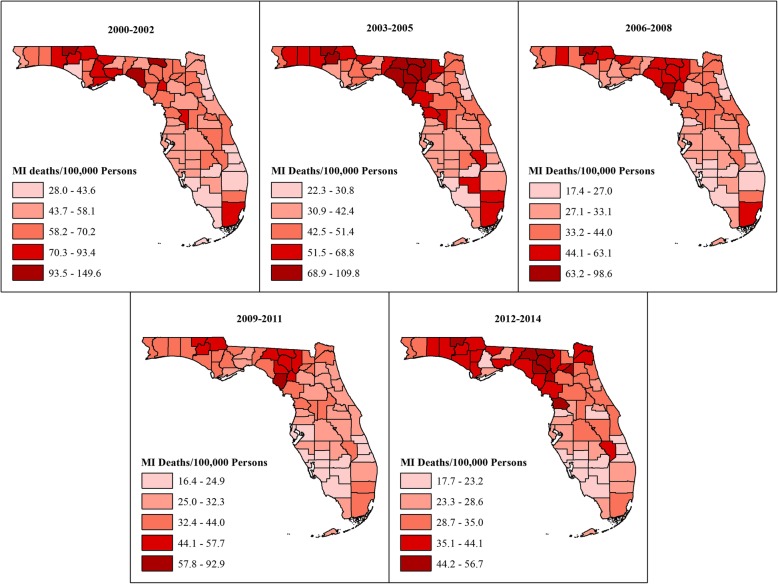
Identifying disparities in myocardial infarction (MI) burden and assessing its temporal changes are critical for guiding resource allocation and policies geared towards reducing/eliminating health disparities. Our objectives were to: (a) investigate the spatial distribution and clusters of MI mortality risk in Florida; and (b) assess temporal changes in geographic disparities in MI mortality risks in Florida from 2000 to 2014.
This is a retrospective ecologic study with county as the spatial unit of analysis. We obtained data for MI deaths occurring among Florida residents between 2000 and 2014 from the Florida Department of Health, and calculated county-level age-adjusted MI mortality risks and Spatial Empirical Bayesian smoothed MI mortality risks. We used Kulldorff's circular spatial scan statistics and Tango's flexible spatial scan statistics to identify spatial clusters.
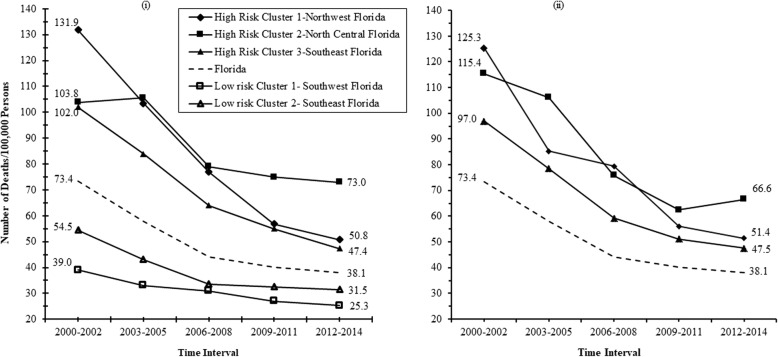
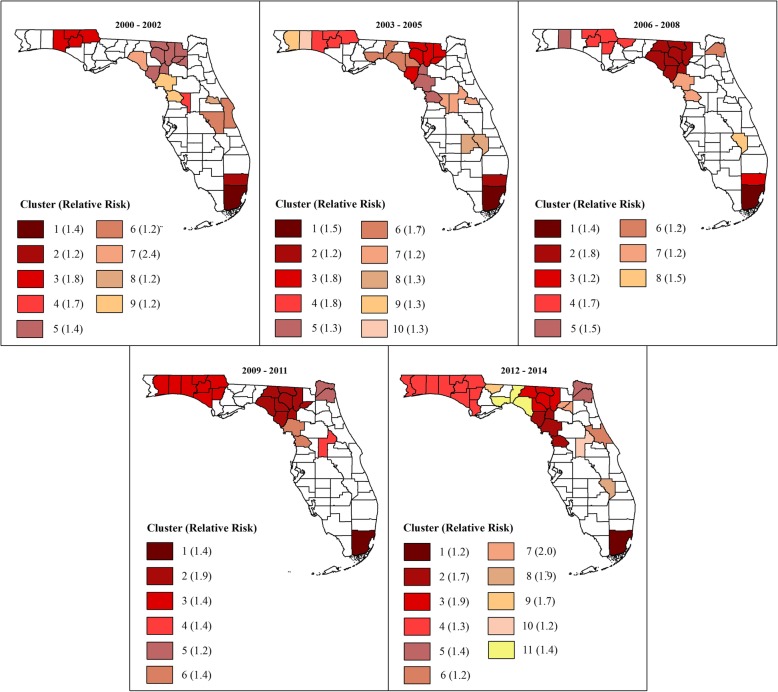
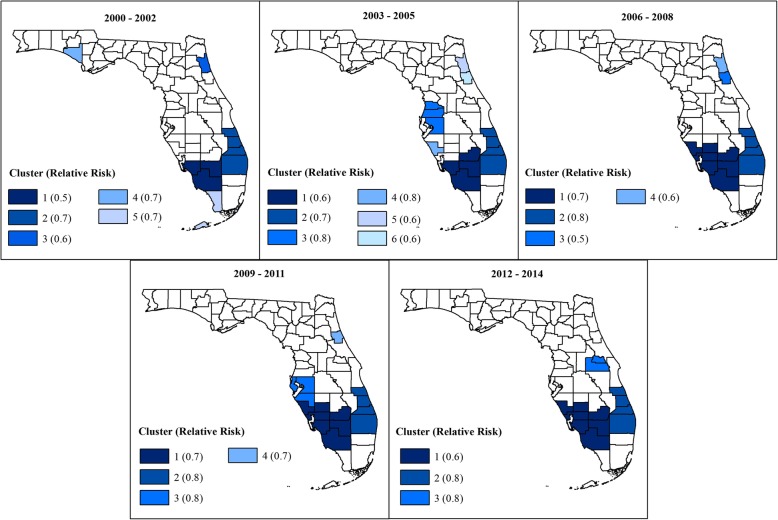
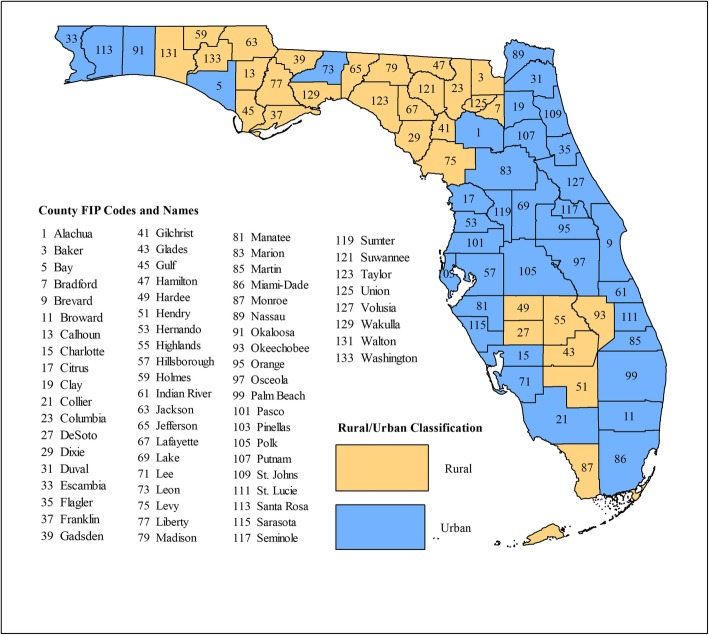
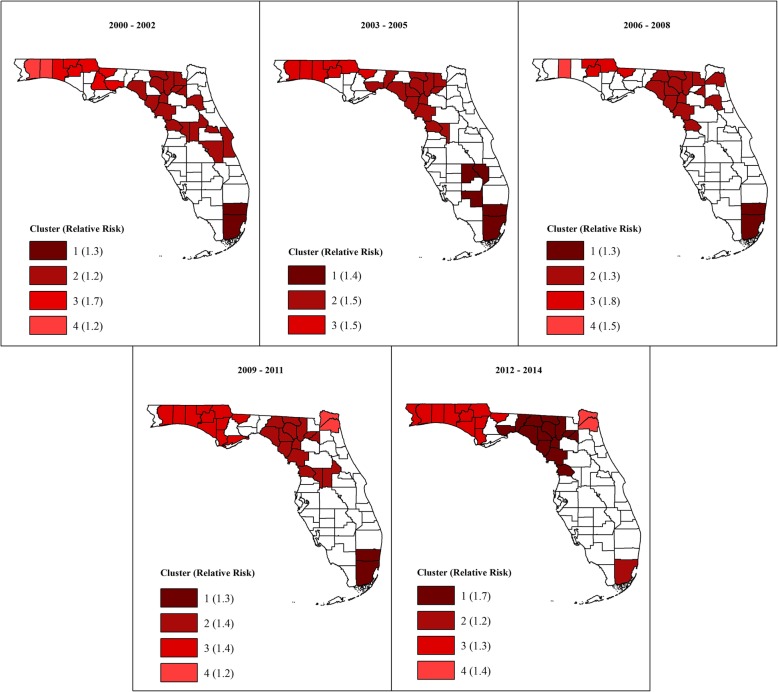
There was an overall decline of 48% in MI mortality risks between 2000 and 2014. However, we found substantial, persistent disparities in MI mortality risks, with high-risk clusters occurring primarily in rural northern counties and low-risk clusters occurring exclusively in urban southern counties. MI mortality risks declined in both low- and high-risk clusters, but the latter showed more dramatic decreases during the first nine years of the study period. Consequently, the risk difference between the high- and low-risk clusters was smaller at the end than at the beginning of the study period. However, the rates of decline levelled off during the last six years of the study, and there are signs that the risks may be on an upward trend in parts of North Florida. Moreover, MI mortality risks for high-risk clusters at the end of the study period were on par with or above those for low-risk clusters at the beginning of the study period. Thus, high-risk clusters lagged behind low-risk clusters by at least 1.5 decades.
Myocardial infarction mortality risks have decreased substantially during the last 15 years, but persistent disparities in MI mortality burden still exist across Florida. Efforts to reduce these disparities will need to target prevention programs to counties in the high-risk clusters.
识别心肌梗死(MI)负担的差异,并评估其时间变化,对于指导资源分配和制定旨在减少/消除健康差异的政策至关重要。我们的目标是:(a)调查佛罗里达州 MI 死亡率风险的空间分布和聚类;(b)评估 2000 年至 2014 年佛罗里达州 MI 死亡率风险的地理差异的时间变化。
这是一项具有县级为空间分析单位的回顾性生态研究。我们从佛罗里达州卫生部获得了 2000 年至 2014 年期间发生在佛罗里达州居民中的 MI 死亡数据,并计算了县级年龄调整后的 MI 死亡率风险和空间经验贝叶斯平滑 MI 死亡率风险。我们使用 Kulldorff 的圆形空间扫描统计和 Tango 的灵活空间扫描统计来识别空间聚类。
2000 年至 2014 年间,MI 死亡率风险总体下降了 48%。然而,我们发现 MI 死亡率风险存在显著且持续的差异,高风险聚类主要发生在北部农村县,低风险聚类仅发生在南部城市县。低风险和高风险聚类的 MI 死亡率风险均有所下降,但后者在研究期的前九年下降更为显著。因此,研究期开始时高风险和低风险聚类之间的风险差异较小,而研究期结束时风险差异较大。然而,在研究的最后六年中,下降速度趋于平稳,并且有迹象表明,佛罗里达州北部部分地区的风险可能呈上升趋势。此外,研究期末高风险聚类的 MI 死亡率风险与研究期初低风险聚类的 MI 死亡率风险相当或更高。因此,高风险聚类至少落后低风险聚类 1.5 个十年。
在过去的 15 年中,MI 死亡率风险大幅下降,但佛罗里达州仍存在 MI 死亡率负担的持续差异。减少这些差异的努力需要将预防计划针对高风险聚类中的县。