Vanderbilt University School of Nursing, Vanderbilt University, Nashville, TN, USA.
Department of Biostatistics, Vanderbilt Ingram Cancer Center, Vanderbilt University Medical Center, Nashville, TN, USA.
Ann Surg Oncol. 2019 Oct;26(10):3250-3259. doi: 10.1245/s10434-019-07344-5. Epub 2019 May 3.
Breast cancer-related lymphedema (BCRL) represents a major source of morbidity among breast cancer survivors. Increasing data support early detection of subclinical BCRL followed by early intervention. A randomized controlled trial is being conducted comparing lymphedema progression rates using volume measurements calculated from the circumference using a tape measure (TM) or bioimpedance spectroscopy (BIS).
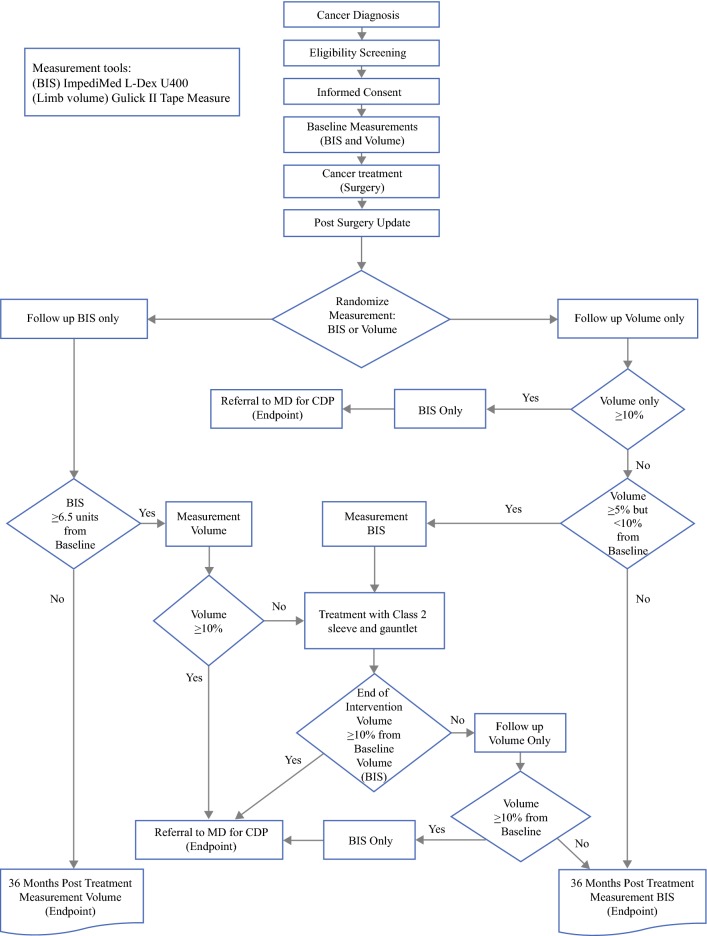
Patients were enrolled and randomized to either TM or BIS surveillance. Patients requiring early intervention were prescribed a compression sleeve and gauntlet for 4 weeks and then re-evaluated. The primary endpoint of the trial was the rate of progression to clinical lymphedema requiring complex decongestive physiotherapy (CDP), with progression defined as a TM volume change in the at-risk arm ≥ 10% above the presurgical baseline. This prespecified interim analysis was performed when at least 500 trial participants had ≥ 12 months of follow-up.
A total of 508 patients were included in this analysis, with 109 (21.9%) patients triggering prethreshold interventions. Compared with TM, BIS had a lower rate of trigger (15.8% vs. 28.5%, p < 0.001) and longer times to trigger (9.5 vs. 2.8 months, p = 0.002). Twelve triggering patients progressed to CDP (10 in the TM group [14.7%] and 2 in the BIS group [4.9%]), representing a 67% relative reduction and a 9.8% absolute reduction (p = 0.130).
Interim results demonstrated that post-treatment surveillance with BIS reduced the absolute rates of progression of BCRL requiring CDP by approximately 10%, a clinically meaningful improvement. These results support the concept of post-treatment surveillance with BIS to detect subclinical BCRL and initiate early intervention.
乳腺癌相关淋巴水肿(BCRL)是乳腺癌幸存者发病和致残的主要原因。越来越多的数据支持对亚临床 BCRL 进行早期检测,然后进行早期干预。目前正在开展一项随机对照试验,比较使用卷尺(TM)或生物阻抗光谱(BIS)测量的周长计算的容积测量值来评估淋巴水肿的进展率。
患者入组并随机分配至 TM 或 BIS 监测组。需要早期干预的患者将被处方使用压缩袖套和臂套 4 周,然后进行重新评估。该试验的主要终点是进展为需要复杂消肿物理治疗(CDP)的临床淋巴水肿的发生率,进展定义为高危手臂的 TM 体积变化超过术前基线 10%以上。当至少 500 名试验参与者有≥12 个月的随访时,进行了此预先指定的中期分析。
共有 508 名患者纳入本分析,其中 109 名(21.9%)患者触发了阈前干预。与 TM 相比,BIS 的触发率较低(15.8% vs. 28.5%,p<0.001),触发时间较长(9.5 个月 vs. 2.8 个月,p=0.002)。12 名触发患者进展为 CDP(TM 组 10 例[14.7%],BIS 组 2 例[4.9%]),相对减少 67%,绝对减少 9.8%(p=0.130)。
中期结果表明,BIS 治疗后监测降低了需要 CDP 的 BCRL 进展的绝对发生率约 10%,这是一个具有临床意义的改善。这些结果支持使用 BIS 进行治疗后监测以检测亚临床 BCRL 并启动早期干预的概念。