DuPont Animal Nutrition, DuPont Nutrition & Biosciences, Leiden, The Netherlands.
University of Applied Sciences Bingen, FB1 - Life Sciences, Bingen am Rhein, Germany.
J Anim Sci. 2019 May 30;97(6):2524-2533. doi: 10.1093/jas/skz151.
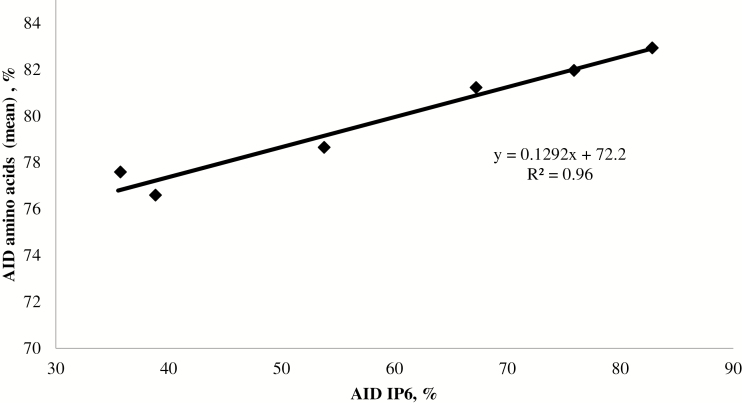
This study evaluated the effects of increasing the dose of a 6-phytase from Buttiauxella on phytate degradation, mineral, energy, and AA digestibility in weaned pigs fed complex diets based on wheat, corn, soybean meal, barley, and rapeseed meal. A negative control (NC) diet containing no added inorganic phosphorus (P) and a reduction of 0.1% calcium (Ca) and 36 kcal/kg ME was supplemented with Buttiauxella phytase at 0, 250, 500, 1,000, or 2,000 FTU/kg diet and tested against a nutritionally adequate, positive control (PC) diet. One phytase units (FTU) is the amount of enzyme that liberates 1 micromole of inorganic phosphate per minute from a sodium phytate substrate at pH 5.5 and 37 °C. Barrows (Topigs × Pietrian; initial mean body weight 19.3 kg) were housed individually in metabolic crates and fed the test diets in mash form via 2 equal meals per day for 9 d (fed at 2.5 times the maintenance energy requirement), with 8 replicate pigs per treatment, in 2 experimental runs (total n = 48). After a 3-d adaptation period, urine and feces were collected over 5 d for measurements of apparent total tract digestibility (ATTD) and retention of nutrients. On day 9, pigs were euthanized and ileal digesta collected for measurements of apparent ileal digestibility (AID) of nutrients. Phytase improved (P < 0.05) digestibility of all measured AA except Trp (P < 0.1), and AID P, nitrogen, phytate, ATTD P, Ca versus NC. Increasing phytase dose from 0 (NC) to 2,000 FTU/kg increased AID Lys, Cys, Thr, Val, Ile, Leu, mean AA, P, N, phytate, ATTD P, N, Na, energy, ME, P retention (g/d), and reduced P excretion (g/d) in a linear or exponential manner (P < 0.05). Phytase at 2,000 FTU/kg improved AA digestibility by between +3.1 percentage points (Trp) and +8.8 percentage points (Cys) versus NC (average +6.3 percentage points) (P < 0.05). Phytase inclusion at 2,000 FTU/kg reduced P excretion (g/d) by 57% versus PC (P < 0.05). In conclusion, increasing Buttiauxella phytase in the range of 0 to 2,000 FTU/kg increased phytate degradation, improved AA and P digestibility, and reduced P excretion in weaned pigs fed complex diets.
本研究评估了在基于小麦、玉米、豆粕、大麦和菜籽粕的复杂日粮中,增加毕赤酵母来源的 6-植酸酶剂量对植酸盐降解、矿物质、能量和 AA 消化率的影响。阴性对照(NC)日粮不含添加无机磷(P),且降低 0.1%钙(Ca)和 36 千卡/千克 ME,并添加 0、250、500、1000 或 2000 单位/千克日粮的毕赤酵母植酸酶,与营养充足的阳性对照(PC)日粮进行对比。一个植酸酶单位(FTU)是指在 pH5.5 和 37°C 下,每分钟从植酸钠底物中释放 1 微摩尔无机磷所需的酶量。试验选用大约克×皮特兰断奶仔猪(初始平均体重 19.3 千克),单独饲养在代谢笼中,9 天内通过每天 2 次等份饲粮进行强制饲喂(能量需要量为维持需要的 2.5 倍),每个处理 8 个重复,共 2 个试验(共 48 头猪)。经过 3 天的适应期后,收集 5 天的尿液和粪便,用于测定全肠道表观消化率(ATTD)和养分保留率。第 9 天,对猪进行安乐死,并收集回肠食糜,用于测定养分的回肠表观消化率(AID)。植酸酶提高了所有测定 AA 的消化率(P<0.05),除色氨酸(P<0.1)外,还提高了 AID P、氮、植酸盐、ATTD P、Ca 相对于 NC。与 0(NC)相比,植酸酶剂量从 0 增加到 2000 FTU/kg 以线性或指数方式提高了 Lys、Cys、Thr、Val、Ile、Leu、平均 AA、P、N、植酸盐、ATTD P、N、Na、能量、ME、P 保留量(g/d),并降低了 P 排泄量(g/d)(P<0.05)。植酸酶添加量为 2000 FTU/kg 与 NC 相比,AA 消化率提高了+3.1 个百分点(Trp)到+8.8 个百分点(Cys)(平均+6.3 个百分点)(P<0.05)。与 PC 相比,植酸酶添加 2000 FTU/kg 降低了 57%的 P 排泄量(g/d)(P<0.05)。综上所述,在断奶仔猪复杂日粮中添加毕赤酵母植酸酶,范围在 0 至 2000 FTU/kg 之间,可提高植酸盐降解率,提高 AA 和 P 的消化率,降低 P 的排泄量。