Kim Yunsoo, Opron Kristopher, Burton Zachary F
University of Michigan, Ann Arbor, MI 48109, USA.
Bioinformatics Core, University of Michigan, Ann Arbor, MI 48109-0674, USA.
Life (Basel). 2019 May 4;9(2):37. doi: 10.3390/life9020037.
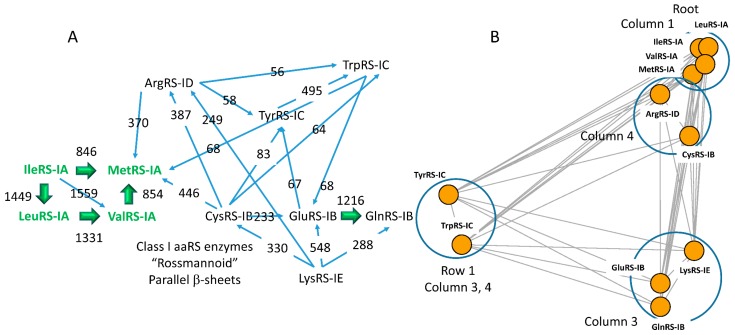
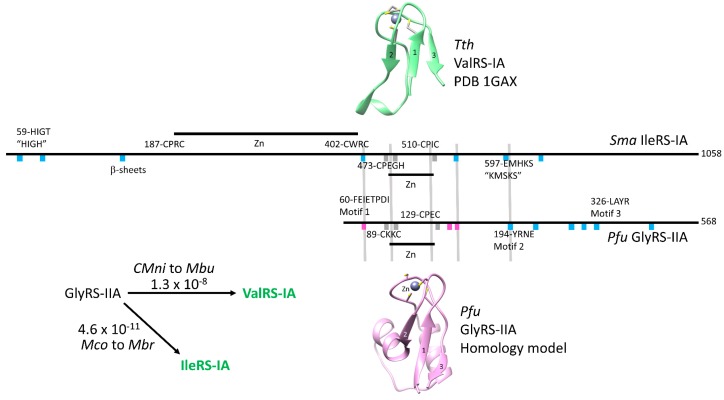
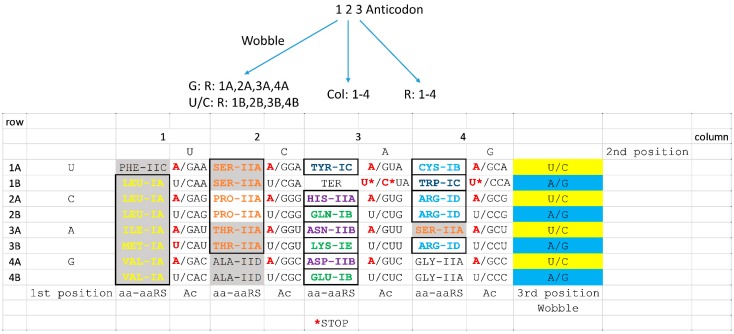
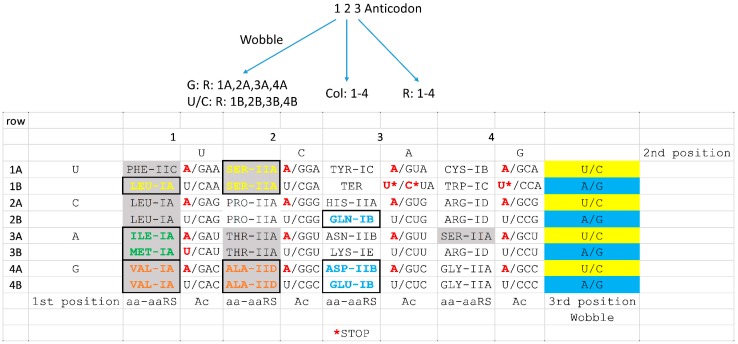
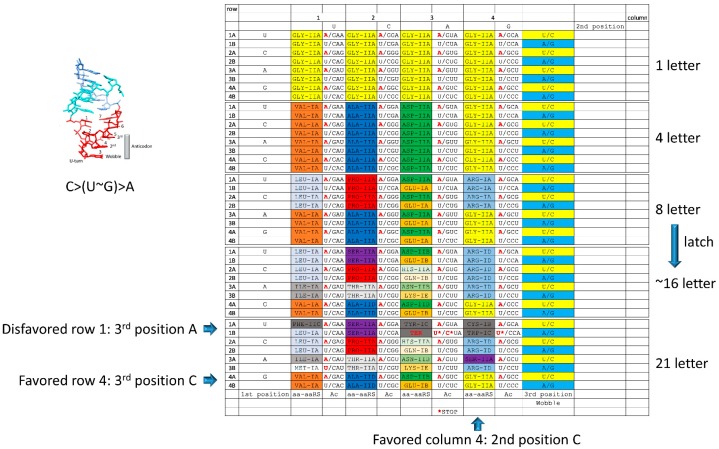
Pathways of standard genetic code evolution remain conserved and apparent, particularly upon analysis of aminoacyl-tRNA synthetase (aaRS) lineages. Despite having incompatible active site folds, class I and class II aaRS are homologs by sequence. Specifically, structural class IA aaRS enzymes derive from class IIA aaRS enzymes by in-frame extension of the protein N-terminus and by an alternate fold nucleated by the N-terminal extension. The divergence of aaRS enzymes in the class I and class II clades was analyzed using the Phyre2 protein fold recognition server. The class I aaRS radiated from the class IA enzymes, and the class II aaRS radiated from the class IIA enzymes. The radiations of aaRS enzymes bolster the coevolution theory for evolution of the amino acids, tRNAomes, the genetic code, and aaRS enzymes and support a tRNA anticodon-centric perspective. We posit that second- and third-position tRNA anticodon sequence preference (C>(U~G)>A) powerfully selected the sectoring pathway for the code. GlyRS-IIA appears to have been the primordial aaRS from which all aaRS enzymes evolved, and glycine appears to have been the primordial amino acid around which the genetic code evolved.
标准遗传密码进化的途径仍然是保守且明显的,尤其是在对氨酰-tRNA合成酶(aaRS)谱系进行分析时。尽管I类和II类aaRS具有不相容的活性位点折叠,但通过序列分析它们是同源物。具体而言,结构IA类aaRS酶是通过蛋白质N端的框内延伸以及由N端延伸引发的另一种折叠方式从IIA类aaRS酶衍生而来。使用Phyre2蛋白质折叠识别服务器分析了I类和II类进化枝中aaRS酶的差异。I类aaRS从IA类酶辐射而来,II类aaRS从IIA类酶辐射而来。aaRS酶的辐射支持了氨基酸、tRNA组、遗传密码和aaRS酶进化的共同进化理论,并支持以tRNA反密码子为中心的观点。我们认为,tRNA反密码子第二和第三位的序列偏好(C>(U~G)>A)有力地选择了密码子的分区途径。GlyRS-IIA似乎是所有aaRS酶进化而来的原始aaRS,而甘氨酸似乎是遗传密码围绕其进化的原始氨基酸。