Department of Coronary Disease and Heart Failure, Jagiellonian University Medical College, Krakow, Poland.
Department of Emergency Medical Care, Jagiellonian University Medical College, Krakow, Poland.
BMC Cardiovasc Disord. 2019 May 7;19(1):105. doi: 10.1186/s12872-019-1076-5.
The function of deiodinases - selenoproteins converting thyroid hormones may be disturbed by oxidative stress accompanying heart failure. Selenium (Se) may be used by glutathione peroxidase, leading to a lack of deiodinase and triiodothyronine (T3). The aim of the study was the evaluation of the prevalence and clinical significance of low T3 syndrome in heart failure and the assessment of the association of low fT3 and Se deficiency.
The study group consisted of 59 consecutive patients hospitalized due to decompensated HFrEF NYHA III or IV. Exclusion criteria were: thyroid dysfunction, severe systemic disease, treatment with amiodarone, steroids or propranolol. Group A included 9 patients with low free T3 (fT3) concentration below 3.1 pmol/L. Group B consisted of the remaining 50 patients with normal fT3 levels.
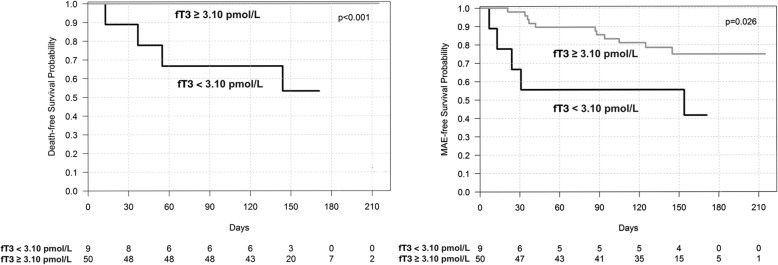
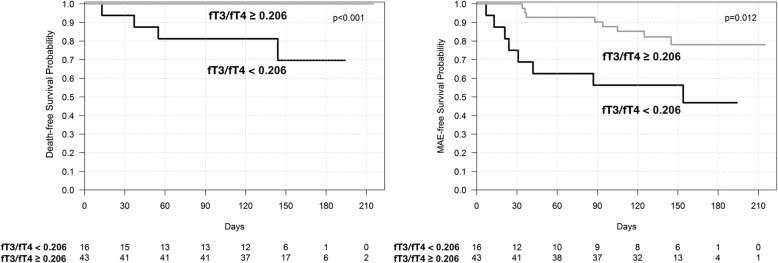
The prevalence of low T3 syndrome was 15.3%. The prevalence of Se deficiency was 74.6%. We demonstrated correlations between fT3 and main clinical variables (i.e. NT-proBNP, LVEF, hsCRP), but we did not find correlation between fT3 and the Se level. Kaplan-Meier survival analysis showed lower survival probability in patients with low fT3 (p < 0.001).
Low T3 syndrome is frequently found in patients with HFrEF and is associated with a poor outcome. We did not identify any significant correlation between Se and fT3 level.
伴随心力衰竭发生的氧化应激可能会干扰将甲状腺激素转化为活性形式的脱碘酶 - 硒蛋白的功能。硒(Se)可能会被谷胱甘肽过氧化物酶消耗,导致脱碘酶和三碘甲状腺原氨酸(T3)缺乏。本研究旨在评估心力衰竭患者中低 T3 综合征的患病率和临床意义,并评估低游离 T3(fT3)与 Se 缺乏的相关性。
研究组包括 59 例因失代偿性射血分数降低心衰(HFrEF)NYHA III 或 IV 级而住院的连续患者。排除标准为:甲状腺功能障碍、严重全身性疾病、使用胺碘酮、皮质类固醇或普萘洛尔。A 组包括游离 T3(fT3)浓度低于 3.1 pmol/L 的 9 例患者。B 组由其余 50 例 fT3 水平正常的患者组成。
低 T3 综合征的患病率为 15.3%。Se 缺乏的患病率为 74.6%。我们证实了 fT3 与主要临床变量(即 NT-proBNP、LVEF、hsCRP)之间存在相关性,但未发现 fT3 与 Se 水平之间存在相关性。Kaplan-Meier 生存分析显示,fT3 水平较低的患者生存概率较低(p<0.001)。
低 T3 综合征在 HFrEF 患者中较为常见,与不良预后相关。我们未发现 Se 与 fT3 水平之间存在任何显著相关性。