School of Biotechnology, Dublin City University, Dublin, Ireland.
Wellcome Trust Sanger Institute, Hinxton, United Kingdom.
mSphere. 2019 May 8;4(3):e00130-19. doi: 10.1128/mSphere.00130-19.
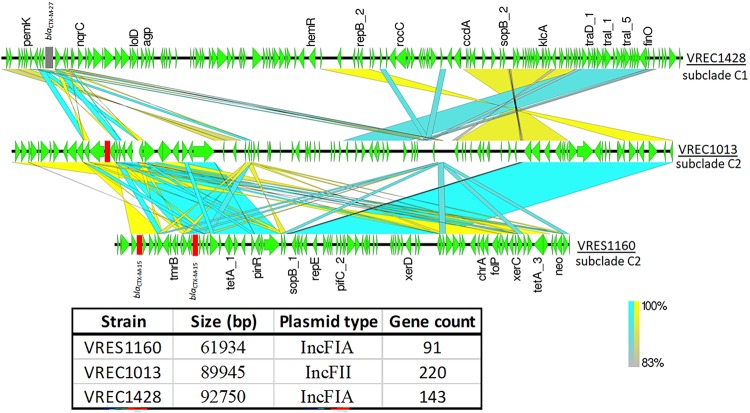
The incidence of infections caused by extraintestinal (ExPEC) is rising globally, which is a major public health concern. ExPEC strains that are resistant to antimicrobials have been associated with excess mortality, prolonged hospital stays, and higher health care costs. sequence type 131 (ST131) is a major ExPEC clonal group worldwide, with variable plasmid composition, and has an array of genes enabling antimicrobial resistance (AMR). ST131 isolates frequently encode the AMR genes , , and , which are often rearranged, amplified, and translocated by mobile genetic elements (MGEs). Short DNA reads do not fully resolve the architecture of repetitive elements on plasmids to allow MGE structures encoding genes to be fully determined. Here, we performed long-read sequencing to decipher the genome structures of six ST131 isolates from six patients. Most long-read assemblies generated entire chromosomes and plasmids as single contigs, in contrast to more fragmented assemblies created with short reads alone. The long-read assemblies highlighted diverse accessory genomes with , , and genes identified in three, one, and one isolates, respectively. One sample had no gene. Two samples had chromosomal and genes, and the latter was at three distinct locations, likely transposed by the adjacent MGEs: IS, IS and Tn This study showed that AMR genes exist in multiple different chromosomal and plasmid contexts, even between closely related isolates within a clonal group such as ST131. Drug-resistant bacteria are a major cause of illness worldwide, and a specific subtype called ST131 causes a significant number of these infections. ST131 bacteria become resistant to treatments by modifying their DNA and by transferring genes among one another via large packages of genes called plasmids, like a game of pass-the-parcel. Tackling infections more effectively requires a better understanding of what plasmids are being exchanged and their exact contents. To achieve this, we applied new high-resolution DNA sequencing technology to six ST131 samples from infected patients and compared the output to that of an existing approach. A combination of methods shows that drug resistance genes on plasmids are highly mobile because they can jump into ST131's chromosomes. We found that the plasmids are very elastic and undergo extensive rearrangements even in closely related samples. This application of DNA sequencing technologies illustrates at a new level the highly dynamic nature of ST131 genomes.
肠外(ExPEC)感染的发病率在全球范围内呈上升趋势,这是一个主要的公共卫生关注点。对 抗生素耐药的 ExPEC 菌株与超额死亡率、住院时间延长和更高的医疗保健成本有关。 序列型 131(ST131)是全球主要的 ExPEC 克隆群,其质粒组成具有可变性,并且具有一系列赋予 抗生素耐药性(AMR)的基因。ST131 分离株经常编码 耐药基因 、 和 ,这些基因经常通过可移动遗传元件(MGE)发生重排、扩增和易位。短 DNA 读段不能完全解析质粒上重复元件的结构,无法全面确定编码 基因的 MGE 结构。在这里,我们进行了长读测序,以解析来自六名患者的六株 ST131 分离株的基因组结构。与单独使用短读段生成的更碎片化的组装相比,大多数长读段组装生成了完整的染色体和质粒作为单个连续体。长读段组装突出显示了具有多样性的辅助基因组,在三个、一个和一个分离株中分别鉴定出了 、 和 基因。一个样本没有 基因。两个样本具有染色体 和 基因,后者位于三个不同位置,可能由相邻的 MGEs 转座:IS、IS 和 Tn 。本研究表明,AMR 基因存在于多个不同的染色体和质粒环境中,即使在 ST131 等克隆群内的密切相关分离株之间也是如此。耐药细菌是全球疾病的主要原因,一种称为 ST131 的特定亚型导致了这些感染中的很大一部分。ST131 细菌通过修改其 DNA 并通过质粒(就像传递包裹一样)在彼此之间转移基因来对抗治疗,从而变得具有耐药性。要更有效地治疗感染,就需要更好地了解正在交换的质粒及其确切内容。为了实现这一目标,我们应用了新的高分辨率 DNA 测序技术来分析来自感染患者的六株 ST131 样本,并将结果与现有方法进行了比较。综合方法表明,质粒上的耐药基因具有很高的移动性,因为它们可以跳到 ST131 的染色体上。我们发现,即使在密切相关的样本中,质粒也非常有弹性,并经历了广泛的重排。这项 DNA 测序技术的应用以新的水平说明了 ST131 基因组的高度动态性质。