Istituto Nazionale di Geofisica e Vulcanologia (INGV), Sezione di Palermo, Via Ugo La Malfa 153, 90146, Palermo, Italy.
Dipartimento di Scienze Matematiche e Informatiche, Scienze Fisiche e Scienze della Terra (MIFT), Università di Messina, Viale Ferdinando Stagno d'Alcontres 31, 98166S, Agata, Messina, Italy.
Sci Rep. 2019 May 8;9(1):7107. doi: 10.1038/s41598-019-43181-y.
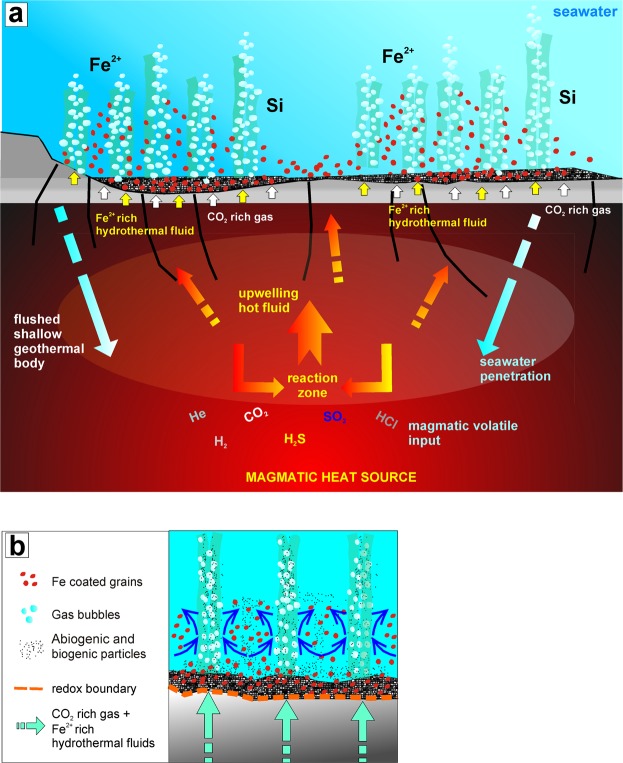
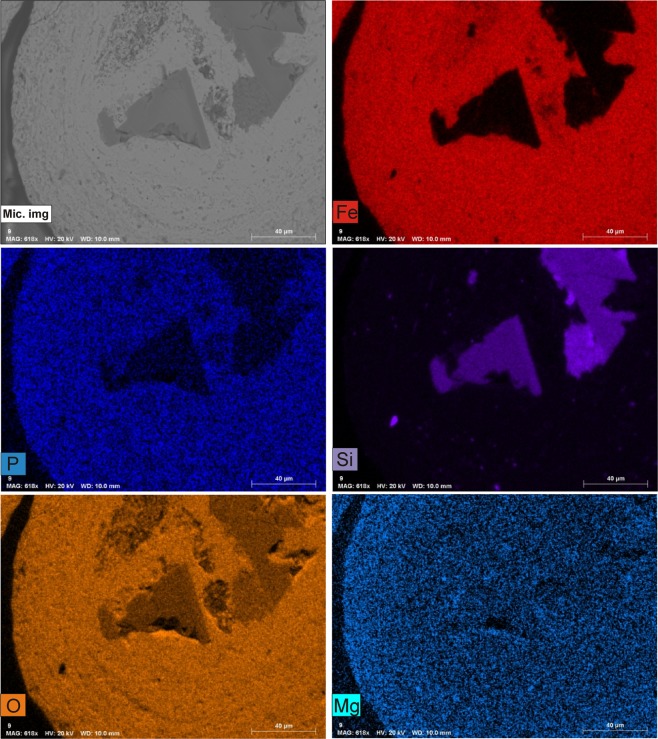
We constrained the origin and genetic environment of modern iron ooids (sand-sized grains with a core and external cortex of concentric laminae) providing new tools for the interpretation of their fossil counterparts as well as the analogous particles discovered on Mars. Here, we report an exceptional, unique finding of a still active deposit of submillimetric iron ooids, under formation at the seabed at a depth of 80 m over an area characterized by intense hydrothermal activity off Panarea, a volcanic island north of Sicily (Italy). An integrated analysis, carried out by X-ray Powder Diffraction, Environmental Scanning Electron Microscopy, X-ray Fluorescence and Raman spectroscopy reveals that Panarea ooids are deposited at the seafloor as concentric laminae of primary goethite around existing nuclei. The process is rapid, and driven by hydrothermal fluids as iron source. A sub-spherical, laminated structure resulted from constant agitation and by degassing of CO-dominated fluids through seafloor sediments. Our investigations point the hydrothermal processes as responsible for the generation of the Panarea ooids, which are neither diagenetic nor reworked. The presence of ooids at the seawater-sediments interface, in fact, highlights how their development and growth is still ongoing. The proposed results show a new process responsible for ooids formation and gain a new insight into the genesis of iron ooids deposits that are distributed at global scale in both modern and past sediments.
我们限制了现代铁豆(具有核心和同心层外皮的砂粒大小的颗粒)的起源和遗传环境,为解释其化石对应物以及在火星上发现的类似颗粒提供了新的工具。在这里,我们报告了一个特殊的、独特的发现,即在西西里岛北部的火山岛帕纳雷阿(Panarea)附近的海底深处 80 米处,仍有一个活跃的亚毫米级铁豆矿床正在形成,该地区的海底存在强烈的热液活动。通过 X 射线粉末衍射、环境扫描电子显微镜、X 射线荧光和拉曼光谱的综合分析表明,帕纳雷阿豆是在海底围绕现有核心形成的原生针铁矿同心层沉积的。这个过程很快,是由热液流体作为铁源驱动的。通过海底沉积物中 CO 为主的流体的不断搅动和脱气,形成了一个亚球形的层状结构。我们的研究指出,热液过程是产生帕纳雷阿豆的原因,这些豆不是成岩作用或再作用的产物。事实上,豆粒存在于海水-沉积物界面上,这表明它们的发育和生长仍在继续。提出的结果表明,这是一种新的铁豆形成过程,为在全球范围内分布在现代和过去沉积物中的铁豆矿床的成因提供了新的见解。