Zham Poonam, Raghav Sanjay, Kempster Peter, Poosapadi Arjunan Sridhar, Wong Kit, Nagao Kanae J, Kumar Dinesh K
School of Engineering, RMIT University, Melbourne, VIC, Australia.
Department of Neurosciences, Monash Medical Centre, Clayton, VIC, Australia.
Front Neurol. 2019 Apr 24;10:403. doi: 10.3389/fneur.2019.00403. eCollection 2019.
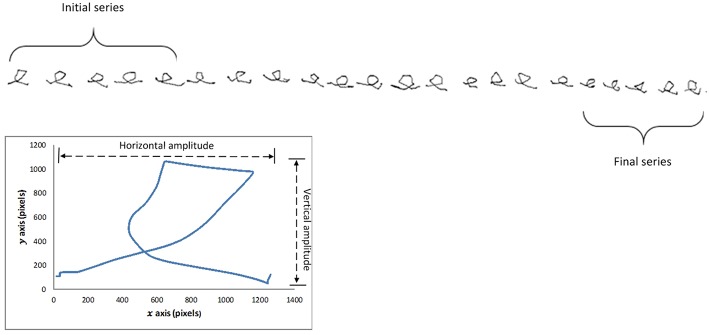
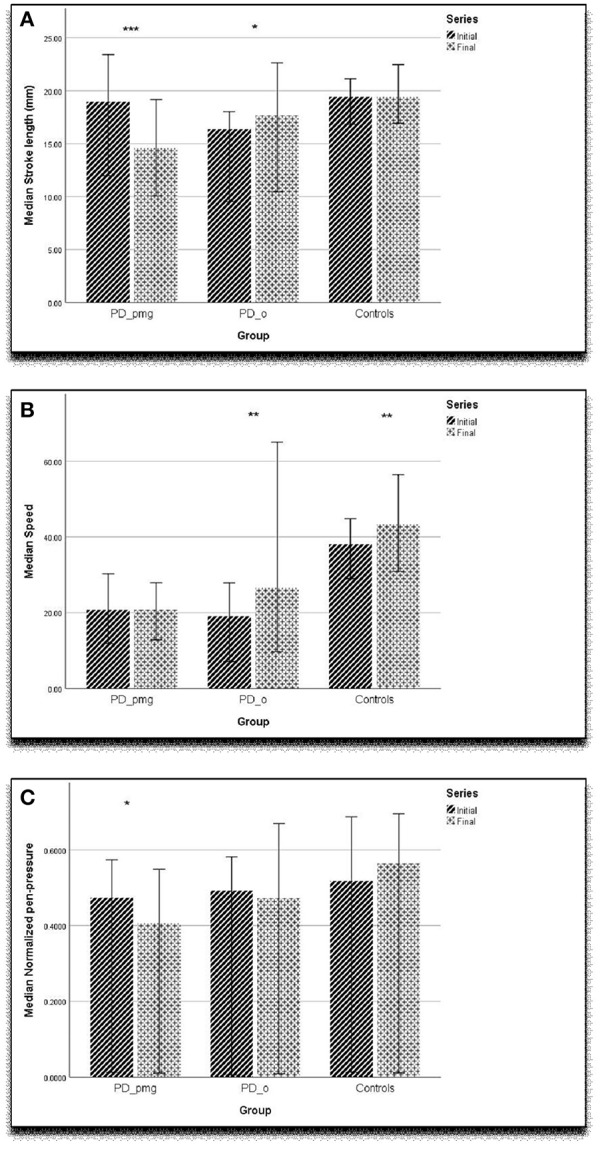
Progressive micrographia is decrement in character size during writing and is commonly associated with Parkinson's disease (PD). This study has investigated the kinematic features of progressive micrographia during a repetitive writing task. Twenty-four PD patients with duration since diagnosis of <10 years and 24 age-matched controls wrote the letter "" repeatedly. PD patients were studied in defined states, with scoring of motor function on the Unified Parkinson's Disease Rating Scale Part III. A digital tablet captured coordinates and ink-pen pressure. Customized software recorded the data and offline analysis derived the kinematic features of pen-tip movement. The average size of the first and the last five letters were compared, with progressive micrographia defined as >10% decrement in letter stroke length. The relationships between dimensional and kinematic features for the control subjects and for PD patients with and without progressive micrographia were studied. Differences between the initial and last letter repetitions within each group were assessed by Wilcoxon signed-rank test, and the Kruskal-Wallis test was applied to compare the three groups. There are five main conclusions from our findings: (i) 66% of PD patients who participated in this study exhibited progressive micrographia; (ii) handwriting kinematic features for all PD patients was significantly lower than controls ( < 0.05); (iii) patients with progressive micrographia lose the normal augmentation of writing speed and acceleration in the axis with left-to-right writing and show decrement of pen-tip pressure ( = 0.034); (iv) kinematic and pen-tip pressure profiles suggest that progressive micrographia in PD reflects poorly sustained net force; and (v) although progressive micrographia resembles the sequence effect of general bradykinesia, we did not find a significant correlation with overall motor disability, nor with the aggregate UPDRS-III bradykinesia scores for the dominant arm.
进行性小写症是指书写时字体大小逐渐减小,通常与帕金森病(PD)相关。本研究调查了重复书写任务期间进行性小写症的运动学特征。24例诊断后病程<10年的PD患者和24例年龄匹配的对照者重复书写字母“”。在特定状态下对PD患者进行研究,并根据统一帕金森病评定量表第三部分对运动功能进行评分。一块数位板记录坐标和笔尖压力。定制软件记录数据,离线分析得出笔尖运动的运动学特征。比较首个和最后五个字母的平均大小,将字母笔画长度减少>10%定义为进行性小写症。研究了对照者以及有和无进行性小写症的PD患者尺寸特征与运动学特征之间的关系。通过Wilcoxon符号秩检验评估每组内首个和最后字母重复之间的差异,并应用Kruskal-Wallis检验比较三组。我们的研究结果有五个主要结论:(i)参与本研究的PD患者中有66%表现出进行性小写症;(ii)所有PD患者的书写运动学特征均显著低于对照者(P<0.05);(iii)有进行性小写症的患者在从左到右书写时失去了正常的书写速度增加和在x轴上的加速度增加,并表现出笔尖压力降低(P=0.034);(iv)运动学和笔尖压力曲线表明,PD中的进行性小写症反映了持续不良的净力;(v)尽管进行性小写症类似于一般运动迟缓的序列效应,但我们未发现其与整体运动功能障碍以及优势侧上肢统一帕金森病评定量表第三部分运动迟缓总分之间存在显著相关性。