1Department of Physics, University of California San Diego, 9500 Gilman Drive, La Jolla, CA 92093 USA.
2Dipartimento di Fisica, Sapienza Università di Roma, Piazzale Aldo Moro 2, Rome, 00185 Italy.
NPJ Syst Biol Appl. 2019 May 1;5:16. doi: 10.1038/s41540-019-0093-4. eCollection 2019.
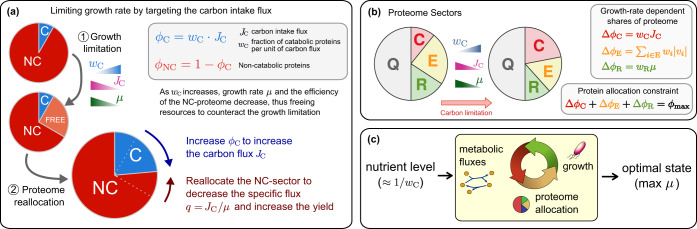
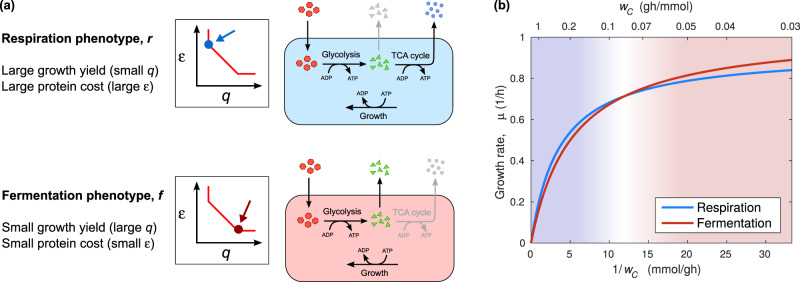
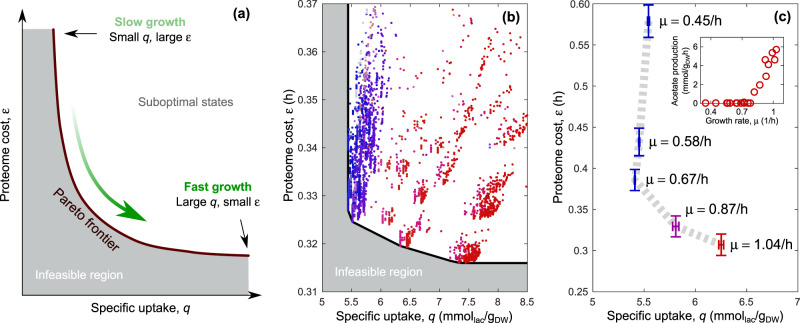
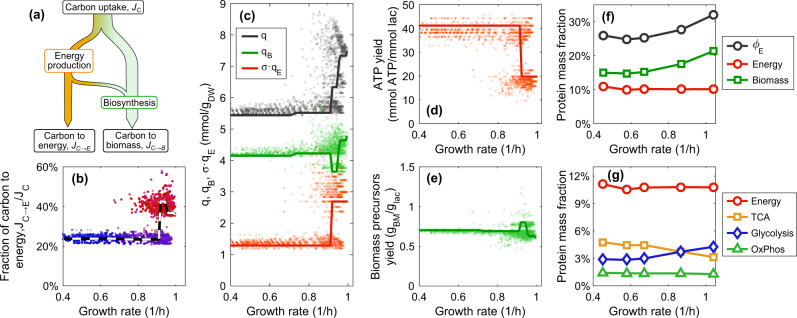
Living cells react to changes in growth conditions by re-shaping their proteome. This accounts for different stress-response strategies, both specific (i.e., aimed at increasing the availability of stress-mitigating proteins) and systemic (such as large-scale changes in the use of metabolic pathways aimed at a more efficient exploitation of resources). Proteome re-allocation can, however, imply significant biosynthetic costs. Whether and how such costs impact the growth performance are largely open problems. Focusing on carbon-limited growth, we integrate genome-scale modeling and proteomic data to address these questions at quantitative level. After deriving a simple formula linking growth rate, carbon intake, and biosynthetic costs, we show that optimal growth results from the tradeoff between yield maximization and protein burden minimization. Empirical data confirm that growth is indeed close to Pareto-optimal over a broad range of growth rates. Moreover, we establish that, while most of the intaken carbon is diverted into biomass precursors, the efficiency of ATP synthesis is the key driver of the yield-cost tradeoff. These findings provide a quantitative perspective on carbon overflow, the origin of growth laws and the multidimensional optimality of metabolism.
活细胞通过重新塑造其蛋白质组来应对生长条件的变化。这解释了不同的应激反应策略,既有特定的(即旨在增加减轻应激的蛋白质的可用性),也有系统的(例如,大规模改变代谢途径的利用,旨在更有效地利用资源)。然而,蛋白质组再分配可能意味着重大的生物合成成本。这些成本是否以及如何影响生长性能在很大程度上仍是悬而未决的问题。我们专注于碳限制生长,通过整合基因组规模建模和蛋白质组数据,从定量的角度来解决这些问题。在得出一个将生长速率、碳摄取和生物合成成本联系起来的简单公式后,我们表明,最优生长是通过最大化产量和最小化蛋白质负担之间的权衡实现的。经验数据证实,在广泛的生长速率范围内,生长确实接近帕累托最优。此外,我们还确定,尽管大部分摄入的碳被转移到生物量前体中,但 ATP 合成的效率是产量-成本权衡的关键驱动因素。这些发现为碳溢出、生长规律的起源以及代谢的多维最优性提供了一个定量的视角。