
代谢的功能分解允许对通量和蛋白质分配到特定代谢功能的系统水平进行定量。
Functional decomposition of metabolism allows a system-level quantification of fluxes and protein allocation towards specific metabolic functions.
机构信息
Department of Physics, University of California San Diego, 9500 Gilman Dr. La Jolla, San Diego, CA, 92093, USA.
Department of Biological Sciences, University of Southern California, Los Angeles, CA, 90089, USA.
出版信息
Nat Commun. 2023 Jul 13;14(1):4161. doi: 10.1038/s41467-023-39724-7.
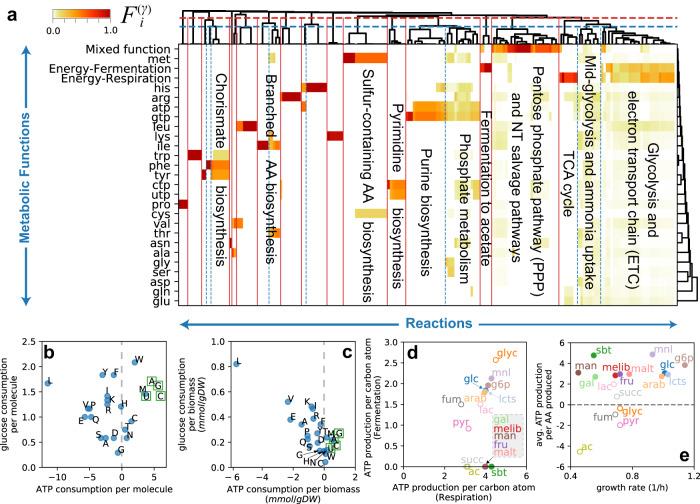
Quantifying the contribution of individual molecular components to complex cellular processes is a grand challenge in systems biology. Here we establish a general theoretical framework (Functional Decomposition of Metabolism, FDM) to quantify the contribution of every metabolic reaction to metabolic functions, e.g. the synthesis of biomass building blocks. FDM allowed for a detailed quantification of the energy and biosynthesis budget for growing Escherichia coli cells. Surprisingly, the ATP generated during the biosynthesis of building blocks from glucose almost balances the demand from protein synthesis, the largest energy expenditure known for growing cells. This leaves the bulk of the energy generated by fermentation and respiration unaccounted for, thus challenging the common notion that energy is a key growth-limiting resource. Moreover, FDM together with proteomics enables the quantification of enzymes contributing towards each metabolic function, allowing for a first-principle formulation of a coarse-grained model of global protein allocation based on the structure of the metabolic network.
量化单个分子成分对复杂细胞过程的贡献是系统生物学中的一个重大挑战。在这里,我们建立了一个通用的理论框架(代谢功能分解,FDM),以量化每个代谢反应对代谢功能的贡献,例如生物量构建块的合成。FDM 允许对生长大肠杆菌细胞的能量和生物合成预算进行详细量化。令人惊讶的是,从葡萄糖合成构建块过程中产生的 ATP 几乎与蛋白质合成的需求相平衡,这是已知生长细胞的最大能量消耗。这使得发酵和呼吸产生的大部分能量都没有得到解释,从而挑战了能量是关键生长限制资源的常见观点。此外,FDM 与蛋白质组学相结合,可以定量分析每个代谢功能所贡献的酶,从而根据代谢网络的结构,首次提出基于粗粒度模型的全局蛋白质分配的公式化。



 Zotero 插件