Risk Factors Intelligence Team, Public Health England, Liverpool, UK.
Alcohol, Drugs and Tobacco Division, Public Health England, London, UK.
BMJ Open. 2019 May 9;9(5):e021046. doi: 10.1136/bmjopen-2017-021046.
To estimate the prevalence, the frequency and the perpetrators of alcohol-related harm to others (AHTO) and identify factors associated with experiencing harm and aggressive harm.
Cross-sectional survey.
England.
Adults (general population) aged 16 and over.
Percentage of respondents who experienced harm. Socioeconomic and demographic factors associated with the outcomes. Outcomes were (1) experienced harm/did not experience harm and (2) experienced aggressive harm (physically threatened, physically hurt and forced/pressured into something sexual)/did not experience an aggressive harm (no aggressive harm plus no harm at all).
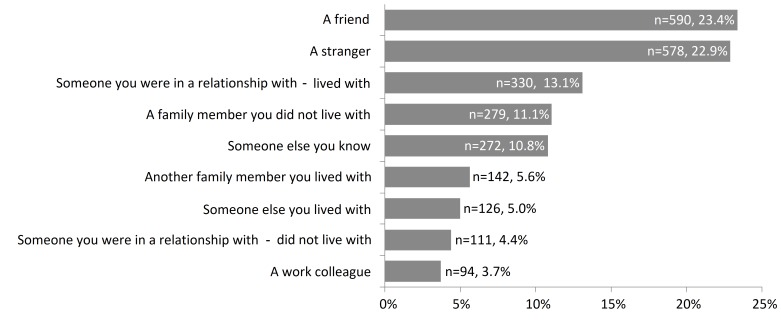
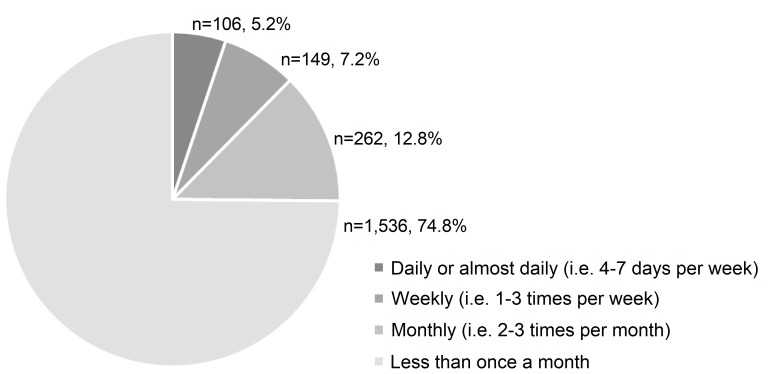
Data to support a response rate calculation were not collected; 96.3% of people surveyed completed the AHTO questions. The weighted sample was 4874; 20.1% (95% CI 18.9 to 21.4, N=980) reported experiencing harm in the previous 12 months and 4.6% (95% CI 4.0 to 5.4, N=225) reported experiencing an aggressive harm. Friends and strangers were the dominant perpetrators. Most harms (74.8%) occurred less than monthly. Factors associated with experiencing harm were: younger age (p<0.001), drinking harmfully/hazardously (p<0.001), white British (p<0.001 compared to other white groups and Asian groups and p=0.017 compared to black groups), having a disability (p<0.001), being educated (p<0.001 compared to no education) and living in private rented accommodation (p=0.004 compared with owned outright). Being in the family stage of life (defined as having children in the household) had significantly lower odds of harm (p=0.006 compared to being single), as did being retired (p<0.001 compared to being employed). Factors associated with experiencing an aggressive harm were similar.
This exploratory study, using data collected through the Alcohol Toolkit Survey, shows that AHTO affects 20.1% of the population of England. Even apparently minor harms, like being kept awake, can have a negative impact on health, while aggressive harms are clearly of concern. Using a standard methodology to measure harm across studies would be advantageous. Policies that focus on alcohol must take into consideration the impact of drinking on those other than the drinker.
估计与他人有关的酒精相关伤害(AHTO)的流行率、频率和实施者,并确定与伤害和攻击性伤害经历相关的因素。
横断面调查。
英格兰。
16 岁及以上的成年人(一般人群)。
经历伤害的受访者比例。与结局相关的社会经济和人口统计学因素。结局为(1)经历伤害/未经历伤害和(2)经历攻击性伤害(身体受到威胁、身体受伤和被迫/被迫进行性行为)/未经历攻击性伤害(无攻击性伤害加无伤害)。
未收集支持回复率计算的数据;接受调查的 96.3%的人完成了 AHTO 问题。加权样本为 4874 人;20.1%(95%CI 18.9 至 21.4,N=980)报告在过去 12 个月中经历过伤害,4.6%(95%CI 4.0 至 5.4,N=225)报告经历过攻击性伤害。朋友和陌生人是主要的实施者。大多数伤害(74.8%)发生频率低于每月一次。与经历伤害相关的因素包括:年龄较小(p<0.001)、有害/危险饮酒(p<0.001)、白种英国人(与其他白人群体和亚洲群体相比 p<0.001,与黑人群体相比 p=0.017)、残疾(p<0.001)、受过教育(p<0.001与未受教育相比)和居住在私人出租住房(与完全自有相比 p=0.004)。处于家庭生活阶段(定义为家中有孩子)的人受伤的可能性显著降低(与单身相比 p=0.006),退休人员也是如此(与在职人员相比 p<0.001)。与经历攻击性伤害相关的因素相似。
这项使用通过酒精工具包调查收集的数据进行的探索性研究表明,AHTO 影响了英格兰 20.1%的人口。即使是像被吵醒这样看似轻微的伤害,也会对健康产生负面影响,而攻击性伤害显然令人担忧。在研究中使用一种标准方法来衡量伤害将是有利的。以饮酒者为重点的政策必须考虑到饮酒对饮酒者以外的人的影响。