Sport Science and Clinical Biomechanics, University of Southern Denmark, Odense, Denmark.
Department of Radiology, Musculoskeletal section, Odense Universitetshospital, Odense, Denmark.
BMJ Open. 2019 May 9;9(5):e027725. doi: 10.1136/bmjopen-2018-027725.
The reliability of ultrasonic strain elastography (SEL) used to detect abnormalities in the supraspinatus tendon is unclear. Thus, the aim of this study was to investigate the reliability of SEL in the supraspinatus tendon.
An intra-rater and inter-rater reliability study.
A single-centre study conducted at the University of Southern Denmark.
Twenty participants with shoulder pain and MRI-verified supraspinatus tendinosis and 20 asymptomatic participants (no MRI).
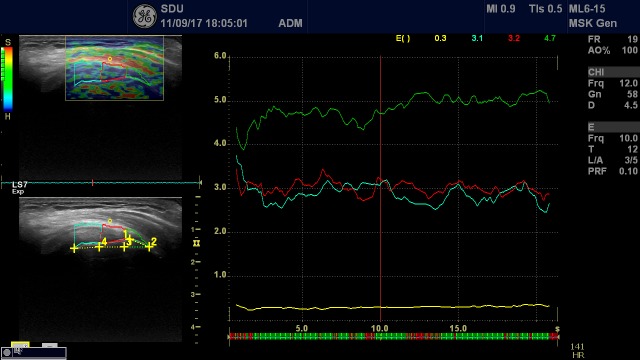
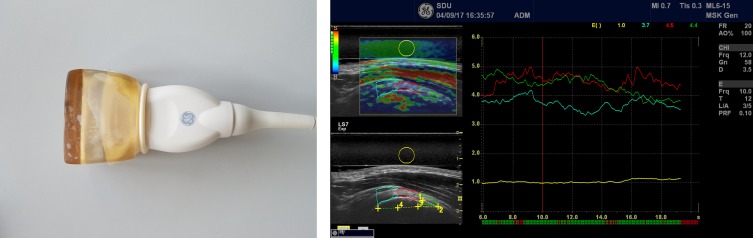
Raw values (RAW) and ratios (deltoid muscle (DELT) and gel pad (GEL) as reference tissues) were calculated and mean values of measurements from three regions of the supraspinatus tendon were reported. Colour scale ratings and number of yellow/red lesions from the three areas were also included.
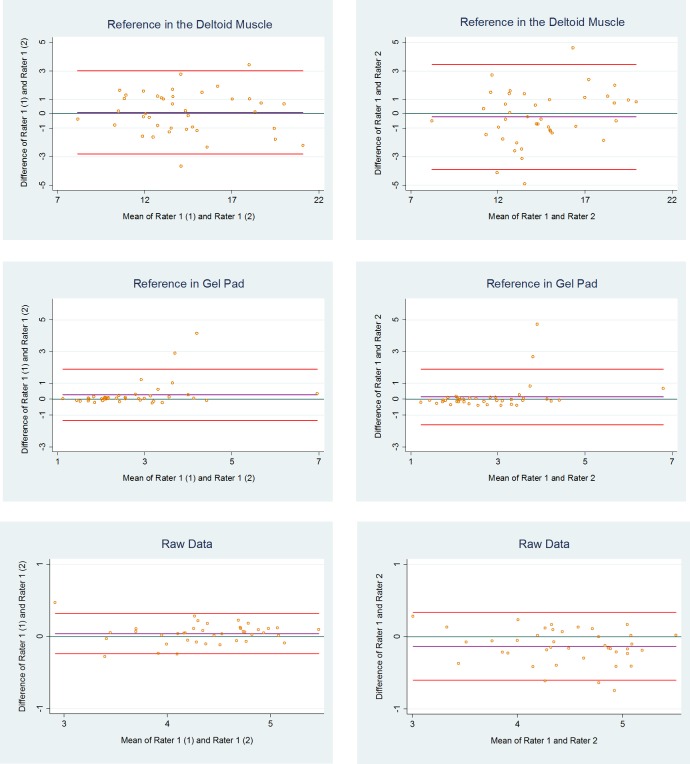
Intra-rater reliability showed intraclass correlation coefficients (ICCs) for RAW, DELT and GEL: 0.97 (minimal detectable change (MDC): 0.28 (6.36% of the mean)), 0.89 (MDC: 2.91 (20.37%)) and 0.73 (MDC: 1.61 (58.82%)), respectively. The ICCs for inter-rater reliability were 0.89 (MDC: 0.47 (10.53%)), 0.78 (MDC: 3.69 (25.51%)) and 0.70 (MDC: 1.75 (62.63%)), respectively.For colour scale ratings, intra-rater reliability (linear weighted kappa) ranged from 0.76 to 0.79, with the inter-rater reliability from 0.71 to 0.81. For the number of lesions, intra-rater reliability ranged from 0.40 to 0.82 and inter-rater reliability from 0.24 to 0.67.
Intra-rater and inter-rater reliability were excellent for raw values and for ratios with deltoid muscle as the reference tissue, and good for ratios with gel pad as the reference tissue. The reliability of colour scale ratings was substantial-to-almost perfect, and for the number of lesions fair-to-almost perfect.Although high reliability was found, validity and responsiveness of these elastographic methods needs further investigation.
The study protocol was approved by the Ethics Committee for the Region of South Denmark (S-20160115) and reported to the Danish Data Protection Agency (2014-41-3266).
超声应变成像(SE)用于检测肩袖肌腱异常的可靠性尚不清楚。因此,本研究旨在探讨 SE 在肩袖肌腱中的可靠性。
观察者内和观察者间可靠性研究。
丹麦南部大学的单中心研究。
20 名有肩痛和 MRI 证实的肩袖肌腱病的参与者和 20 名无症状参与者(无 MRI)。
计算原始值(RAW)和比值(三角肌(DELT)和凝胶垫(GEL)作为参考组织),并报告肩袖肌腱三个区域的测量平均值。还包括三个区域的彩色比例尺评分和黄色/红色病变数量。
观察者内可靠性显示 RAW、DELT 和 GEL 的组内相关系数(ICC)分别为 0.97(最小可检测变化(MDC):0.28(平均值的 6.36%))、0.89(MDC:2.91(20.37%))和 0.73(MDC:1.61(58.82%))。观察者间可靠性的 ICC 分别为 0.89(MDC:0.47(10.53%))、0.78(MDC:3.69(25.51%))和 0.70(MDC:1.75(62.63%))。对于彩色比例尺评分,观察者内可靠性(线性加权 κ)范围为 0.76 至 0.79,观察者间可靠性范围为 0.71 至 0.81。对于病变数量,观察者内可靠性范围为 0.40 至 0.82,观察者间可靠性范围为 0.24 至 0.67。
对于原始值和以三角肌为参考组织的比值,观察者内和观察者间可靠性均为优秀,而以凝胶垫为参考组织的比值为良好。彩色比例尺评分的可靠性为中等至近乎完美,病变数量的可靠性为良好至近乎完美。尽管发现了高可靠性,但这些弹性成像方法的有效性和反应性仍需要进一步研究。
该研究方案获得了南丹麦地区伦理委员会(S-20160115)的批准,并向丹麦数据保护局(2014-41-3266)报告。