Ruaro Barbara, Smith Vanessa, Sulli Alberto, Pizzorni Carmen, Tardito Samuele, Patané Massimo, Paolino Sabrina, Cutolo Maurizio
Research Laboratory and Academic Division of Clinical Rheumatology, Department of Internal Medicine (Di.M.I.), San Martino Polyclinic Hospital, University of Genova, Genova, Italy.
Department of Rheumatology, Ghent University Hospital, Ghent, Belgium.
Front Pharmacol. 2019 Apr 16;10:360. doi: 10.3389/fphar.2019.00360. eCollection 2019.
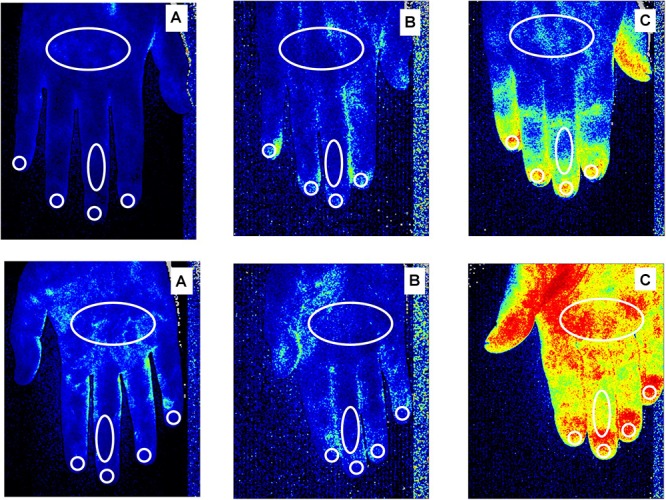
Raynaud's phenomenon (RP) is characterized by intense vasospasm of the digital arteries that causes characteristic color changes in fingers. There are two main types of RP: Primary RP (PRP) and Secondary RP (SRP). PRP is a benign condition. Whilst SRP is associated with several connective tissue diseases (CTD), in particular systemic sclerosis (SSc). The objectives of this report were: to present a short review on morphological (nailfold videocapillaroscopy, NVC) and functional techniques (laser tools and thermography) that allow for a correct diagnosis and treatment of RP and to investigate blood perfusion (BP) by laser speckle contrast analysis (LASCA) in different skin areas of hands and face in PRP, SRP to SSc, and healthy subjects (CNT). 31 PRP patients (LeRoy criteria), 70 SRP to SSc (ACR/EULAR criteria) and 68 CNT were enrolled. BP was assessed by LASCA at the level different areas of hands and face. NVC was performed to distinguish between PRP and SRP, and to detect the proper pattern of nailfold microangiopathy in SSc patients. Both PRP and SRP showed a statistically significant lower BP than CNT at the level of fingertips ( < 0.0001), periungual ( < 0.0001), palmar aspect of 3rd finger ( < 0.0001), and palm areas ( < 0.0001). Moreover, BP was significantly lower in PRP than in SRP to SSc with the "Early" pattern of microangiopathy in the same areas as above ( < 0.04). By considering a small cohort of patients, BP of hands was found lower in PRP than in SSc patients with the "Early" NVC pattern of microangiopathy.
雷诺现象(RP)的特征是指动脉强烈血管痉挛,导致手指出现特征性颜色变化。RP主要有两种类型:原发性RP(PRP)和继发性RP(SRP)。PRP是一种良性病症。而SRP与多种结缔组织病(CTD)相关,尤其是系统性硬化症(SSc)。本报告的目的是:简要综述形态学(甲襞视频毛细血管显微镜检查,NVC)和功能技术(激光工具和热成像),这些技术有助于正确诊断和治疗RP,并通过激光散斑对比分析(LASCA)研究PRP、从SRP到SSc的患者以及健康对照者(CNT)手部和面部不同皮肤区域的血液灌注(BP)。纳入了31例PRP患者(符合勒罗伊标准)、70例从SRP到SSc的患者(符合美国风湿病学会/欧洲抗风湿病联盟标准)和68例对照者。通过LASCA评估手部和面部不同区域的BP。进行NVC以区分PRP和SRP,并检测SSc患者甲襞微血管病变的特征模式。PRP和SRP在指尖水平(<0.0001)、甲周(<0.0001)、第三指掌面(<0.0001)和手掌区域(<0.0001)的BP均显著低于对照者。此外,在上述相同区域具有“早期”微血管病变模式的PRP患者的BP显著低于从SRP到SSc的患者(<0.04)。通过观察一小群患者发现,具有“早期”NVC微血管病变模式的PRP患者手部的BP低于SSc患者。