Epidemiology II, Helmholtz Zentrum München-German Research Center for Environmental Health, Neuherberg, Germany.
Department of Epidemiology, Erasmus University Medical Center, Rotterdam, the Netherlands.
PLoS One. 2019 May 10;14(5):e0216222. doi: 10.1371/journal.pone.0216222. eCollection 2019.
Fibrinogen is an essential hemostatic factor and cardiovascular disease risk factor. Early attempts at evaluating the causal effect of fibrinogen on coronary heart disease (CHD) and myocardial infraction (MI) using Mendelian randomization (MR) used single variant approaches, and did not take advantage of recent genome-wide association studies (GWAS) or multi-variant, pleiotropy robust MR methodologies.
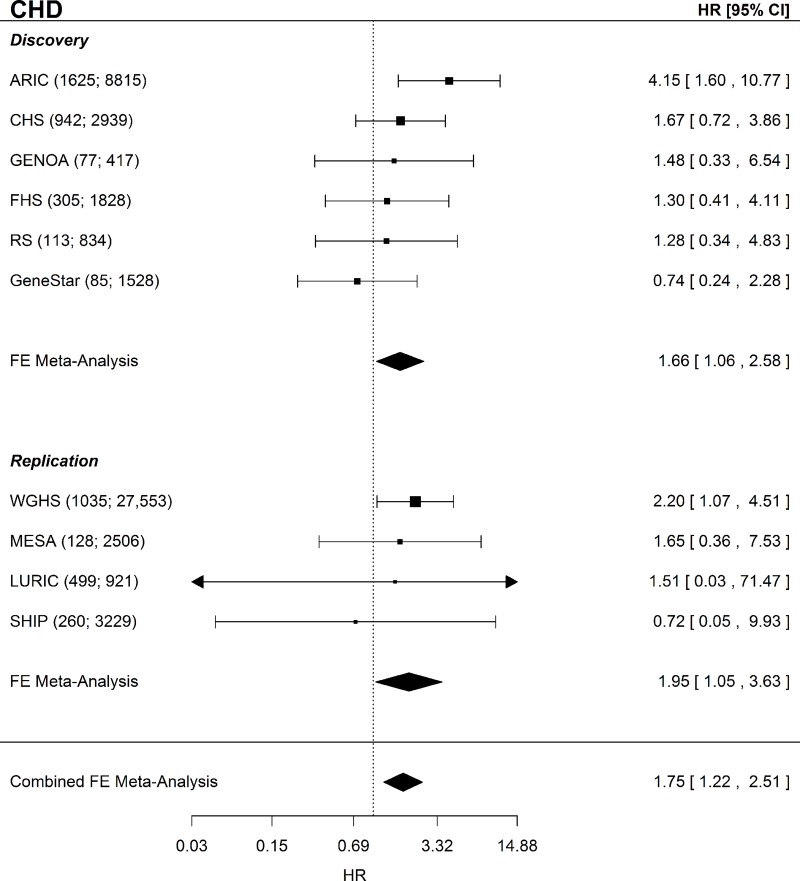
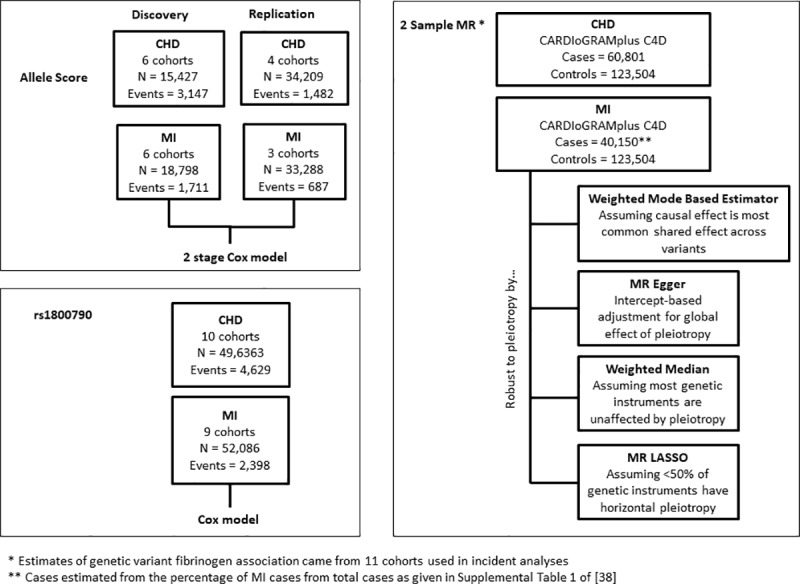
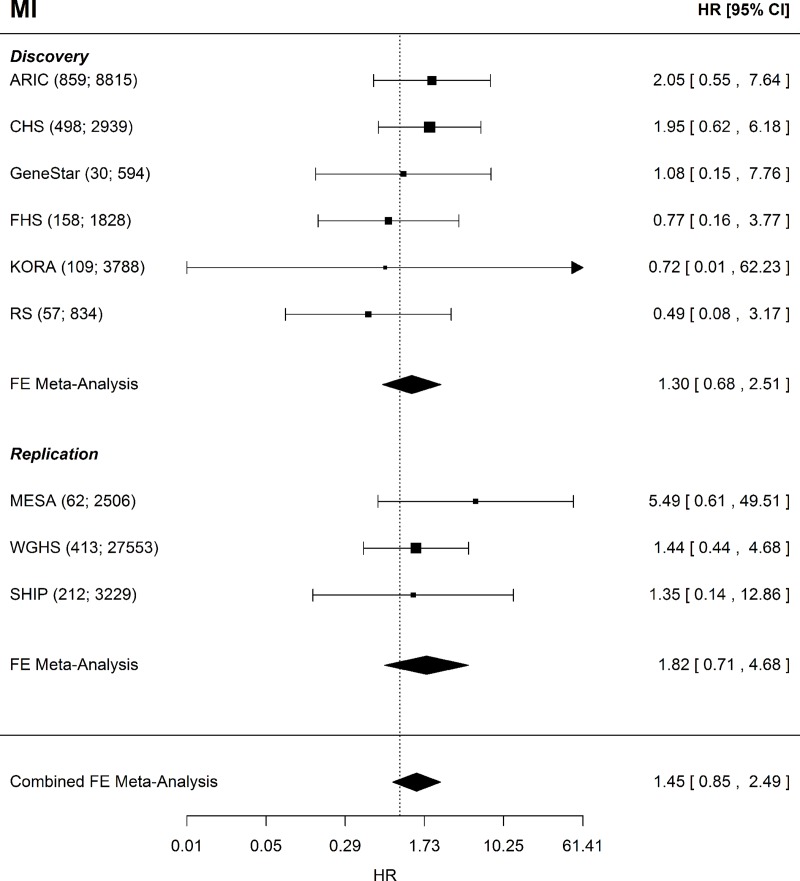
We evaluated evidence for a causal effect of fibrinogen on both CHD and MI using MR. We used both an allele score approach and pleiotropy robust MR models. The allele score was composed of 38 fibrinogen-associated variants from recent GWAS. Initial analyses using the allele score used a meta-analysis of 11 European-ancestry prospective cohorts, free of CHD and MI at baseline, to examine incidence CHD and MI. We also applied 2 sample MR methods with data from a prevalent CHD and MI GWAS. Results are given in terms of the hazard ratio (HR) or odds ratio (OR), depending on the study design, and associated 95% confidence interval (CI). In single variant analyses no causal effect of fibrinogen on CHD or MI was observed. In multi-variant analyses using incidence CHD cases and the allele score approach, the estimated causal effect (HR) of a 1 g/L higher fibrinogen concentration was 1.62 (CI = 1.12, 2.36) when using incident cases and the allele score approach. In 2 sample MR analyses that accounted for pleiotropy, the causal estimate (OR) was reduced to 1.18 (CI = 0.98, 1.42) and 1.09 (CI = 0.89, 1.33) in the 2 most precise (smallest CI) models, out of 4 models evaluated. In the 2 sample MR analyses for MI, there was only very weak evidence of a causal effect in only 1 out of 4 models.
A small causal effect of fibrinogen on CHD is observed using multi-variant MR approaches which account for pleiotropy, but not single variant MR approaches. Taken together, results indicate that even with large sample sizes and multi-variant approaches MR analyses still cannot exclude the null when estimating the causal effect of fibrinogen on CHD, but that any potential causal effect is likely to be much smaller than observed in epidemiological studies.
纤维蛋白原是一种重要的止血因子和心血管疾病风险因素。早期使用孟德尔随机化(MR)评估纤维蛋白原对冠心病(CHD)和心肌梗死(MI)的因果效应的尝试使用了单一变异方法,并且没有利用最近的全基因组关联研究(GWAS)或多变异、多效稳健的 MR 方法。
我们使用 MR 评估了纤维蛋白原对 CHD 和 MI 的因果效应的证据。我们使用了等位基因评分方法和多效稳健的 MR 模型。等位基因评分由最近的 GWAS 中的 38 个纤维蛋白原相关变异组成。使用 11 个欧洲血统的前瞻性队列的荟萃分析,这些队列在基线时没有 CHD 和 MI,来评估 CHD 和 MI 的发生率,初始分析使用了等位基因评分。我们还应用了 2 种样本 MR 方法,数据来自 CHD 和 MI 的 GWAS。结果以风险比(HR)或比值比(OR)表示,具体取决于研究设计和相关的 95%置信区间(CI)。在单变异分析中,没有观察到纤维蛋白原对 CHD 或 MI 的因果效应。在使用发病率 CHD 病例和等位基因评分方法的多变量分析中,当使用发病率病例和等位基因评分方法时,纤维蛋白原浓度每升高 1g/L 的估计因果效应(HR)为 1.62(CI=1.12,2.36)。在考虑多效性的 2 种样本 MR 分析中,在评估的 4 种模型中,因果估计值(OR)分别减少到 1.18(CI=0.98,1.42)和 1.09(CI=0.89,1.33),这两种模型是最精确的(CI 最小)模型。在 MI 的 2 种样本 MR 分析中,只有在 4 种模型中的 1 种中观察到纤维蛋白原对 MI 的因果效应的微弱证据。
使用多变量 MR 方法(考虑多效性)可以观察到纤维蛋白原对 CHD 的微小因果效应,但使用单变量 MR 方法则不能。总的来说,结果表明,即使使用大样本量和多变量方法,MR 分析在估计纤维蛋白原对 CHD 的因果效应时仍不能排除无效假设,但任何潜在的因果效应可能比在流行病学研究中观察到的要小得多。