Postgraduate Program in Epidemiology, Federal University of Pelotas, Pelotas, Brazil.
MRC Integrative Epidemiology Unit.
Int J Epidemiol. 2017 Dec 1;46(6):1985-1998. doi: 10.1093/ije/dyx102.
Mendelian randomization (MR) is being increasingly used to strengthen causal inference in observational studies. Availability of summary data of genetic associations for a variety of phenotypes from large genome-wide association studies (GWAS) allows straightforward application of MR using summary data methods, typically in a two-sample design. In addition to the conventional inverse variance weighting (IVW) method, recently developed summary data MR methods, such as the MR-Egger and weighted median approaches, allow a relaxation of the instrumental variable assumptions.
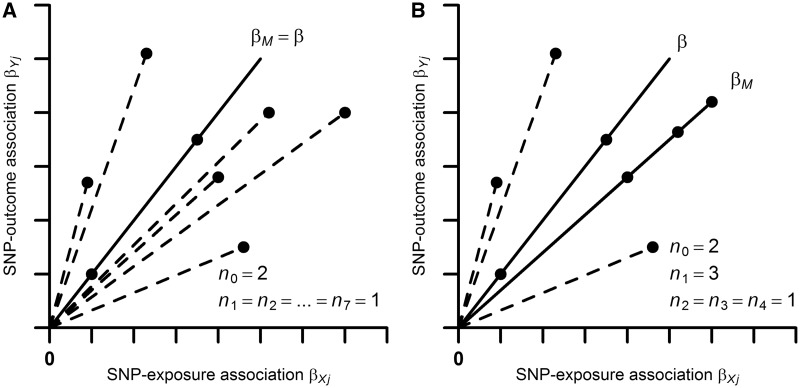
Here, a new method - the mode-based estimate (MBE) - is proposed to obtain a single causal effect estimate from multiple genetic instruments. The MBE is consistent when the largest number of similar (identical in infinite samples) individual-instrument causal effect estimates comes from valid instruments, even if the majority of instruments are invalid. We evaluate the performance of the method in simulations designed to mimic the two-sample summary data setting, and demonstrate its use by investigating the causal effect of plasma lipid fractions and urate levels on coronary heart disease risk.
The MBE presented less bias and lower type-I error rates than other methods under the null in many situations. Its power to detect a causal effect was smaller compared with the IVW and weighted median methods, but was larger than that of MR-Egger regression, with sample size requirements typically smaller than those available from GWAS consortia.
The MBE relaxes the instrumental variable assumptions, and should be used in combination with other approaches in sensitivity analyses.
孟德尔随机化(MR)越来越多地被用于加强观察性研究中的因果推断。来自大型全基因组关联研究(GWAS)的各种表型的遗传关联汇总数据的可用性允许使用汇总数据方法(通常在两样本设计中)直接应用 MR。除了传统的逆方差加权(IVW)方法外,最近开发的汇总数据 MR 方法,如 MR-Egger 和加权中位数方法,允许放松工具变量假设。
这里提出了一种新的方法 - 基于模式的估计(MBE) - 用于从多个遗传工具中获得单个因果效应估计。当最大数量的相似(在无限样本中相同)个体工具因果效应估计来自有效工具时,MBE 是一致的,即使大多数工具都是无效的。我们通过模拟两样本汇总数据设置的模拟来评估该方法的性能,并通过研究血浆脂质分数和尿酸水平对冠心病风险的因果效应来证明其用途。
在许多情况下,MBE 在零假设下比其他方法具有更小的偏差和更低的第一类错误率。与 IVW 和加权中位数方法相比,其检测因果效应的能力较小,但与 MR-Egger 回归相比,其所需的样本量通常小于 GWAS 联盟的样本量。
MBE 放宽了工具变量假设,应与敏感性分析中的其他方法结合使用。