School of Medicine, Chang Gung University, Kweishan, Taoyuan, Taiwan.
Department of Pediatrics, Chang Gung Memorial Hospital at Linkou, No. 5, Fu-Shin Street, Kweishan, 333, Taoyuan, Taiwan.
BMC Infect Dis. 2019 May 10;19(1):402. doi: 10.1186/s12879-019-4033-0.
There have been no reports regarding clinical features and molecular characteristics of childhood methicillin-susceptible Staphylococcus aureus (MSSA) infections in Taiwan.
We prospectively collected clinical S. aureus isolates from patients aged < 18 years in a university-affiliated hospital in 2015. Only the first isolate from each patient was included. Medical records were retrospectively reviewed. Patients were classified as community-associated (CA) or healthcare-associated (HA) by the epidemiologic criteria. All MSSA isolates were molecularly characterized.
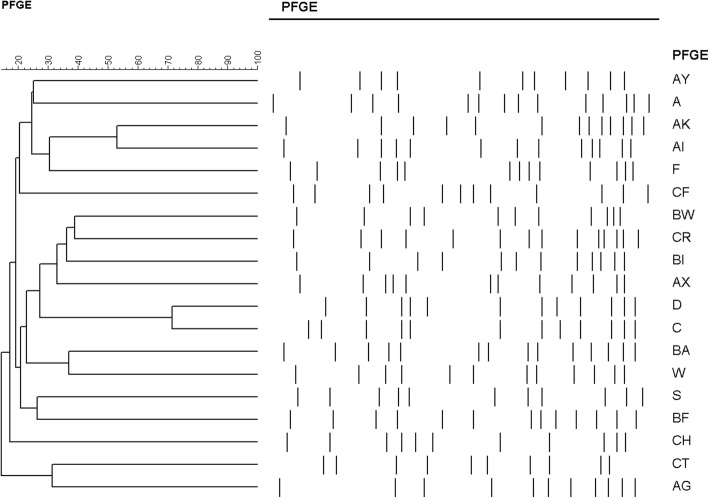
A total of 495 S. aureus isolates were identified, and 178 (36.0%) were MSSA. Among the 131 MSSA-infected patients enrolled, 94 (71.8%) were community-associated and 60 (45.8%) were inpatients. Patients with HA infections was significantly younger than those with CA infections (median, 15 vs. 67.5 months). The most common specimen of MSSA identified was pus or wound (73.3%). Compared to HA-MSSA, CA-MSSA isolates were significantly less frequently from sputum (6.4% vs. 27%, p = 0.001). Nineteen pulsotypes were identified. Four pulsotypes accounted for 60% of the isolates. Isolates of ST15/pulsotype F were more frequently seen in CA than in HA (p = 0.064) while isolates of ST188/pulsotype AX frequently seen in HA (p = 0.049). PVL genes were identified in 11 isolates (8.4%), nine of which were characterized as ST59/pulsotype D, same as the local endemic CA-MRSA clone.
MSSA accounted for around one-third of childhood S. aureus infections in northern Taiwan. SSTI was the most common manifestation. The molecular characteristics of these clinical MSSA isolates were relatively diverse and had certain significant differences between CA and HA isolates.
台湾地区尚无儿童耐甲氧西林金黄色葡萄球菌(MSSA)感染的临床特征和分子特征的报道。
我们前瞻性地收集了 2015 年在一所大学附属医院就诊的<18 岁患者的临床金黄色葡萄球菌分离株。仅纳入每位患者的第一个分离株。回顾性查阅病历。根据流行病学标准将患者分为社区相关(CA)或医疗保健相关(HA)。所有 MSSA 分离株均进行了分子特征分析。
共鉴定出 495 株金黄色葡萄球菌分离株,其中 178 株(36.0%)为 MSSA。在纳入的 131 例 MSSA 感染患者中,94 例(71.8%)为 CA,60 例(45.8%)为住院患者。HA 感染患者明显比 CA 感染患者年轻(中位数,15 岁比 67.5 个月)。MSSA 最常见的标本是脓液或伤口(73.3%)。与 HA-MSSA 相比,CA-MSSA 分离株来自痰液的比例明显较低(6.4%比 27%,p=0.001)。共鉴定出 19 种脉冲场凝胶电泳(PFGE)型,其中 4 种型占所有分离株的 60%。ST15/pulsotype F 分离株在 CA 中比在 HA 中更常见(p=0.064),而 ST188/pulsotype AX 分离株在 HA 中更常见(p=0.049)。11 株(8.4%)分离株中检测到 PVL 基因,其中 9 株为 ST59/pulsotype D,与当地流行的 CA-MRSA 克隆相同。
MSSA 约占台湾北部儿童金黄色葡萄球菌感染的三分之一。SSTI 是最常见的表现形式。这些临床 MSSA 分离株的分子特征相对多样化,且 CA 和 HA 分离株之间存在一定的显著差异。