Obstetrics and Gynecology Department, School of Medical Sciences of Unicamp, Rua Alexander Fleming 101, Campinas, 13083-790, Brazil.
Medicine School of PUC-Campinas, Av. John Boyd Dunlop s/n, Campinas, 13060-904, Brazil.
BMC Cancer. 2019 May 10;19(1):432. doi: 10.1186/s12885-019-5647-8.
Breast cancer is the most common female cancer in Brazil with an estimated 60 thousand new cases per year. Widespread use of mammography opportunistic screening has been observed in the last 20 years, including women under 50 years old. The present study aimed to analyse the trends in breast cancer stage distribution at diagnosis as a function of age in the study period.
This paper examined temporal trends of stage distribution in women with breast cancer diagnosed between 2000 and 2015 in São Paulo state, Brazil. Data from the Hospital Cancer Registry of the region were utilized. Completeness was high. The sample was described according to age, stage and date of diagnosis using absolute frequency and proportions (%). For trends, the Cochran-Armitage test was used with a 5% level of significance (P-value< 0.05).
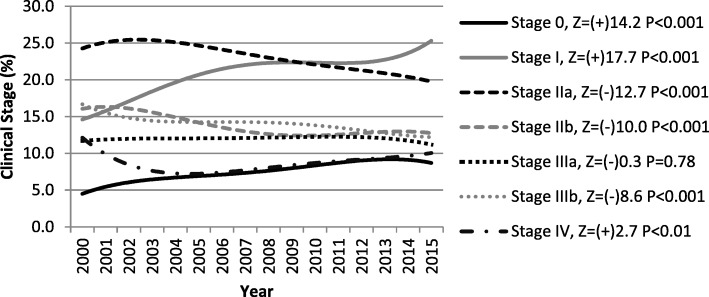
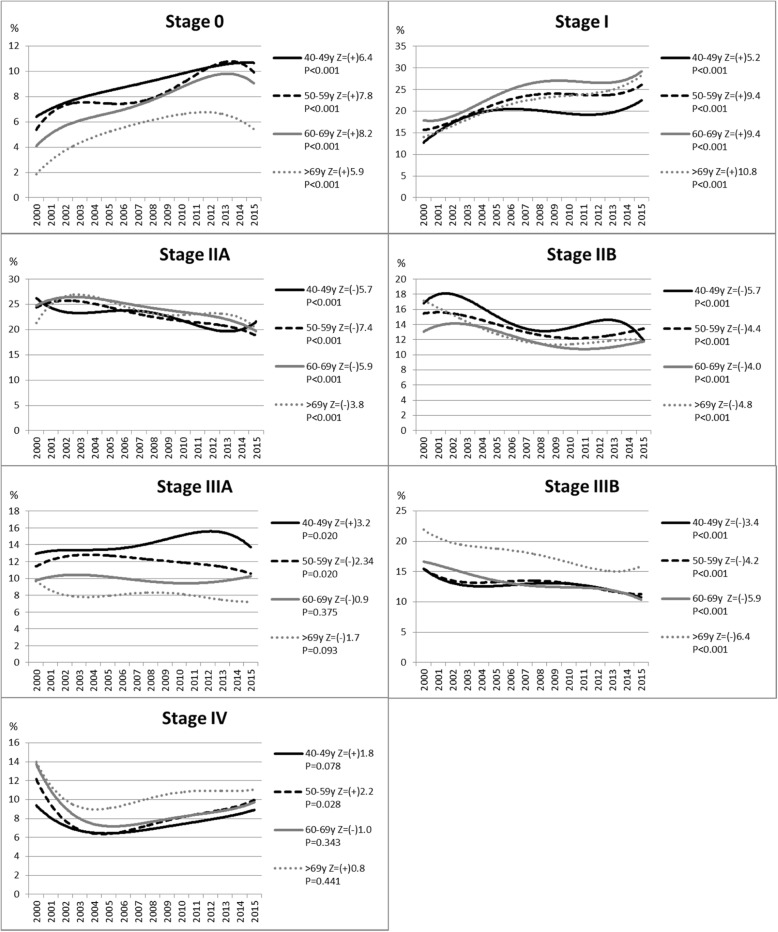
A total of 93,674 women were included in the analysis with a median age of 56 years old. One-third (34.4%) of the women were younger than 50 years old, and stage II was the most frequent stage (36.4%), even when analysed by age groups. Stage 0 corresponded to 7.7% (7247 women) of cases. In the study period, there was a significant trend towards an increase in Stages 0, I and IV (P < 0.01) and a trend towards a decrease in Stages IIA, IIB and IIIB (P < 0.001). Stage IIA was more prevalent until 2009, and stage I was more prevalent thereafter. The trends to increase the proportion of Stages 0 and I and to decrease the proportion of stages IIA, IIB and IIIB were significant in all age groups.
Breast cancer cases are diagnosed mainly at early stages, and approximately one-third of cases are younger than 50 years old. Downstaging has been shown. Opportunistic screening may have supported these results. Further studies are needed to show whether these results will impact the prognosis.
乳腺癌是巴西最常见的女性癌症,每年估计有 6 万例新发病例。在过去的 20 年中,广泛开展了机会性筛查乳腺 X 线摄影,包括 50 岁以下的女性。本研究旨在分析研究期间诊断时乳腺癌分期分布随年龄变化的趋势。
本文分析了 2000 年至 2015 年期间在巴西圣保罗州诊断为乳腺癌的女性的分期分布的时间趋势。该研究使用了该地区医院癌症登记处的数据。数据完整性较高。根据年龄、分期和诊断日期,使用绝对频率和比例(%)对样本进行描述。对于趋势,使用 Cochran-Armitage 检验,显著性水平为 5%(P 值<0.05)。
共纳入 93674 名女性进行分析,中位年龄为 56 岁。三分之一(34.4%)的女性年龄小于 50 岁,即使按年龄组分析,最常见的分期也是 II 期(36.4%)。0 期相当于 7.7%(7247 例)的病例。在研究期间,0 期、I 期和 IV 期呈显著上升趋势(P<0.01),IIA、IIB 和 IIIB 期呈下降趋势(P<0.001)。直到 2009 年,IIA 期更为常见,此后 I 期更为常见。在所有年龄组中,增加 0 期和 I 期比例以及减少 IIA、IIB 和 IIIB 期比例的趋势均具有统计学意义。
乳腺癌病例主要诊断为早期,约三分之一的病例年龄小于 50 岁。降期现象明显。机会性筛查可能支持了这些结果。需要进一步研究以显示这些结果是否会影响预后。