SGS, Mechelen, Belgium.
Global Clinical Development, Chiesi Farmaceutici S.p.A, Parma, Italy.
CPT Pharmacometrics Syst Pharmacol. 2019 Jul;8(7):460-468. doi: 10.1002/psp4.12405. Epub 2019 May 11.
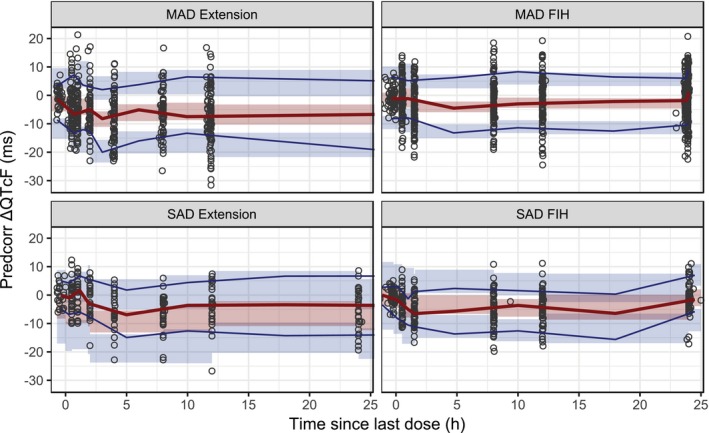
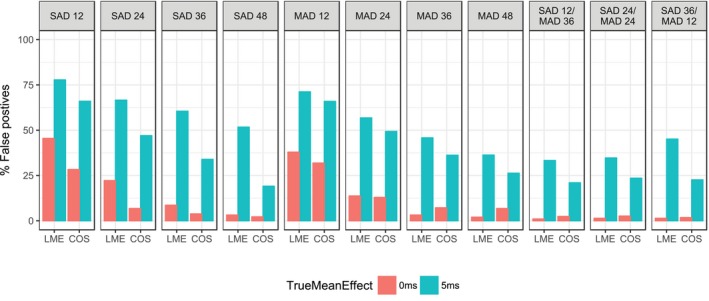
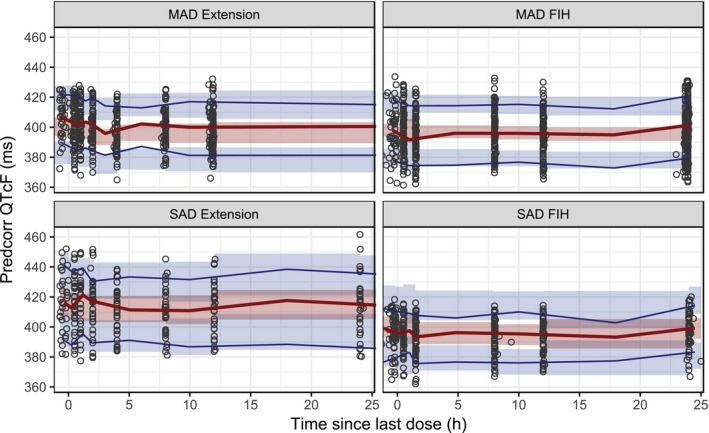
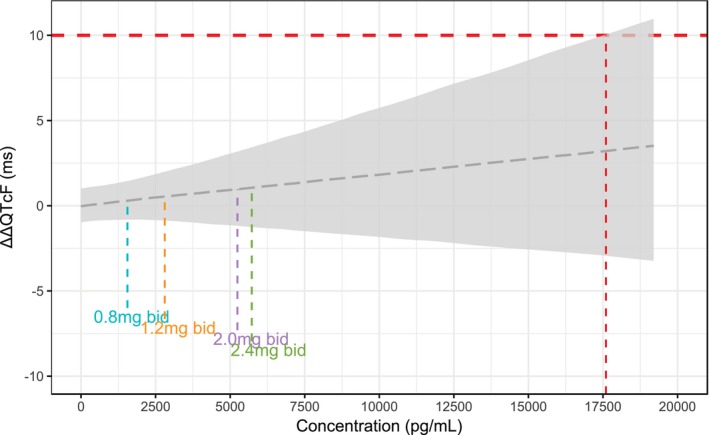
Concentration-QTcF data obtained from two phase I studies in healthy volunteers treated with a novel phosphodiesterase-4 inhibitor currently under development for the treatment of chronic obstructive pulmonary disease were analyzed by means of mixed-effects modeling. A simple linear mixed-effects model and a more complex model that included oscillatory functions were employed and compared. The slope of the concentration-QTcF relationship was not significantly greater than 0 in both approaches, and the simulations showed that the upper limit of the 90% confidence interval around the mean ΔΔQTcF is not expected to exceed 10 ms within the range of clinically relevant concentrations. An additional simulation study confirmed the robustness of the simple linear mixed-effects model for the analysis of concentration-QT data and supported the modeling of data obtained from studies with different designs (parallel and crossover).
采用混合效应模型分析了目前正在开发用于治疗慢性阻塞性肺疾病的新型磷酸二酯酶-4 抑制剂在健康志愿者中进行的两项 I 期研究中的浓度-QTcF 数据。使用了简单的线性混合效应模型和更复杂的包含振荡函数的模型,并对其进行了比较。两种方法中,浓度-QTcF 关系的斜率均不显著大于 0,模拟结果表明,在临床相关浓度范围内,平均 ΔΔQTcF 的 90%置信区间上限预计不会超过 10 ms。另外一项模拟研究证实了简单线性混合效应模型用于分析浓度-QT 数据的稳健性,并支持对具有不同设计(平行和交叉)的研究数据进行建模。