Scherrer Jeffrey F, Salas Joanne, Lustman Patrick, Tuerk Peter, Gebauer Sarah, Norman Sonya B, Schneider F David, Chard Kathleen M, van den Berk-Clark Carissa, Cohen Beth E, Schnurr Paula P
Department of Family and Community Medicine, Saint Louis University School of Medicine, USA.
Harry S. Truman Veterans Administration Medical Center, Columbia, USA.
Eur J Prev Cardiol. 2020 Sep;27(13):1412-1422. doi: 10.1177/2047487319850717. Epub 2019 May 13.
Prescription opioid analgesic use (OAU) is associated with increased risk of cardiovascular disease (CVD). OAU is more common in patients with than without posttraumatic stress disorder (PTSD), and PTSD is associated with higher CVD risk. We determined whether PTSD and OAU have an additive or multiplicative association with incident CVD.
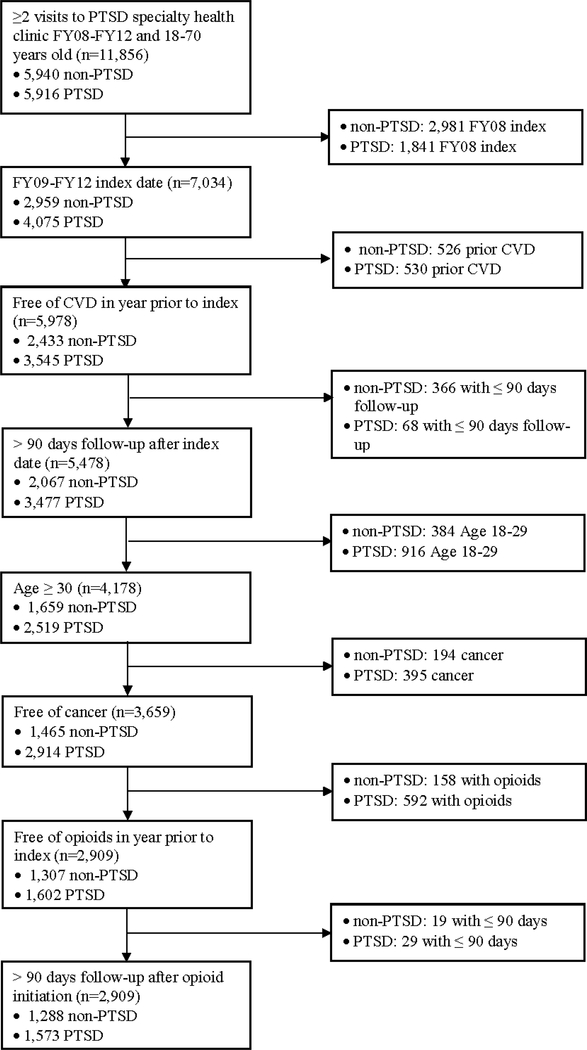
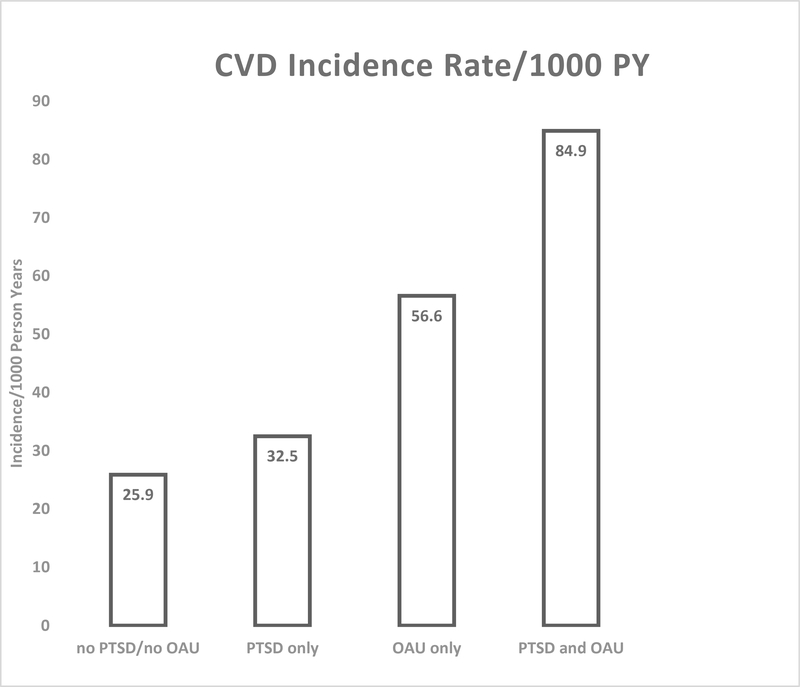
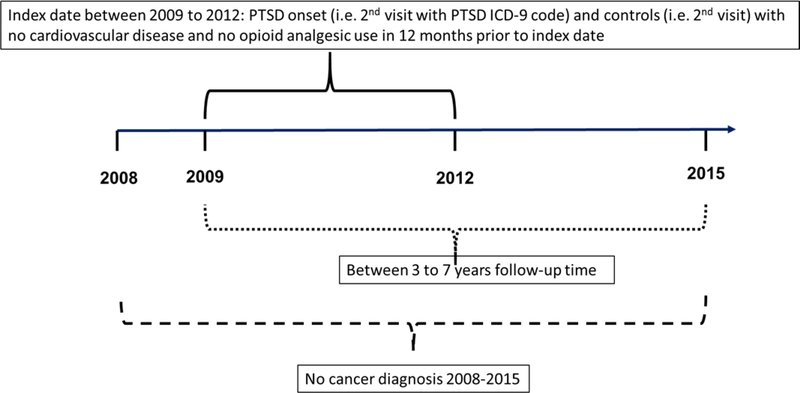
Veterans Health Affairs patient medical record data from 2008 to 2015 was used to identify 2861 patients 30-70 years of age, free of cancer, CVD and OAU for 12 months before index date. We defined a four-level exposure variable: 1) no PTSD/no OAU, 2) OAU alone, 3) PTSD alone and 4) PTSD+OAU. Cox proportional hazard models estimated the association between the exposure variable and incident CVD. The mean age was 49.0 (±11.0), 85.7% were male and 58.3% were White, 34.4% had no PTSD/no OAU, 32.9% had PTSD alone, 10.6% had OAU alone, and 22.1% had PTSD+OAU. Compared with patients with no PTSD/no OAU, those with PTSD alone were not at increased risk of incident CVD (hazard ratio = 0.82; 95% confidence interval (CI): 0.63-1.17); however, OAU alone and PTSD+OAU were both significantly associated with incident CVD (hazard ratio = 1.99; 95% CI:1.36-2.92 and hazard ratio = 2.20; 95% CI: 1.61-3.02). There was no significant additive or multiplicative PTSD and OAU association with incident CVD.
OAU is associated with nearly a two-fold increased risk of CVD in patients with and without PTSD. Despite no additive or multiplicative interaction effects, the high prevalence of OAU in PTSD may represent a novel contributor to the elevated CVD burden among patients with PTSD.
处方阿片类镇痛药的使用(OAU)与心血管疾病(CVD)风险增加相关。OAU在患有创伤后应激障碍(PTSD)的患者中比未患PTSD的患者更常见,且PTSD与更高的CVD风险相关。我们确定了PTSD和OAU与新发CVD之间是存在相加还是相乘关联。
利用退伍军人健康管理局2008年至2015年患者病历数据,确定了2861例年龄在30至70岁之间、在索引日期前12个月无癌症、CVD和OAU的患者。我们定义了一个四级暴露变量:1)无PTSD/无OAU,2)仅OAU,3)仅PTSD,4)PTSD+OAU。Cox比例风险模型估计了暴露变量与新发CVD之间的关联。平均年龄为49.0(±11.0)岁,85.7%为男性,58.3%为白人,34.4%无PTSD/无OAU,32.9%仅患有PTSD,10.6%仅使用OAU,22.1%患有PTSD+OAU。与无PTSD/无OAU的患者相比,仅患有PTSD的患者发生新发CVD的风险没有增加(风险比=0.82;95%置信区间(CI):0.63-1.17);然而,仅OAU和PTSD+OAU均与新发CVD显著相关(风险比=1.99;95%CI:1.36-2.92和风险比=2.20;95%CI:1.61-3.02)。PTSD和OAU与新发CVD之间不存在显著的相加或相乘关联。
无论有无PTSD,OAU均与CVD风险增加近两倍相关。尽管不存在相加或相乘的交互作用,但PTSD中OAU的高患病率可能是PTSD患者CVD负担升高的一个新因素。