Kadekar Sandeep, Nawale Ganesh N, Karlsson Kira, Ålander Cecilia, Oommen Oommen P, Varghese Oommen P
Translational Chemical Biology Laboratory, Polymer Chemistry Division, Department of Chemistry, Ångström Laboratory, Uppsala University, 751 21 Uppsala, Sweden.
Bioengineering and Nanomedicine Lab, Faculty of Medicine and Health Technology, Tampere University and BioMediTech Institute, 33720 Tampere, Finland.
Mol Ther Nucleic Acids. 2019 Jun 7;16:597-604. doi: 10.1016/j.omtn.2019.04.012. Epub 2019 Apr 19.
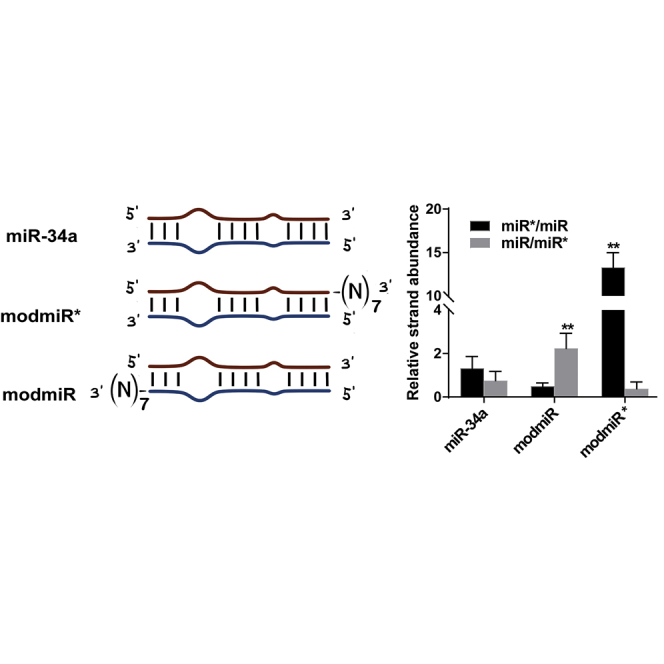
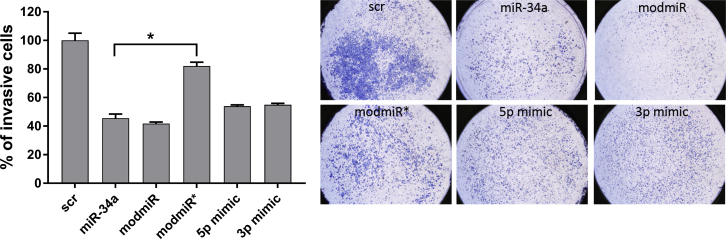
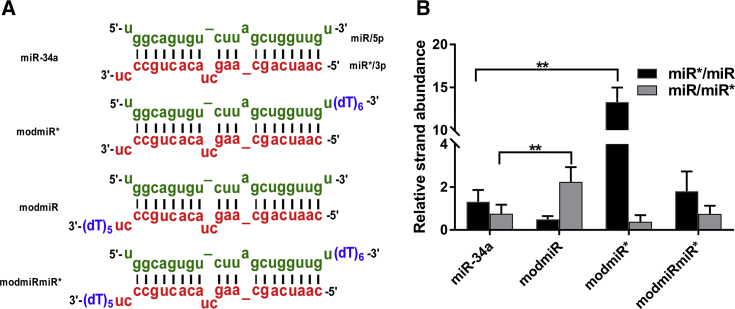
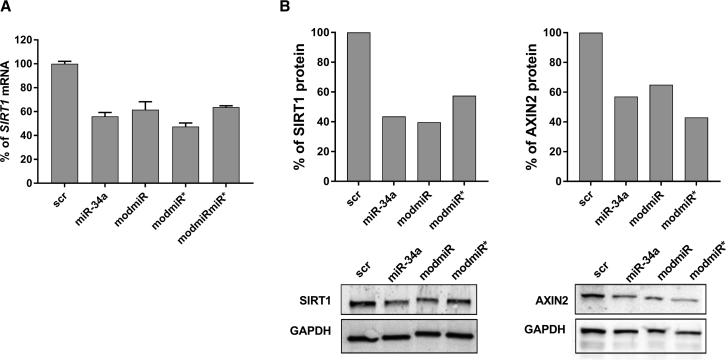
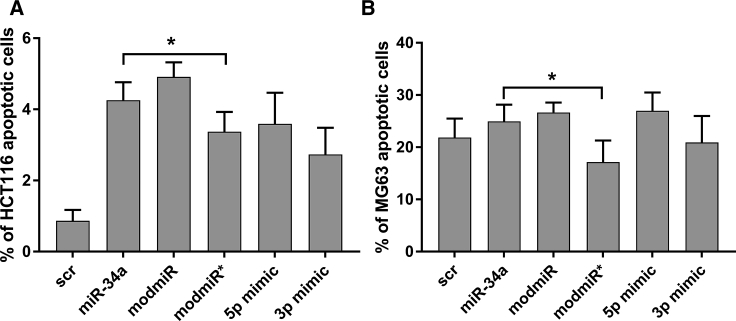
We developed a novel miRNA design that significantly improves strand selection within the RISC complex by engineering the 3' end by adding extra nucleotides. Addition of seven nucleotides at the 3' ends of the miR or miR* strand resulted in a thermodynamic asymmetry at either of the two ends, which resulted in selective RISC recruitment, as demonstrated by a stem-loop PCR experiment. Such selective recruitment was also corroborated at the protein level by western blot analysis. To investigate the functional effect because of selective recruitment, we performed apoptosis and metastasis studies using human colon carcinoma cells (HCT116) and human osteosarcoma cells (MG63). These experiments indicated that recruitment of the miR strand is responsible for inducing apoptosis and inhibiting the invasiveness of cancer cells. Recruitment of the miR* strand, on the other hand, had the opposite effect. To the best of our knowledge, our strand engineering strategy is the first report of improved strand selection of a desired miRNA strand by RISC without using any chemical modifications or mismatches. We believe that such structural modifications of miR34a could mitigate some of the off-target effects of miRNA therapy and would also allow a better understanding of sequence-specific gene regulation. Such a design could also be adapted to other miRNAs to enhance their therapeutic potential.
我们开发了一种新型的微小RNA(miRNA)设计,通过在3'端添加额外的核苷酸对其进行工程改造,从而显著改善RNA诱导沉默复合体(RISC)中的链选择。在miR或miR链的3'端添加七个核苷酸会在两端之一产生热力学不对称性,这导致了RISC的选择性招募,茎环PCR实验证明了这一点。蛋白质印迹分析在蛋白质水平上也证实了这种选择性招募。为了研究由于选择性招募导致的功能效应,我们使用人结肠癌细胞(HCT116)和人骨肉瘤细胞(MG63)进行了凋亡和转移研究。这些实验表明,miR链的招募负责诱导癌细胞凋亡并抑制其侵袭性。另一方面,miR链的招募则产生相反的效果。据我们所知,我们的链工程策略是首次报道在不使用任何化学修饰或错配的情况下,RISC对所需miRNA链的链选择得到改善。我们相信,miR34a的这种结构修饰可以减轻miRNA疗法的一些脱靶效应,并且还能更好地理解序列特异性基因调控。这种设计也可以应用于其他miRNA,以增强它们的治疗潜力。