Emotion and Development Branch, National Institute of Mental Health, 9000 Rockville Pike, Building 15K, Bethesda, MD, 20892-2670, USA.
Department of Psychology, University of California-Los Angeles, 1285 Franz Hall, Los Angeles, CA, 90025, USA.
Behav Res Ther. 2019 Jul;118:141-149. doi: 10.1016/j.brat.2019.04.007. Epub 2019 Apr 22.
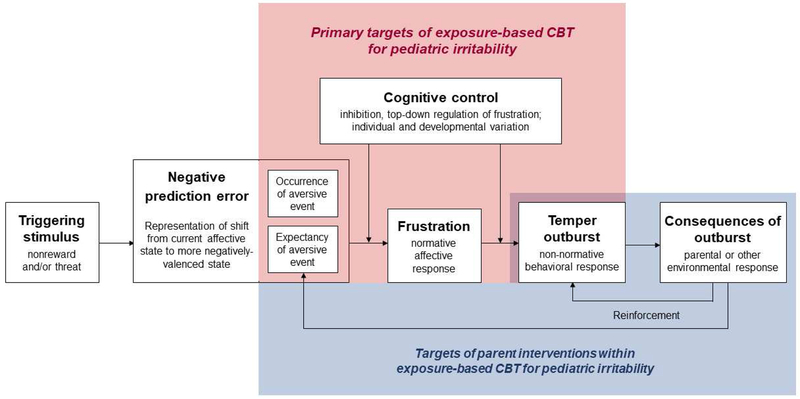
Pediatric irritability is prevalent and impairing, yet little is known about its pathophysiology and treatment. In this article, we build on our and others' previous work to posit core mechanisms of irritability operating across the brain, behavior, and environment. Specifically, we propose proximal processes that surround the symptomatology of irritability and are potential targets for an exposure-based cognitive-behavioral therapy (CBT) for irritability that our group has developed. The heart of this model focuses on neurocognitive processes: youth's encoding of nonreward and threat stimuli, which involves prediction error signaling in the brain, and cognitive control in the context of frustration. Alterations in these processes are theorized to be central to chronic, severe irritability. Environmental responses to youth's symptom expression are also examined. Exposure-based CBT for irritability utilizes controlled, in vivo exposure to nonreward and threat stimuli with the aim to engage cognitive control and target top-down regulation of frustration. This intervention integrates selected parent management training techniques to target symptom reinforcement processes. Continued pathophysiological and treatment studies of irritability will not only refine our emerging understanding of the phenotype, but also inform broader questions on the brain and behavioral mechanisms of CBT efficacy.
儿科烦躁是普遍存在且具有损害性的,但对于其病理生理学和治疗方法却知之甚少。在本文中,我们基于我们和其他人之前的工作,提出了在大脑、行为和环境中普遍存在的烦躁核心机制。具体来说,我们提出了围绕烦躁症状的近端过程,这些过程可能是我们小组开发的基于暴露的认知行为疗法(CBT)治疗烦躁的潜在靶点。该模型的核心重点是神经认知过程:青少年对非奖励和威胁刺激的编码,这涉及大脑中的预测误差信号,以及在挫折情境下的认知控制。这些过程的改变被认为是慢性、严重烦躁的核心。我们还研究了环境对青少年症状表达的反应。基于暴露的烦躁症 CBT 利用对非奖励和威胁刺激的受控、现场暴露,旨在参与认知控制,并针对挫折的自上而下调节。这种干预措施整合了一些父母管理训练技术,以针对症状强化过程。对烦躁症的持续病理生理学和治疗研究不仅将完善我们对表型的新兴理解,还将为 CBT 疗效的大脑和行为机制的更广泛问题提供信息。