Department of Psychology, University of Copenhagen, Copenhagen, Denmark.
Department of Mathematical Sciences, University of Copenhagen, Copenhagen, Denmark.
PLoS One. 2019 May 14;14(5):e0216322. doi: 10.1371/journal.pone.0216322. eCollection 2019.
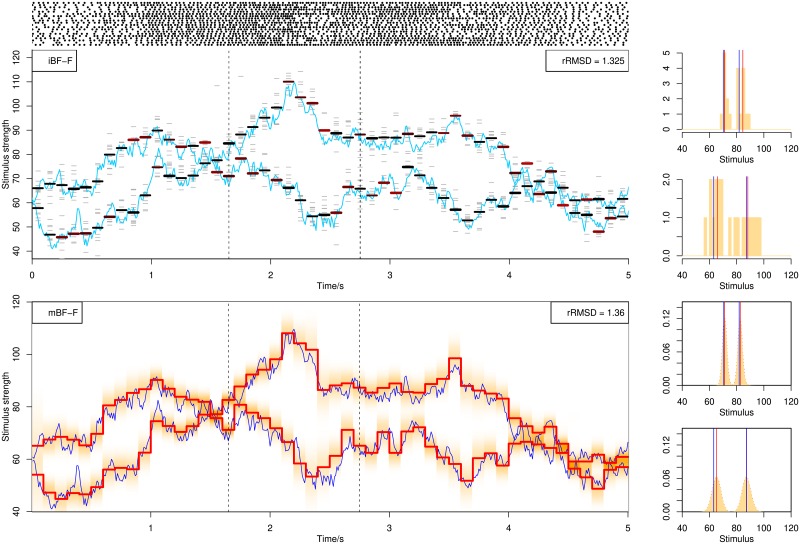
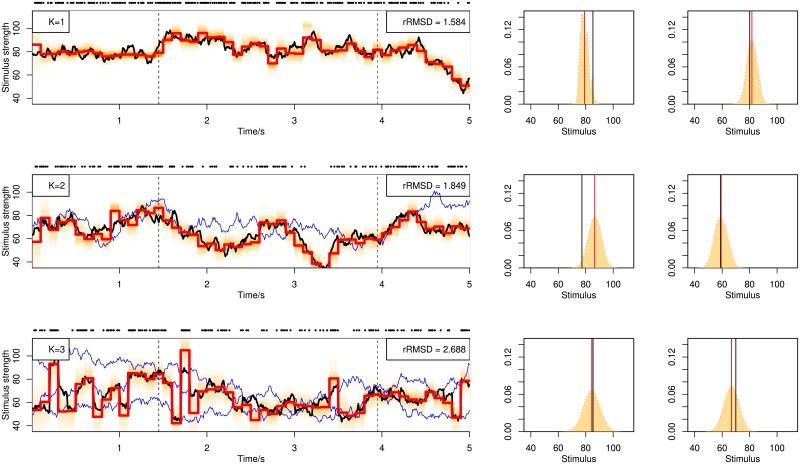
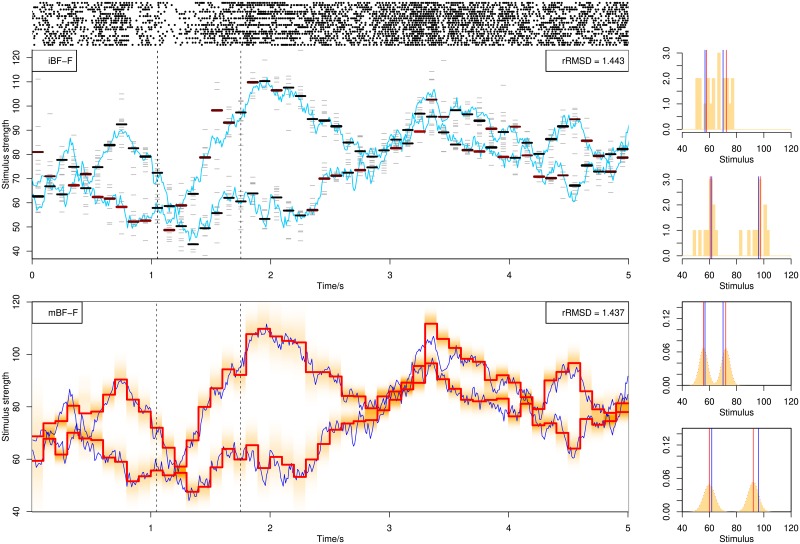
How the brain makes sense of a complicated environment is an important question, and a first step is to be able to reconstruct the stimulus that give rise to an observed brain response. Neural coding relates neurobiological observations to external stimuli using computational methods. Encoding refers to how a stimulus affects the neuronal output, and entails constructing a neural model and parameter estimation. Decoding refers to reconstruction of the stimulus that led to a given neuronal output. Existing decoding methods rarely explain neuronal responses to complicated stimuli in a principled way. Here we perform neural decoding for a mixture of multiple stimuli using the leaky integrate-and-fire model describing neural spike trains, under the visual attention hypothesis of probability mixing in which the neuron only attends to a single stimulus at any given time. We assume either a parallel or serial processing visual search mechanism when decoding multiple simultaneous neurons. We consider one or multiple stochastic stimuli following Ornstein-Uhlenbeck processes, and dynamic neuronal attention that switches following discrete Markov processes. To decode stimuli in such situations, we develop various sequential Monte Carlo particle methods in different settings. The likelihood of the observed spike trains is obtained through the first-passage time probabilities obtained by solving the Fokker-Planck equations. We show that the stochastic stimuli can be successfully decoded by sequential Monte Carlo, and different particle methods perform differently considering the number of observed spike trains, the number of stimuli, model complexity, etc. The proposed novel decoding methods, which analyze the neural data through psychological visual attention theories, provide new perspectives to understand the brain.
大脑如何理解复杂的环境是一个重要的问题,而第一步是能够重建引起观察到的大脑反应的刺激。神经编码使用计算方法将神经生物学观察结果与外部刺激联系起来。编码是指刺激如何影响神经元输出,并需要构建神经模型和参数估计。解码是指重建导致给定神经元输出的刺激。现有的解码方法很少能够以一种有原则的方式解释神经元对复杂刺激的反应。在这里,我们使用描述神经元尖峰序列的漏失积分和放电模型,在视觉注意力假设下对多个刺激进行神经解码,该假设认为神经元在任何给定时间仅关注单个刺激。当解码多个同时的神经元时,我们假设存在并行或串行处理的视觉搜索机制。我们考虑了一个或多个遵循 Ornstein-Uhlenbeck 过程的随机刺激,以及遵循离散马尔可夫过程的动态神经元注意力切换。为了解码这种情况下的刺激,我们在不同的设置下开发了各种顺序蒙特卡罗粒子方法。通过求解福克-普朗克方程获得的首次通过时间概率来获得观察到的尖峰序列的似然。我们表明,通过顺序蒙特卡罗可以成功地对随机刺激进行解码,并且不同的粒子方法在考虑观察到的尖峰序列的数量、刺激的数量、模型的复杂性等方面表现不同。所提出的新颖解码方法通过心理视觉注意力理论分析神经数据,为理解大脑提供了新的视角。