Kitazawa Noriyuki, Shomura Ayahiko, Mizubayashi Tatsumi, Ando Tsuyu, Nagata Kazufumi, Hayashi Nagao, Takahashi Akira, Yamanouchi Utako, Fukuoka Shuichi
Institute of Crop Science, National Agriculture and Food Research Organization, 2-1-2 Kannondai, Tsukuba, Ibaraki 305-8518, Japan.
Institute of Agrobiological Sciences, National Agriculture and Food Research Organization, 2-1-2 Kannondai, Tsukuba, Ibaraki 305-8518, Japan.
Breed Sci. 2019 Mar;69(1):68-83. doi: 10.1270/jsbbs.18143. Epub 2019 Feb 15.
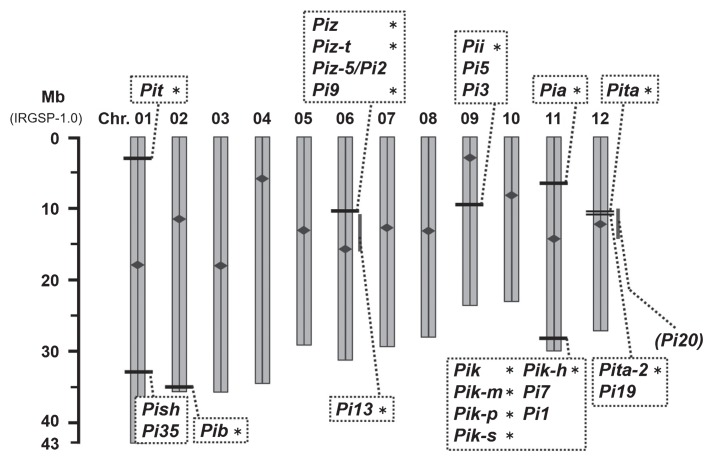
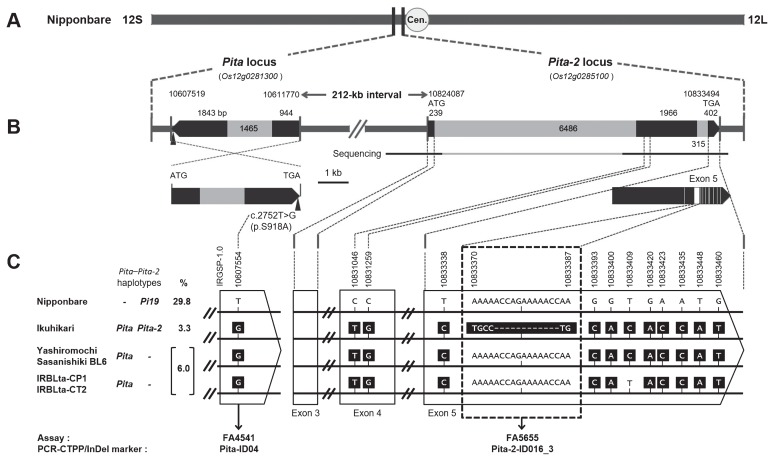
The fungal pathogen causes blast, a severe disease of rice ( L.). Improving blast resistance is important in rice breeding programs. Inoculation tests have been used to select for resistance genotypes, with DNA marker-based selection becoming an efficient alternative. No comprehensive DNA marker system for race-specific resistance alleles in the Japanese rice breeding program has been developed because some loci contain multiple resistance alleles. Here, we used the Fluidigm SNP genotyping platform to determine a set of 96 single nucleotide polymorphism (SNP) markers for 10 loci with race-specific resistance. The markers were then used to evaluate the presence or absence of 24 resistance alleles in 369 cultivars; results were 93.5% consistent with reported inoculation test-based genotypes in varieties. The evaluation system was successfully applied to high-yield varieties with genetic backgrounds. The system includes polymorphisms that distinguish the resistant alleles at the tightly linked and loci, thereby confirming that all the tested cultivars with allele carry allele. We also developed and validated insertion/deletion (InDel) markers for ten resistance loci. Combining SNP and InDel markers is an accurate and efficient strategy for selection for race-specific resistance to blast in breeding programs.
这种真菌病原体引发稻瘟病,这是水稻(Oryza sativa L.)的一种严重病害。提高稻瘟病抗性在水稻育种计划中至关重要。接种试验已被用于筛选抗性基因型,基于DNA标记的选择正成为一种有效的替代方法。由于一些位点包含多个抗性等位基因,日本水稻育种计划中尚未开发出针对小种特异性抗性等位基因的全面DNA标记系统。在此,我们使用Fluidigm SNP基因分型平台确定了一组针对10个具有小种特异性抗性位点的96个单核苷酸多态性(SNP)标记。然后使用这些标记评估369个品种中24个抗性等位基因的存在与否;结果与报道的基于接种试验的178个品种的基因型一致性达93.5%。该评估系统成功应用于具有不同遗传背景的高产品种。该系统包括区分紧密连锁的Pi2和Pi9位点上抗性等位基因的多态性,从而证实所有携带Pi9等位基因的测试品种都携带Pi2等位基因。我们还开发并验证了针对10个抗性位点的插入/缺失(InDel)标记。在育种计划中,结合SNP和InDel标记是筛选对稻瘟病小种特异性抗性的准确有效策略。