Nagata Kazufumi, Ando Tsuyu, Nonoue Yasunori, Mizubayashi Tatsumi, Kitazawa Noriyuki, Shomura Ayahiko, Matsubara Kazuki, Ono Nozomi, Mizobuchi Ritsuko, Shibaya Taeko, Ogiso-Tanaka Eri, Hori Kiyosumi, Yano Masahiro, Fukuoka Shuichi
National Institute of Agrobiological Sciences , 2-1-2 Kannondai, Tsukuba, Ibaraki 305-8602 , Japan.
National Institute of Agrobiological Sciences , 2-1-2 Kannondai, Tsukuba, Ibaraki 305-8602 , Japan ; Institute of the Society for Techno-innovation of Agriculture, Forestry and Fisheries , 446-1 Ippaizuka, Kamiyokoba, Tsukuba, Ibaraki 305-0854 , Japan.
Breed Sci. 2015 Sep;65(4):308-18. doi: 10.1270/jsbbs.65.308. Epub 2015 Sep 1.
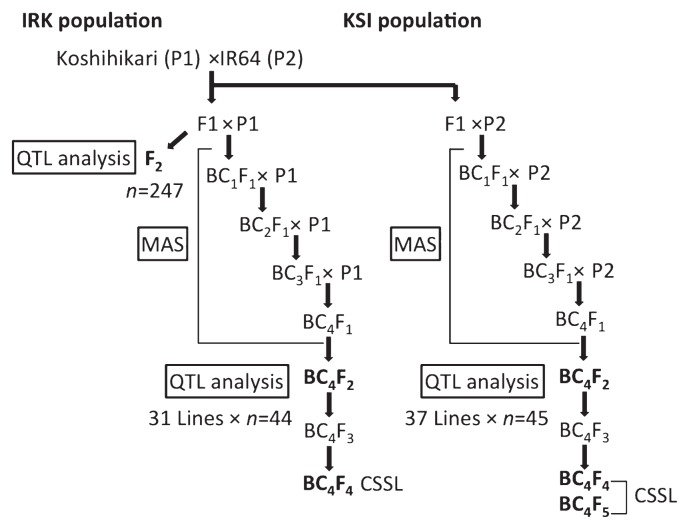
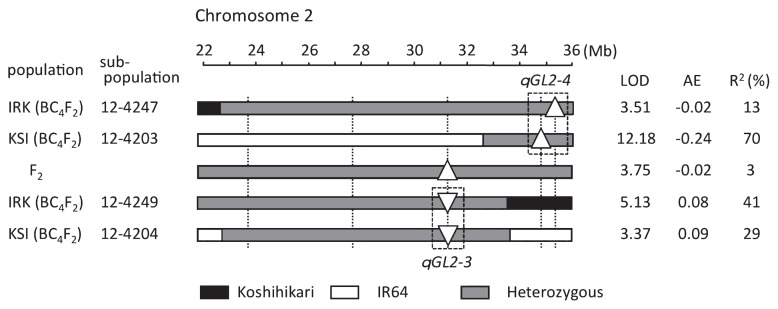
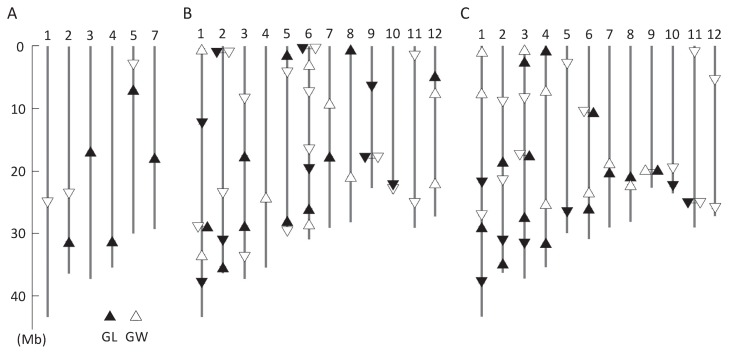
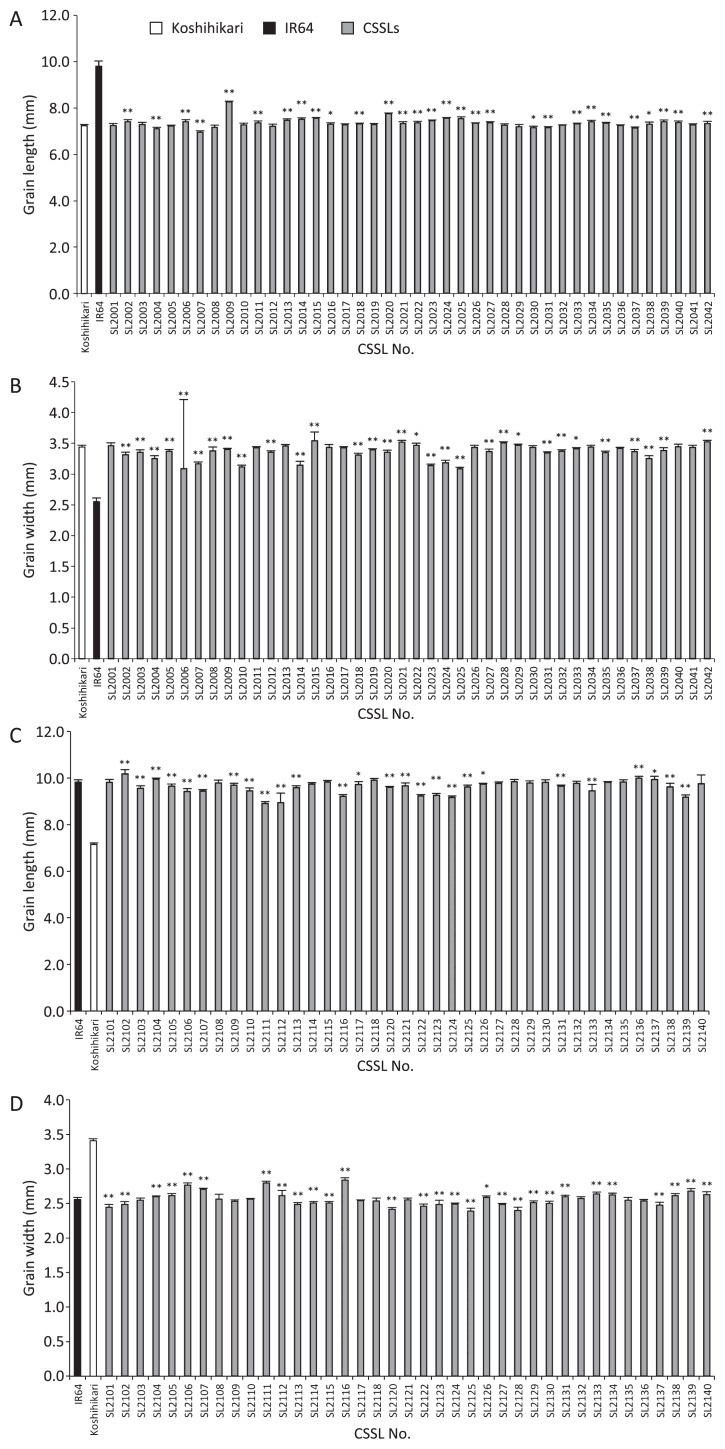
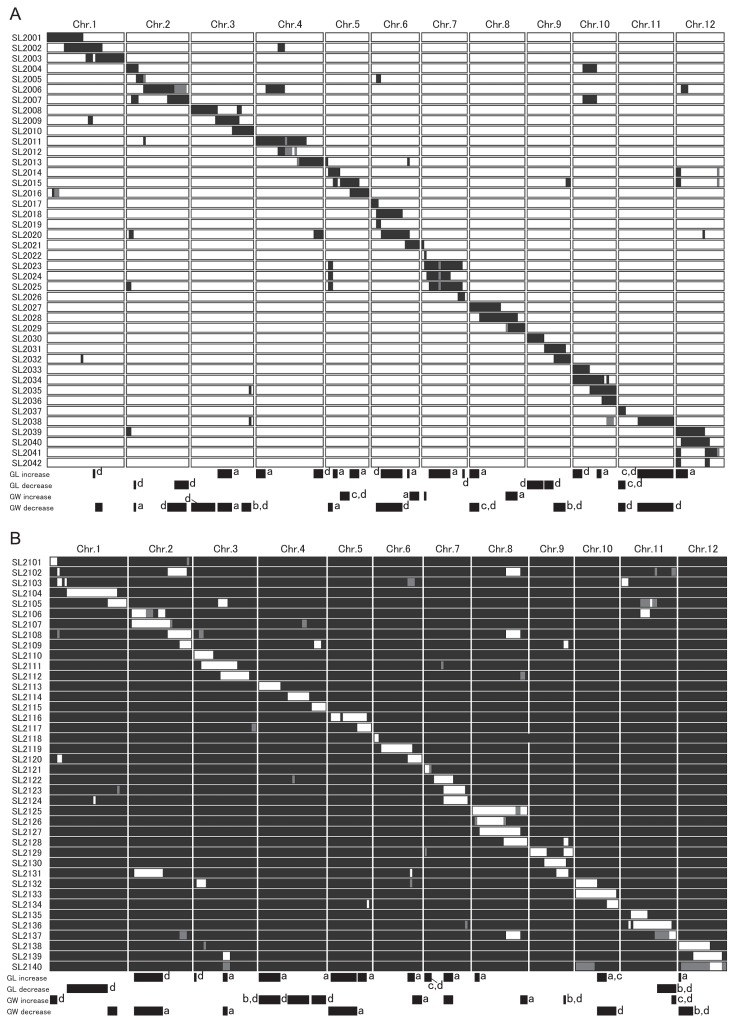
Grain shape is an important trait for improving rice yield. A number of quantitative trait loci (QTLs) for this trait have been identified by using primary F2 mapping populations and recombinant inbred lines, in which QTLs with a small effect are harder to detect than they would be in advanced generations. In this study, we developed two advanced mapping populations (chromosome segment substitution lines [CSSLs] and BC4F2 lines consisting of more than 2000 individuals) in the genetic backgrounds of two improved cultivars: a japonica cultivar (Koshihikari) with short, round grains, and an indica cultivar (IR64) with long, slender grains. We compared the ability of these materials to reveal QTLs for grain shape with that of an F2 population. Only 8 QTLs for grain length or grain width were detected in the F2 population, versus 47 in the CSSL population and 65 in the BC4F2 population. These results strongly suggest that advanced mapping populations can reveal QTLs for agronomic traits under complicated genetic control, and that DNA markers linked with the QTLs are useful for choosing superior allelic combinations to enhance grain shape in the Koshihikari and IR64 genetic backgrounds.
粒形是提高水稻产量的一个重要性状。利用初级F2作图群体和重组自交系已鉴定出许多控制该性状的数量性状位点(QTL),其中效应较小的QTL在这些群体中比在高世代群体中更难检测到。在本研究中,我们在两个改良品种的遗传背景下构建了两个高世代作图群体(染色体片段代换系[CSSL]和由2000多个个体组成的BC4F2群体):一个是粳稻品种(越光),其粒短而圆;另一个是籼稻品种(IR64),其粒长而细。我们将这些材料与F2群体揭示粒形QTL的能力进行了比较。在F2群体中仅检测到8个控制粒长或粒宽的QTL,而在CSSL群体中检测到47个,在BC4F2群体中检测到65个。这些结果有力地表明,高世代作图群体能够揭示复杂遗传控制下的农艺性状QTL,并且与这些QTL连锁的DNA标记有助于在越光和IR64的遗传背景中选择优良等位基因组合来改良粒形。