Clinical Medical College of Yangzhou University, Department of Respiratory Medicine, Subei People's Hospital, Yangzhou, China.
Department of Respiratory Medicine, Subei People's Hospital, Dalian Medical University, Yangzhou, China.
Cancer Med. 2019 Jun;8(6):2979-2993. doi: 10.1002/cam4.2188. Epub 2019 May 14.
Lung large cell neuroendocrine carcinoma (L-LCNEC) is a rare, aggressive tumor, for which the optimal treatment strategies for LCNEC have not yet been established. In order to explore how to improve the outcome of prognosis for patients with LCNEC, this study investigated the effect of different treatments based on the data obtained from the Surveillance, Epidemiology, and End Results (SEER) database.
A total of 2594 LCNEC cases with conditional information were extracted from SEER database. Propensity Score Matching (PSM) method was conducted to reduce possible bias between groups. One-way ANOVA was used to test the differences of characteristics between groups. Univariate and multivariate Cox proportional hazard models were applied to identify prognostic factors.
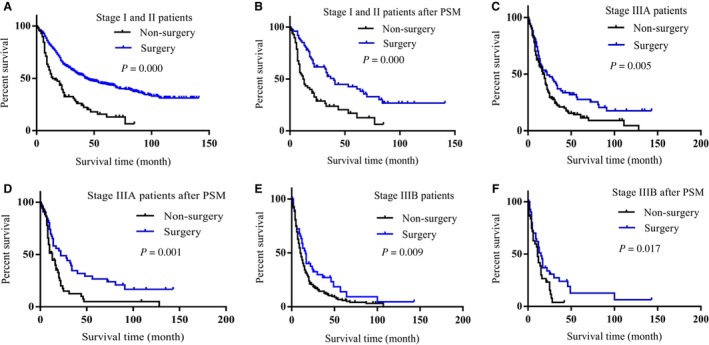
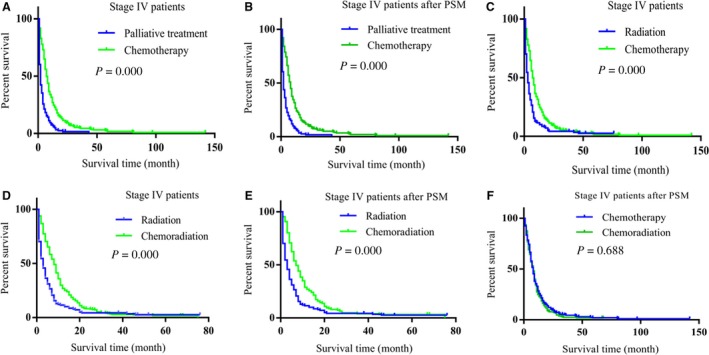
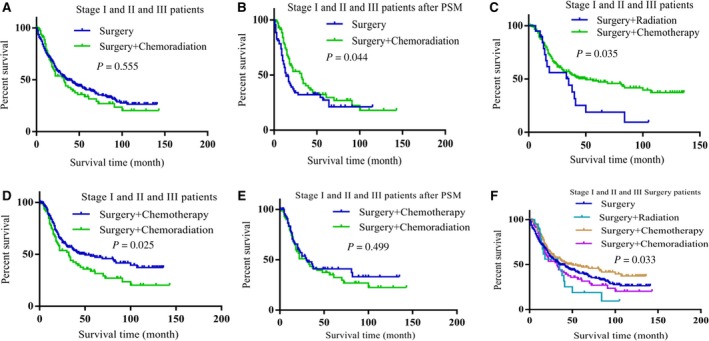
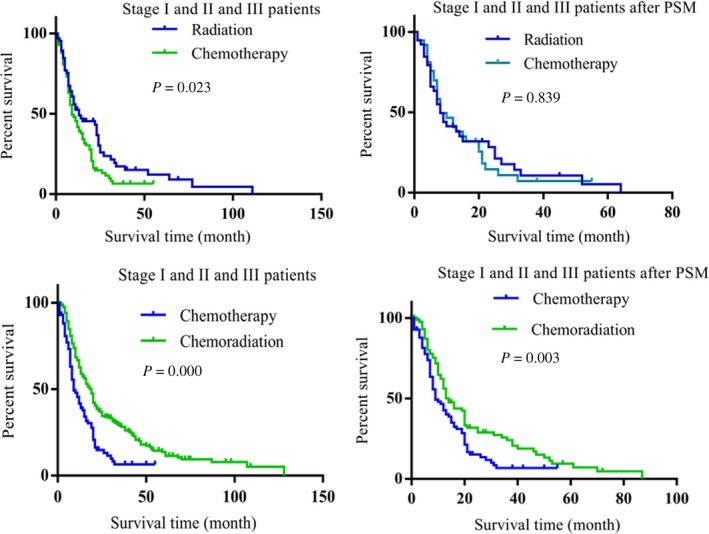
Clinicopathologic characteristics including gender, age, TNM stage, T stage, N stage, and M stage were all identified as independent prognostic factors. Surgery benefited stage I, II, and III LCNEC patients' prognoses. The combination treatment that surgery combining with chemotherapy was the optimal treatment for stage I, II, and III LCENC patients. Compared with palliative treatment, stage IV patients obtained better prognoses with the treatment of radiation, chemotherapy, or chemoradiation. When comparing the effect of the three treatments (radiation, chemotherapy, and chemoradiation) in achieving better prognosis for stage IV patients, chemotherapy alone was better than the other treatments.
Surgery combining with chemotherapy was the optimal treatment for stage I, II, and III LCNEC patients; chemotherapy alone achieves more benefit than the other treatments for stage IV patients.
肺大细胞神经内分泌癌(L-LCNEC)是一种罕见且侵袭性强的肿瘤,目前尚未确定 LCNEC 的最佳治疗策略。为了探讨如何改善 LCNEC 患者的预后,本研究基于监测、流行病学和最终结果(SEER)数据库的数据,探讨了不同治疗方法的效果。
从 SEER 数据库中提取了 2594 例具有条件信息的 LCNEC 病例。采用倾向评分匹配(PSM)方法减少组间可能存在的偏差。采用单因素方差分析检验组间特征差异。采用单变量和多变量 Cox 比例风险模型识别预后因素。
临床病理特征包括性别、年龄、TNM 分期、T 分期、N 分期和 M 分期均被确定为独立预后因素。手术有利于 I 期、II 期和 III 期 LCNEC 患者的预后。手术联合化疗是 I 期、II 期和 III 期 LCNEC 患者的最佳治疗方法。与姑息治疗相比,IV 期患者接受放疗、化疗或放化疗治疗的预后更好。在比较三种治疗方法(放疗、化疗和放化疗)对 IV 期患者获得更好预后的效果时,单独化疗优于其他治疗。
手术联合化疗是 I 期、II 期和 III 期 LCNEC 患者的最佳治疗方法;单独化疗对 IV 期患者的疗效优于其他治疗。