The African Cancer Registry Network, INCTR African Registry Programme, Oxford, United Kingdom.
Nuffield Department of Population Health, University of Oxford, Oxford, United Kingdom.
Int J Cancer. 2020 Mar 1;146(5):1208-1218. doi: 10.1002/ijc.32406. Epub 2019 Jun 14.
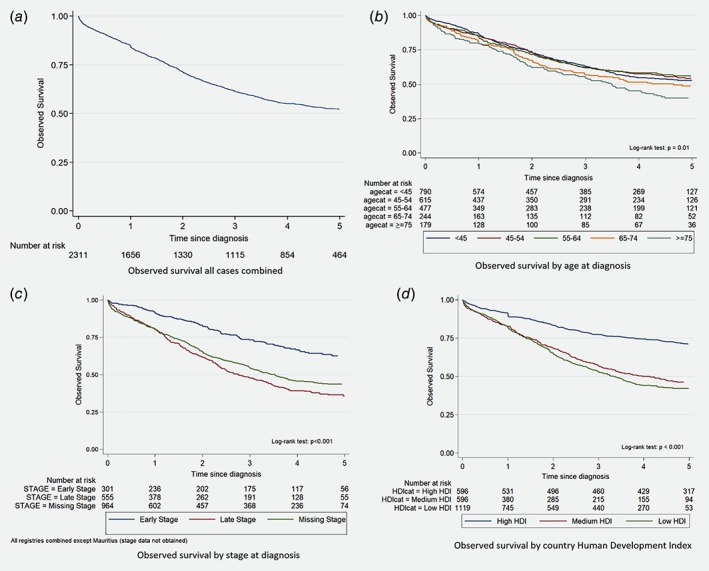
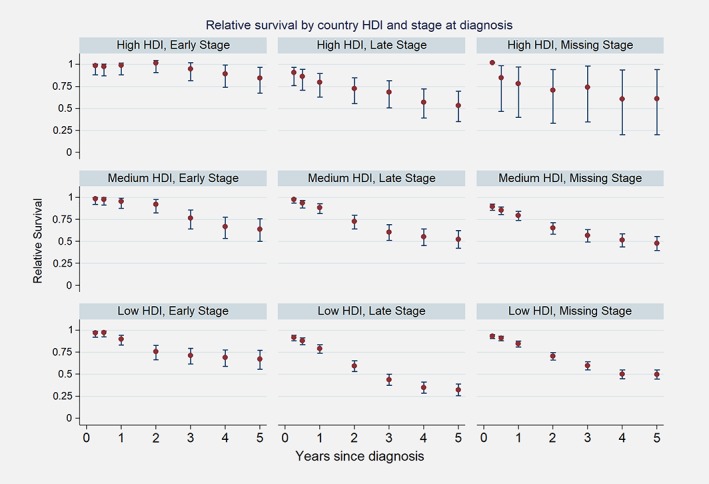
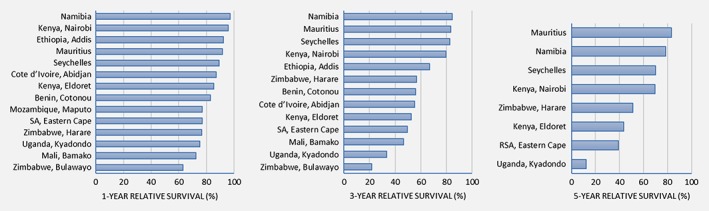
Breast cancer is the leading cancer diagnosis and second most common cause of cancer deaths in sub-Saharan Africa (SSA). Yet, there are few population-level survival data from Africa and none on the survival differences by stage at diagnosis. Here, we estimate breast cancer survival within SSA by area, stage and country-level human development index (HDI). We obtained data on a random sample of 2,588 breast cancer incident cases, diagnosed in 2008-2015 from 14 population-based cancer registries in 12 countries (Benin, Cote d'Ivoire, Ethiopia, Kenya, Mali, Mauritius, Mozambique, Namibia, Seychelles, South Africa, Uganda and Zimbabwe) through the African Cancer Registry Network. Of these, 2,311 were included for survival analyses. The 1-, 3- and 5-year observed and relative survival (RS) were estimated by registry, stage and country-level HDI. We equally estimated the excess hazards adjusting for potential confounders. Among patients with known stage, 64.9% were diagnosed in late stages, with 18.4% being metastatic at diagnosis. The RS varied by registry, ranging from 21.6%(8.2-39.8) at Year 3 in Bulawayo to 84.5% (70.6-93.5) in Namibia. Patients diagnosed at early stages had a 3-year RS of 78% (71.6-83.3) in contrast to 40.3% (34.9-45.7) at advanced stages (III and IV). The overall RS at Year 1 was 86.1% (84.4-87.6), 65.8% (63.5-68.1) at Year 3 and 59.0% (56.3-61.6) at Year 5. Age at diagnosis was not independently associated with increased mortality risk after adjusting for the effect of stage and country-level HDI. In conclusion, downstaging breast cancer at diagnosis and improving access to quality care could be pivotal in improving breast cancer survival outcomes in Africa.
在撒哈拉以南非洲(SSA),乳腺癌是癌症诊断的首要原因,也是癌症死亡的第二大常见原因。然而,非洲几乎没有人群水平的生存数据,也没有关于不同诊断阶段的生存差异的数据。在这里,我们按地区、阶段和国家人类发展指数(HDI)来估计 SSA 内的乳腺癌生存情况。我们从非洲癌症登记处网络中的 12 个国家的 14 个基于人群的癌症登记处获得了 2008-2015 年间随机抽取的 2588 例乳腺癌新发病例的数据,这些病例在 Benin、Cote d'Ivoire、Ethiopia、Kenya、Mali、Mauritius、Mozambique、Namibia、Seychelles、South Africa、Uganda 和 Zimbabwe。其中,2311 例用于生存分析。通过登记处、阶段和国家 HDI 来估计 1 年、3 年和 5 年的观察生存率(OS)和相对生存率(RS)。我们同样根据潜在的混杂因素调整了过度风险。在已知阶段的患者中,64.9%被诊断为晚期,18.4%在诊断时发生转移。RS 因登记处而异,从 Bulawayo 的第 3 年的 21.6%(8.2-39.8)到 Namibia 的 84.5%(70.6-93.5)不等。早期诊断的患者 3 年 RS 为 78%(71.6-83.3),而晚期(III 和 IV 期)患者的 RS 为 40.3%(34.9-45.7)。第 1 年的总体 RS 为 86.1%(84.4-87.6),第 3 年为 65.8%(63.5-68.1),第 5 年为 59.0%(56.3-61.6)。调整了阶段和国家 HDI 的影响后,诊断时的年龄与死亡率风险增加无关。总之,在诊断时降期乳腺癌和改善获得高质量护理的机会可能是改善非洲乳腺癌生存结果的关键。